Where

PressBeyond Logo

Best hotels in Chengdu | A Curated Visual Guide to Top Stays

Welcome to PressBeyond, the ultimate curated visual guide for design-driven hotels! My name is Will Miller and these are my recommendations for the best boutique and luxury hotels in Chengdu.

I am the founder of PressBeyond and I am an ultra-meticulous hotel curator who loves clean visuals. I have individually analyzed and tiered each hotel included in this guide based on a variety of criteria (architecture & design, location, brand & brand affiliation, existing reviews, and my own personal experiences), and importantly, I have hand-selected the leading imagery for each hotel to provide you with easily-digestible, yet detailed and complete, like-for-like, high-level visual profiles. I felt this summarization step was a critical missing piece across existing guides, blogs, and booking platforms. My aim is to make it easier for people to identify hotel environments that resonate with them, along with enabling them to visualize the types of social experiences that those environments help foster. My brain doesn't work when exposed to cluttered content, so my goal was to create the opposite.

Underneath this, we are also a full booking engine offering 5% Venmo cash back along with other exclusive perks. For all of you design-obsessed hotel enthusiasts out there, I hope this guide helps get you to where you see yourself!

An Overview of the Boutique & Luxury Hotel Landscape in Chengdu

The Temple House might be the clearest argument for what Chengdu does better than almost any other Chinese megacity: it refuses to treat its own history as decoration. Built around a restored Ming-dynasty courtyard complex in the Taikoo Li development off Chun Xi Road, the property integrates genuine heritage fabric — ceramic roof tiles, timber columns, ceremonial thresholds — into a hotel designed by Make Architects that reads as contemporary without apology. The juxtaposition is not nostalgic. A few blocks away, the Niccolo Chengdu occupies the upper floors of a high-rise in the same district, its interiors by Hirsch Bedner Associates working a more cosmopolitan register — polished, urban, calibrated for the business traveler who also knows what a good bar looks like. These two properties within the same commercial precinct represent the productive tension at the heart of modern Chengdu: a city that has absorbed rapid verticalization without entirely losing its relationship to slower, older ways of inhabiting space. The central city pulls together a different cluster of international brand flagships. The Ritz-Carlton and the St. Regis anchor Tianfu Square and the CBD respectively, both operating at a high tier with the kind of resolved, brand-consistent interiors that reward guests who know exactly what they want and prefer not to be surprised. The Waldorf Astoria in Financial City and the Fairmont in Century City extend this logic further south, into the newer administrative and financial districts where wide boulevards and ambitious mixed-use towers define the urban scale. These are hotels for Chengdu as it intends to be seen internationally — confident, capacious, finished. The most genuinely distinct option in the portfolio sits well outside the city altogether. Six Senses Qing Cheng Mountain positions itself in the forested hills associated with Taoist culture and some of China's oldest temple complexes, and the Six Senses approach — low-rise structures, landscape integration, wellness programming rooted in local botanical and culinary traditions — makes unusual sense in this particular geography. The W Chengdu in Gaoxin brings the brand's characteristic high-energy interior language to the tech-heavy southern district, while the Shangri-La along the Jinjiang River remains a reliable mid-tier anchor for travelers who want central access without the premium of the Chun Xi Road corridor. YiuTeung Mansion in Wuhou, a boutique entry at a modest rate, gestures toward a quieter residential Chengdu that the larger brands rarely bother to acknowledge.

Book with PB and get cash back
The Ritz-Carlton, Chengdu - Image 1
The Ritz-Carlton, Chengdu - Image 2
The Ritz-Carlton, Chengdu - Image 3
The Ritz-Carlton, Chengdu - Image 4
The Ritz-Carlton, Chengdu - Image 5

The Ritz-Carlton, Chengdu

Chengdu • Central Business District • OPTIMIZE

avg. $134 / night

Includes $7 / night in cash back

Cash back is redeemable via Virtual Visa, Venmo, or bank transfer starting 24-48 hours after check-out

Marriott Bonvoy® property

The Ritz-Carlton, Chengdu Design Editorial

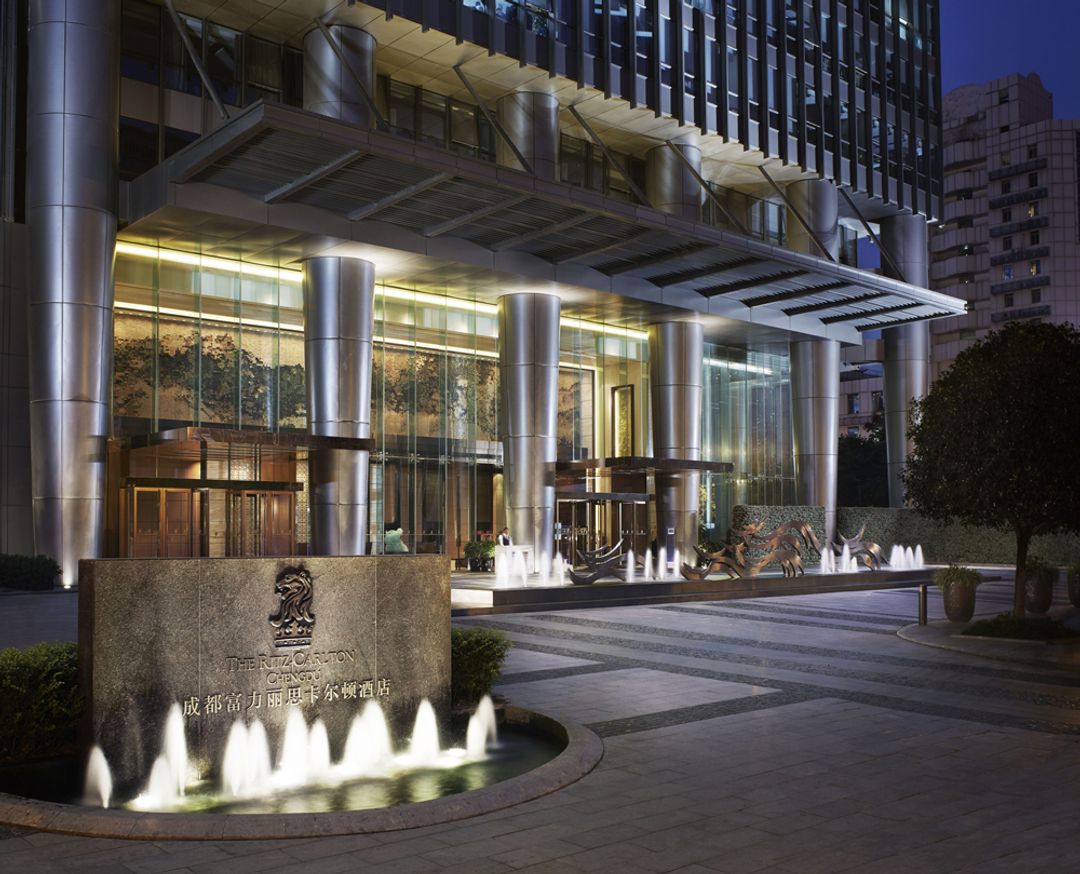
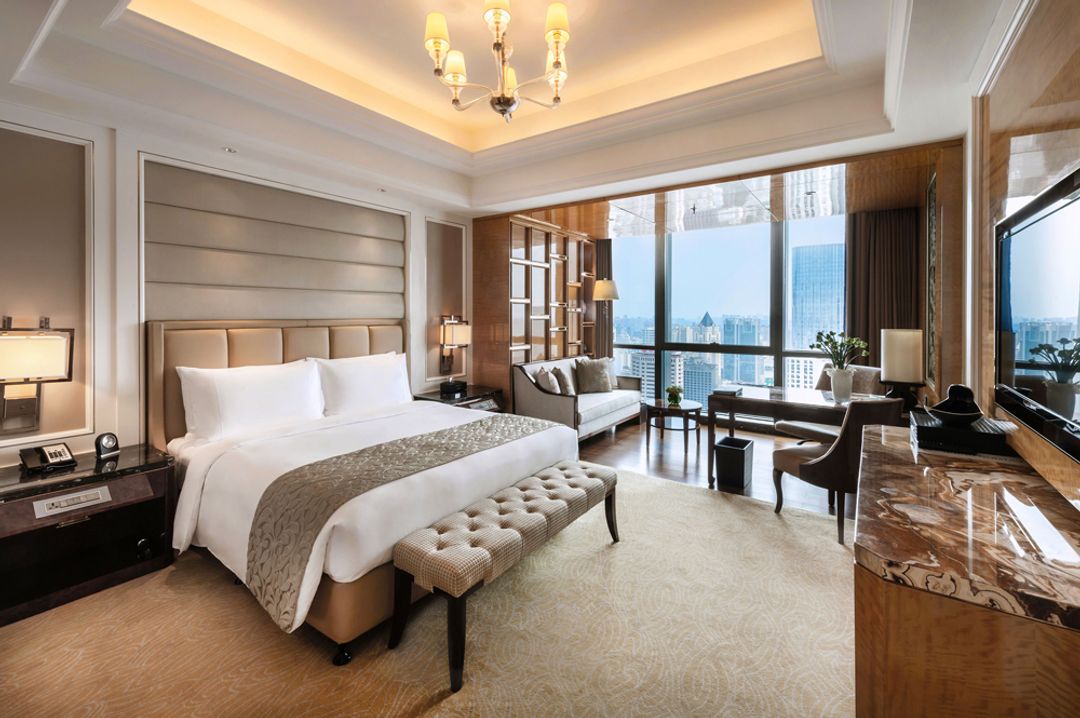
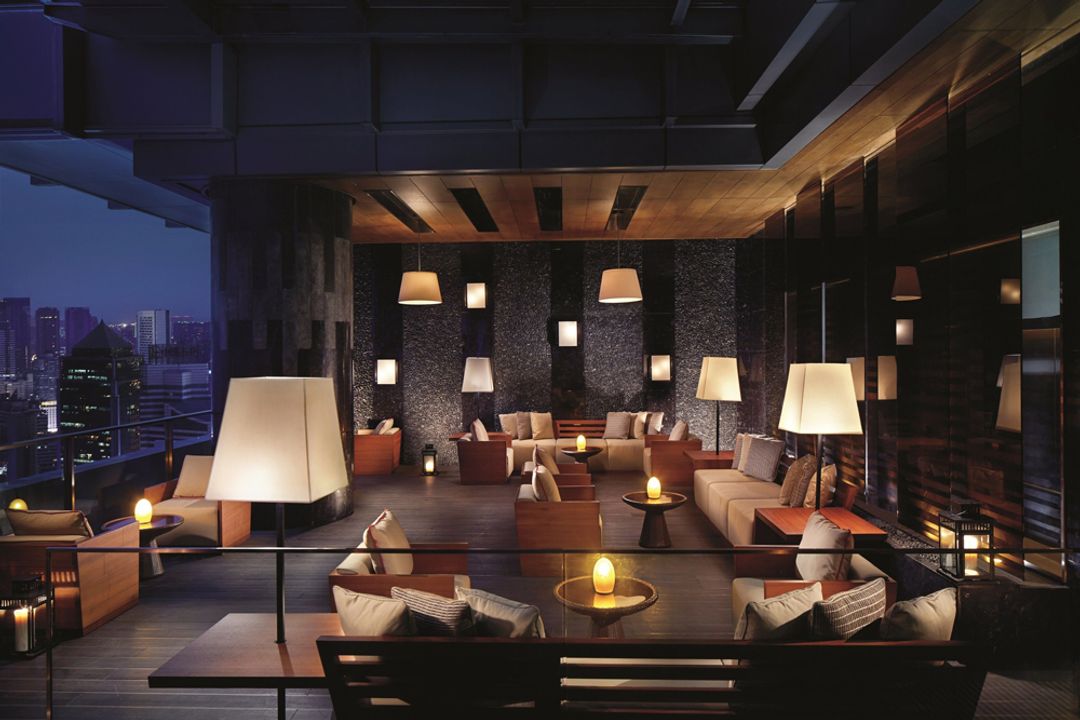
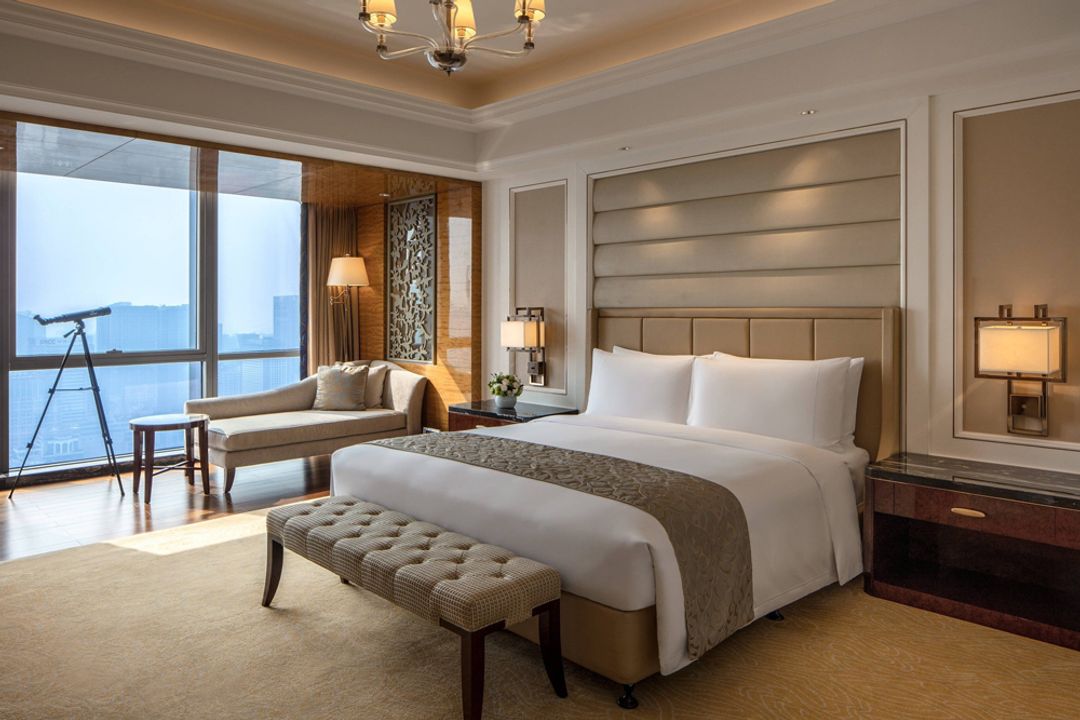
Sichuan's capital spent much of the 2000s building skyward with remarkable speed, and the tower that houses The Ritz-Carlton, Chengdu — rising above the city's central business district in a curtain-walled column of steel and glass — was among the more architecturally deliberate of that era's additions. The entrance sequence announces its ambitions plainly: polished stainless steel columns of considerable girth support an angular porte-cochère canopy, bronze revolving doors framed by large-scale landscape murals visible through floor-to-ceiling glazing, and a forecourt animated by low fountains and figurative bronze sculpture. The gesture is formal without rigidity, calibrated for a city that was rapidly repositioning itself as a cultural and commercial peer to Shanghai and Beijing. Inside, the 353 rooms carry a palette of warm taupe leathers, dark-stained hardwood floors, and heavily figured brown marble — surfaces visible across the countertops and credenzas in the images — with tufted ottomans at the foot of each bed and lacquered screens providing a restrained nod to regional craft traditions. The elevated pool, enclosed behind full-height glazed colonnades with timber-clad ceilings bathed in amber uplighting, transforms a functional amenity into something closer to a belvedere. The rooftop bar pulls the same trick at night: mosaic-tiled feature walls, oversized linen shade lamps arranged in clusters, and timber decking carry the space past mere lounge territory into an atmospheric room that earns its elevation above the Chengdu grid below.

Book with PB and get cash back
The St. Regis Chengdu - Image 1
The St. Regis Chengdu - Image 2
The St. Regis Chengdu - Image 3
The St. Regis Chengdu - Image 4
The St. Regis Chengdu - Image 5

The St. Regis Chengdu

Chengdu • Tianfu Square • OPTIMIZE

avg. $152 / night

Includes $8 / night in cash back

Cash back is redeemable via Virtual Visa, Venmo, or bank transfer starting 24-48 hours after check-out

Marriott Bonvoy® property

The St. Regis Chengdu Design Editorial

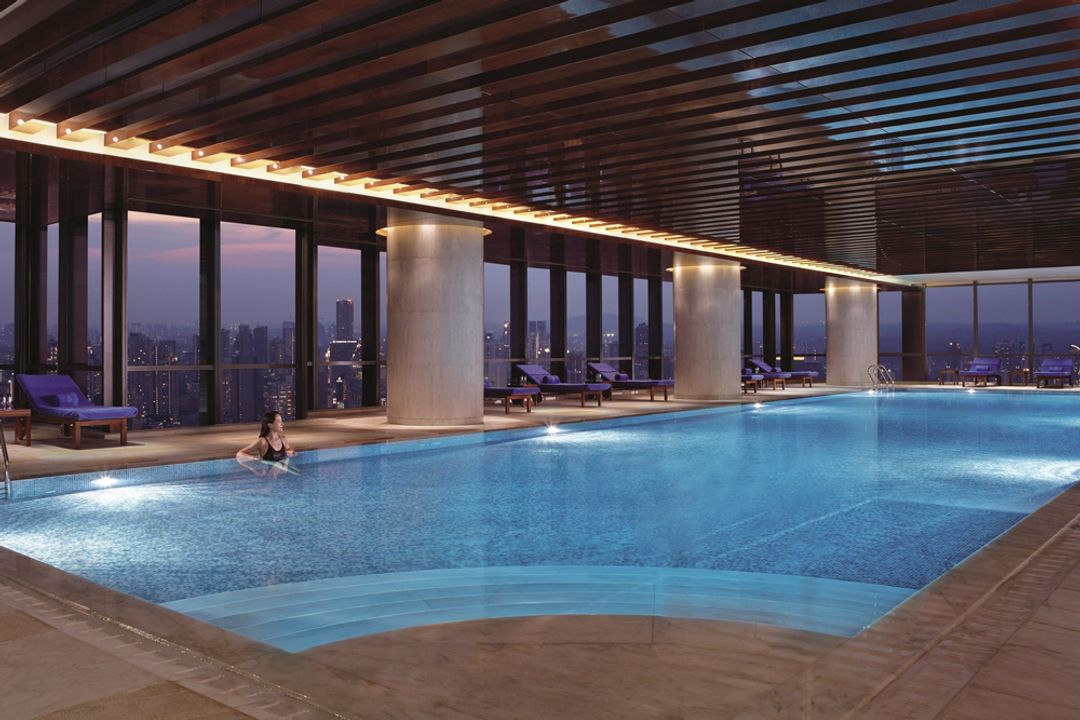
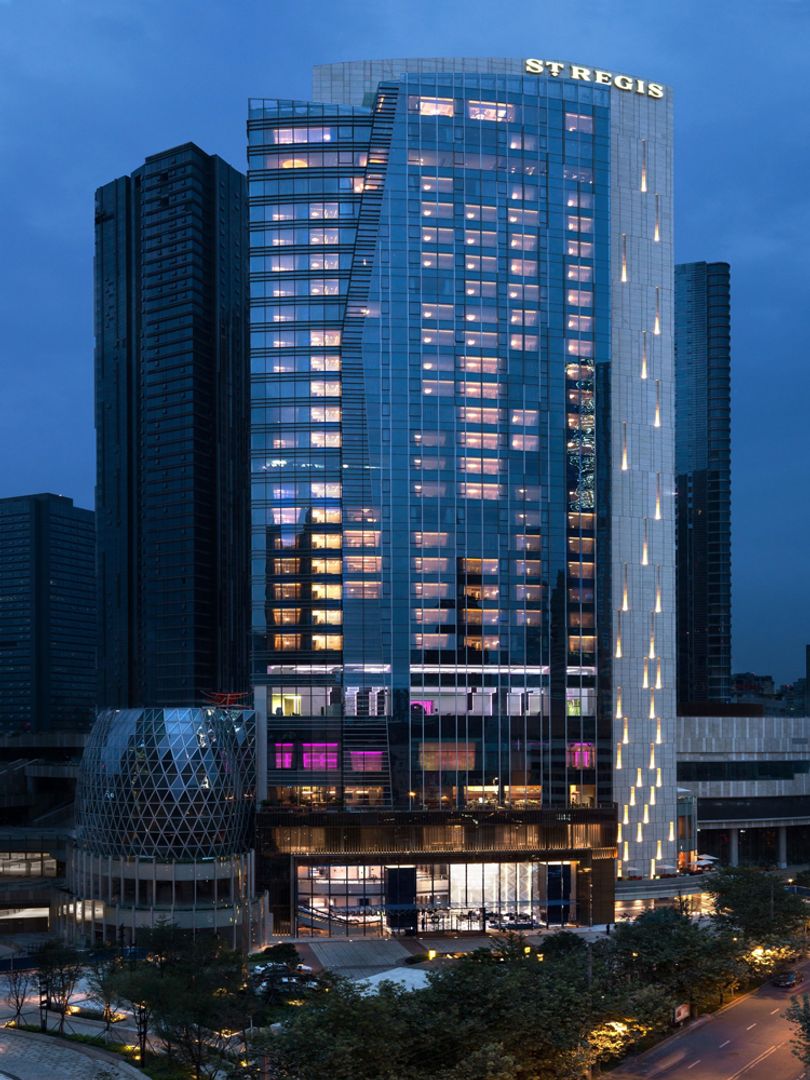
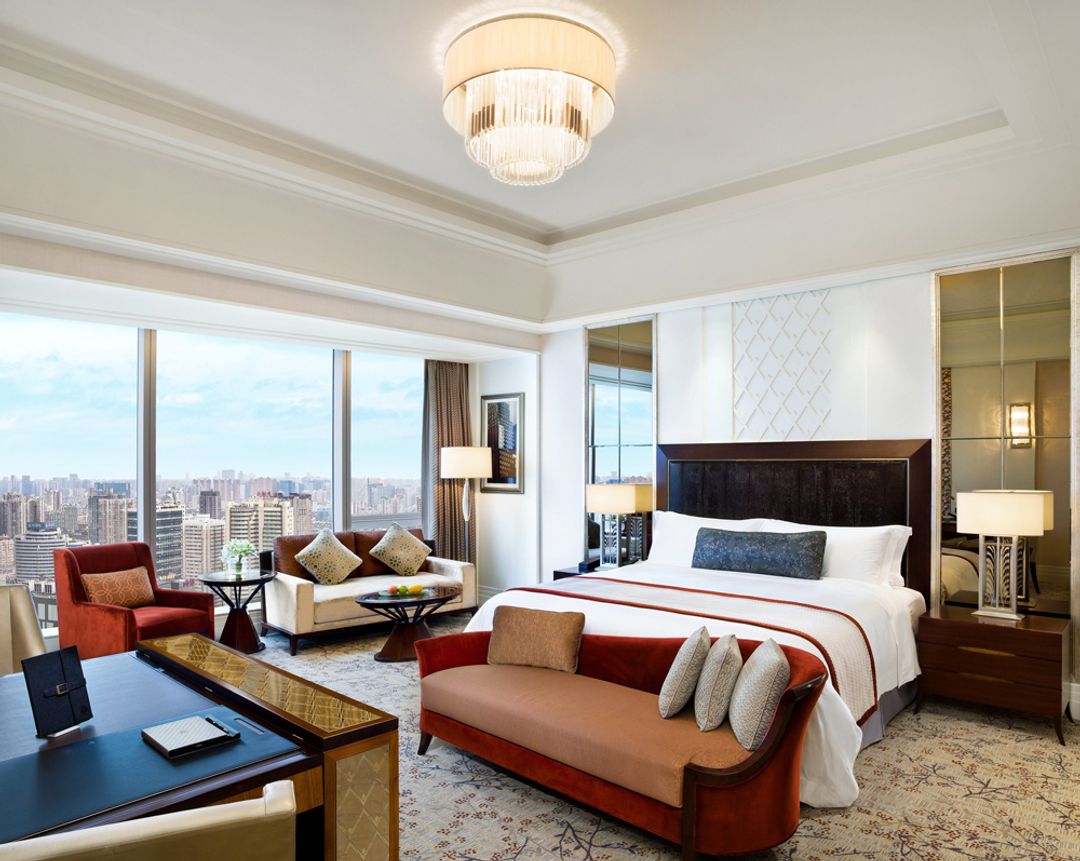
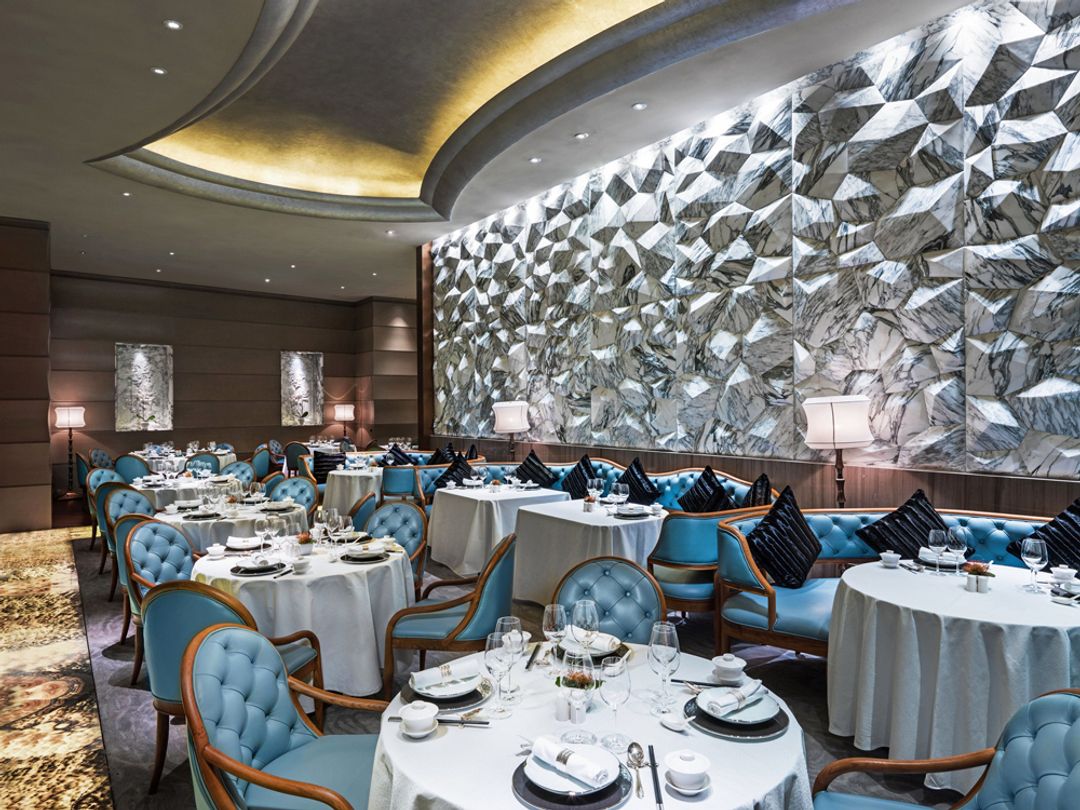
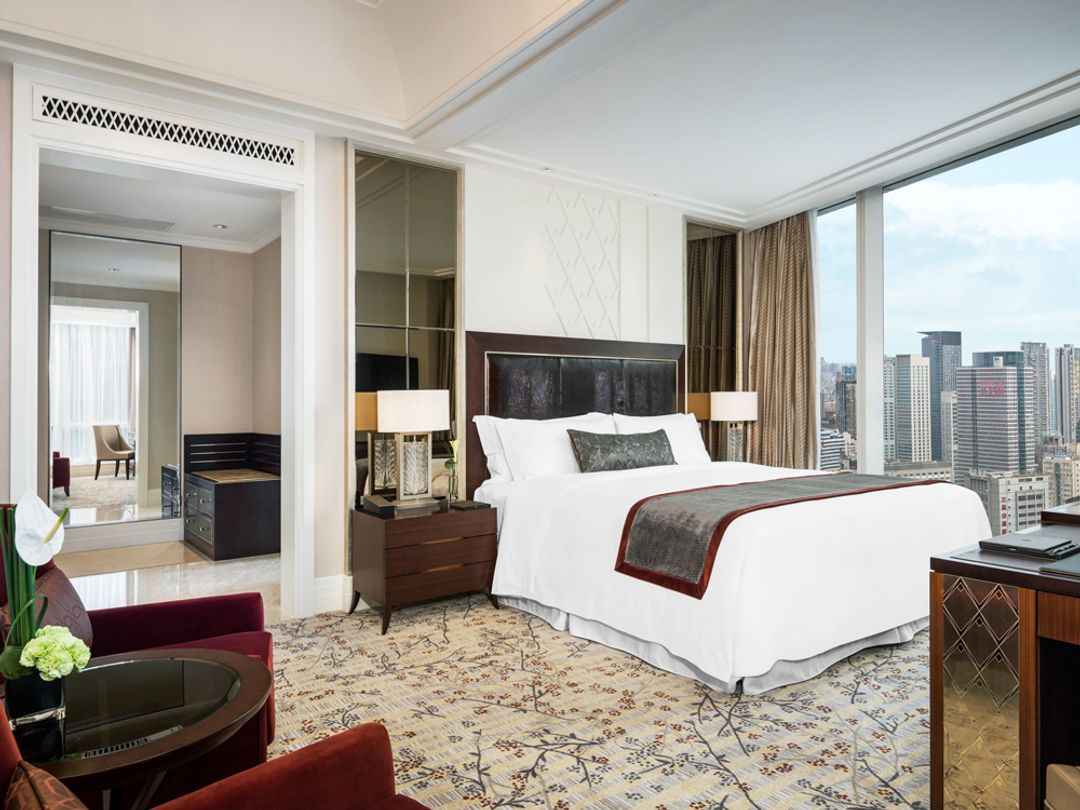
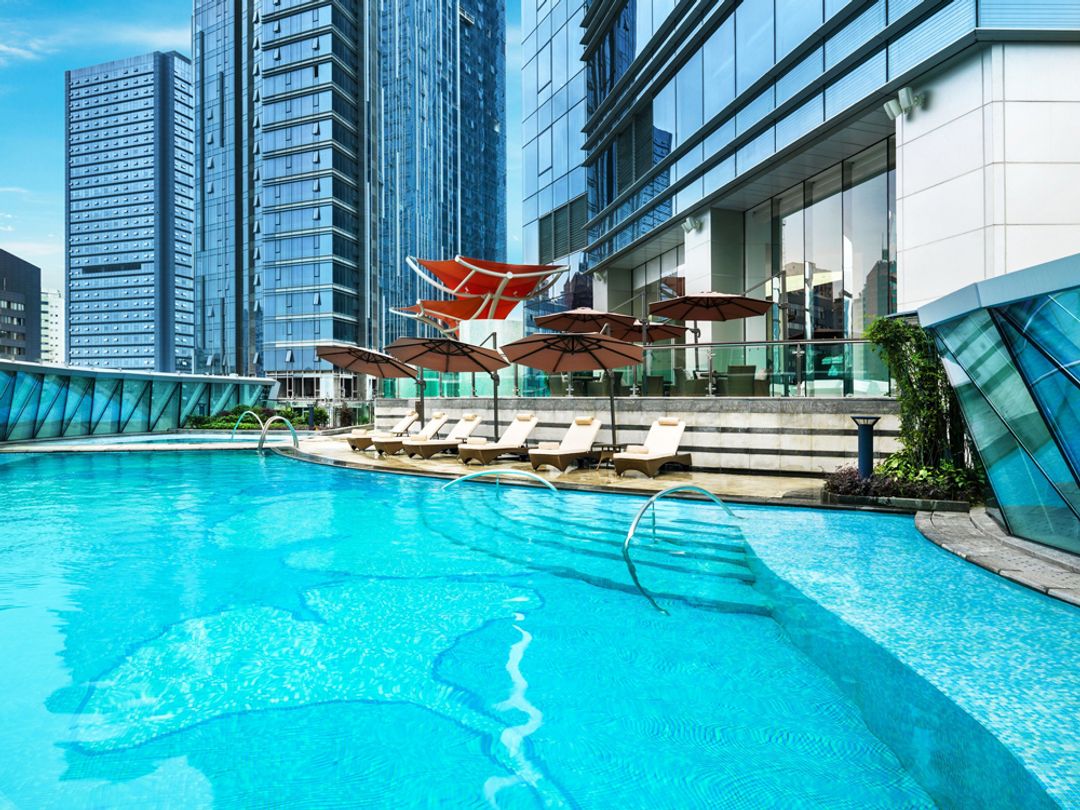
At the geographic and symbolic heart of Chengdu, where Tianfu Square anchors the city's civic identity just steps from the giant Mao statue, a curtain-walled tower of approximately 280 rooms rises over a podium base clad in warm bronze metalwork and double-height glazing. The St. Regis Chengdu, which opened in 2015, negotiates the familiar tension of the brand's China properties — how to translate a New York Beaux-Arts heritage into a contemporary glass tower without losing the sense of occasion that defines a St. Regis arrival. The exterior, rising around thirty floors above street level, carries the faceted geometry characteristic of Skidmore, Owings & Merrill's tower work, though the interiors are where the design ambition concentrates. Guest rooms are dressed in floral-patterned carpets, dark-stained walnut headboards with quilted diamond detailing behind, and bench seating upholstered in burnt sienna velvet — a palette that sits closer to a restrained European grand hotel than to the maximalist chinoiserie that defines lesser luxury properties in Sichuan. The Chinese restaurant is the most architecturally charged space in the building: a sculpted wall treatment in grey-veined marble cut into faceted three-dimensional panels dominates one entire elevation, tufted duck-egg blue leather chairs pulled around white-clothed rounds beneath a curved ceiling washed in gold leaf. The terrace pool on the lower podium, surrounded by the tower's glass curtain wall on two sides, gives the hotel an unexpectedly resort-like amenity for a city-centre address.
Book with PB and get cash back
W Chengdu - Image 1
W Chengdu - Image 2
W Chengdu - Image 3
W Chengdu - Image 4
W Chengdu - Image 5

W Chengdu

Chengdu • Gaoxin District • OPTIMIZE

avg. $158 / night

Includes $8 / night in cash back

Cash back is redeemable via Virtual Visa, Venmo, or bank transfer starting 24-48 hours after check-out

Marriott Bonvoy® property

W Chengdu Design Editorial

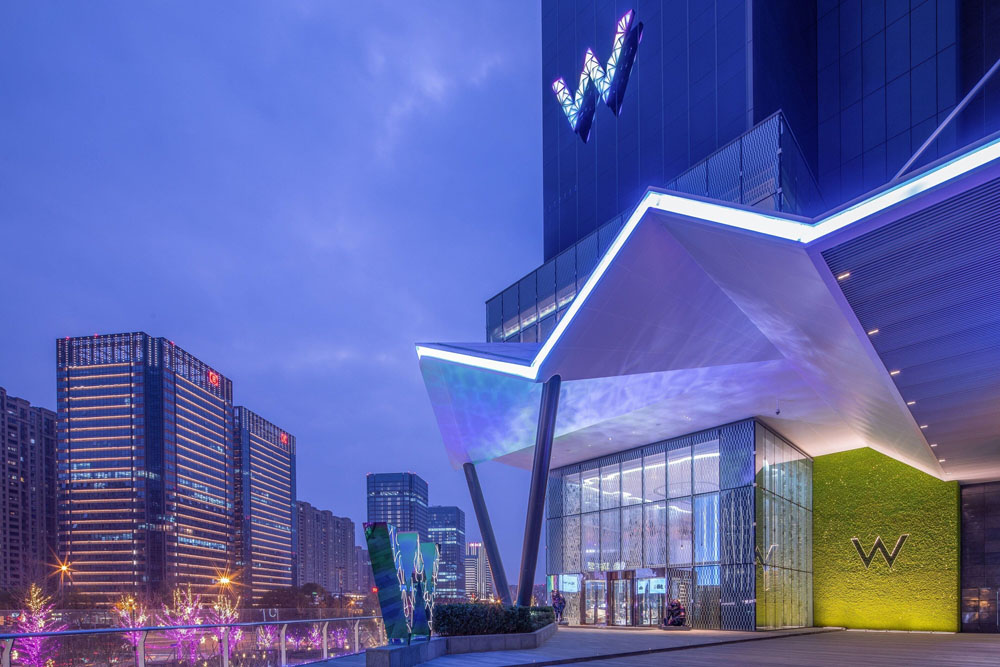
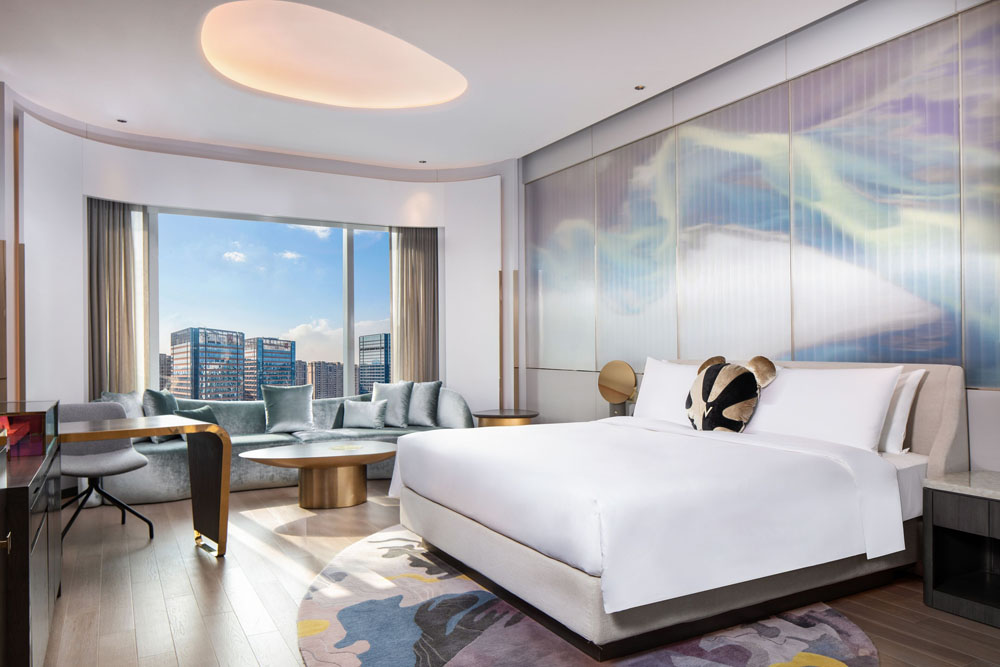
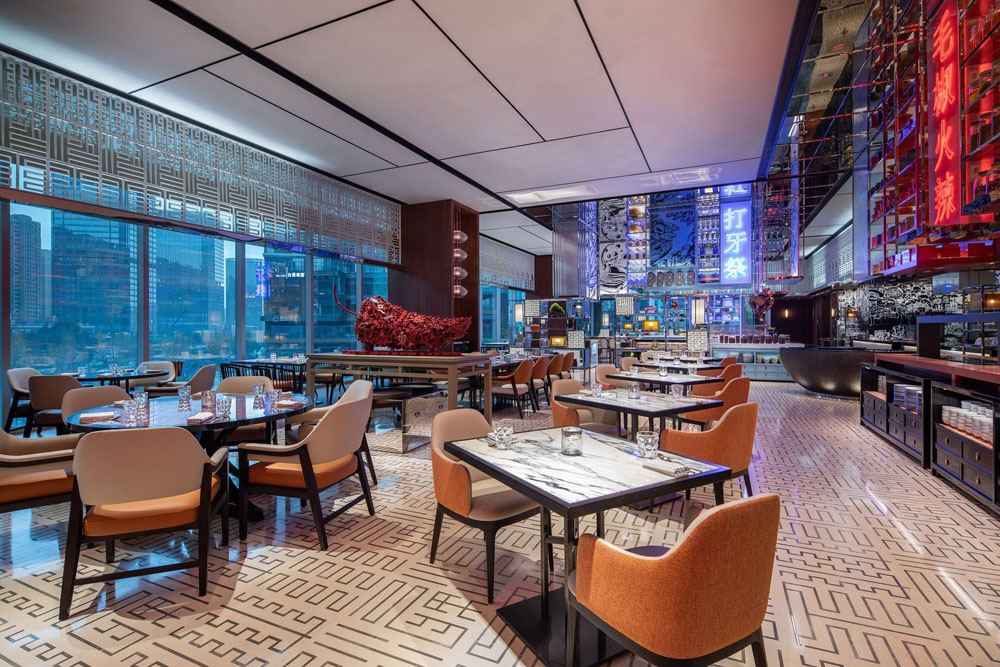
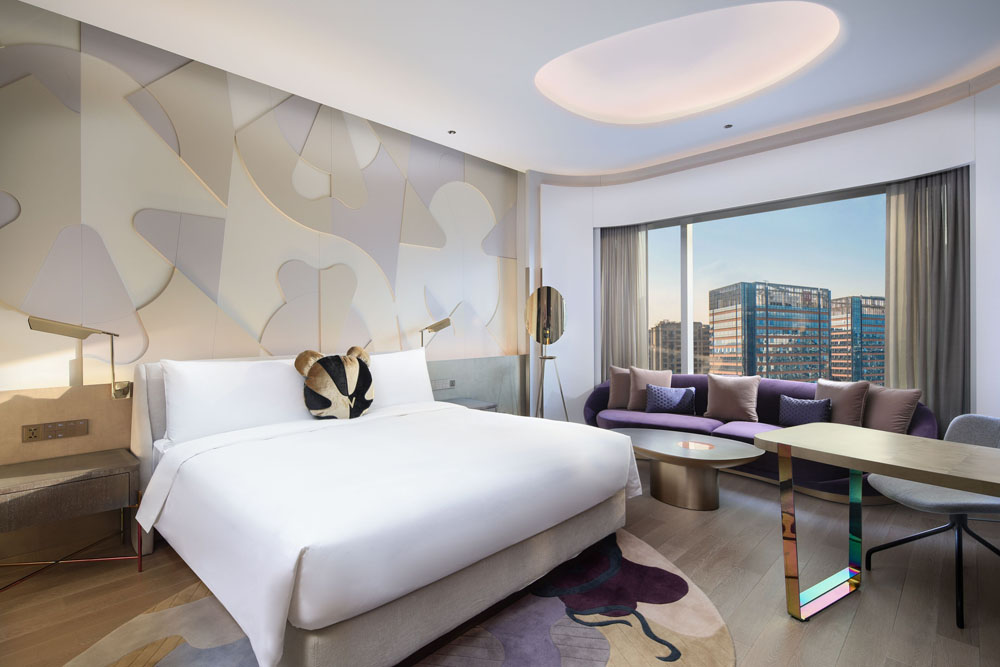
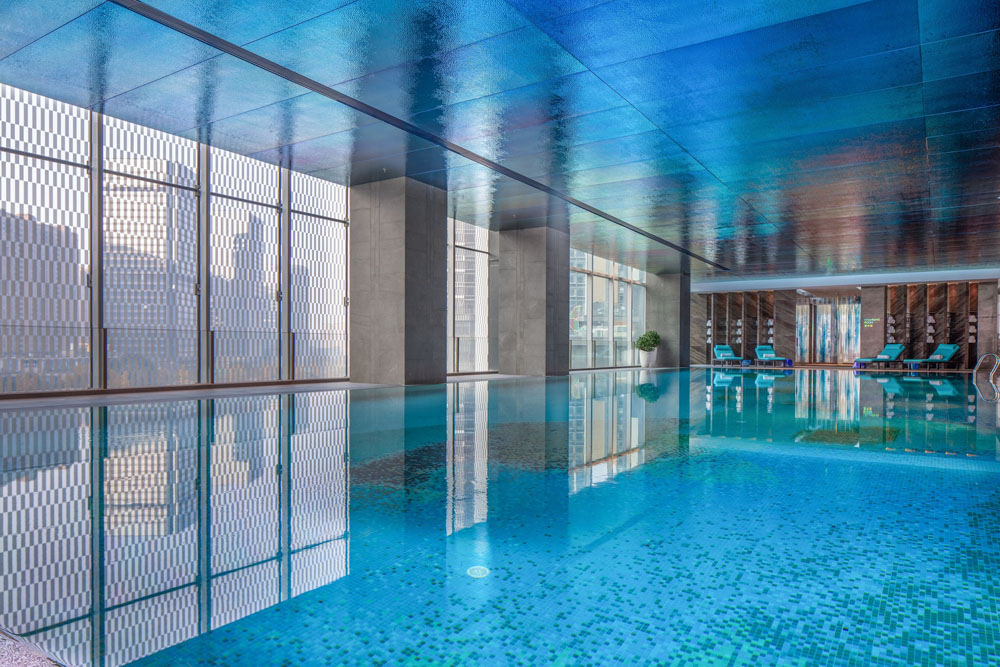
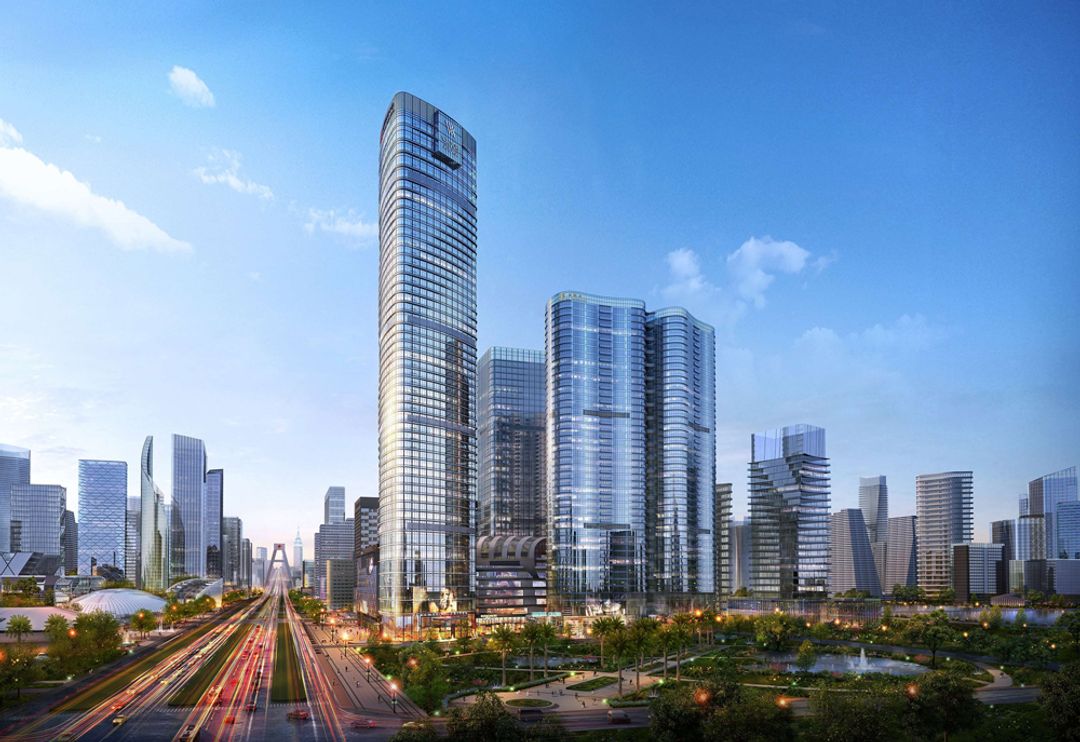
Chengdu's Gaoxin technology district — a grid of glass towers that didn't exist twenty years ago — gets its most theatrically committed building in the W Chengdu, where a folded aluminium canopy punches out from the base of the tower like a crumpled sheet of origami, LED strips tracing its sharp geometry against the blue-hour sky. The pixelated W signage crowning the upper floors signals the brand's characteristic visual aggression, but the entrance sequence, with its moss-covered feature wall and faceted metallic porte-cochère, manages something more considered than spectacle alone. Inside, the interiors move between two distinct registers. Guest rooms are handled with surprising restraint — curved bay windows framing the Sichuan skyline, iridescent headboard panels shifting between violet and gold, brass-legged desks with dichroic detailing, and abstract sculptural wall reliefs worked in tonal ivory plaster. The all-day dining space pivots hard in the opposite direction: a geometric fretwork floor in honed stone, neon Chinese characters blazing across mirror-clad walls, and a sculptural red bull centrepiece that references Chengdu's own hotpot mythology with knowing irreverence. The indoor pool sits higher in the tower, its ceiling clad entirely in reflective blue tile that doubles the water below into an immersive turquoise envelope. Throughout, the property treats Sichuan cultural identity not as wallpaper but as active material — loud where the city is loud, contemplative where the altitude earns quiet.
Book with PB and get cash back
Waldorf Astoria Chengdu - Image 1
Waldorf Astoria Chengdu - Image 2
Waldorf Astoria Chengdu - Image 3
Waldorf Astoria Chengdu - Image 4
Waldorf Astoria Chengdu - Image 5

Waldorf Astoria Chengdu

Chengdu • Financial City • OPTIMIZE

avg. $176 / night

Includes $9 / night in cash back

Cash back is redeemable via Virtual Visa, Venmo, or bank transfer starting 24-48 hours after check-out

Hilton Honors™ property

Waldorf Astoria Chengdu Design Editorial

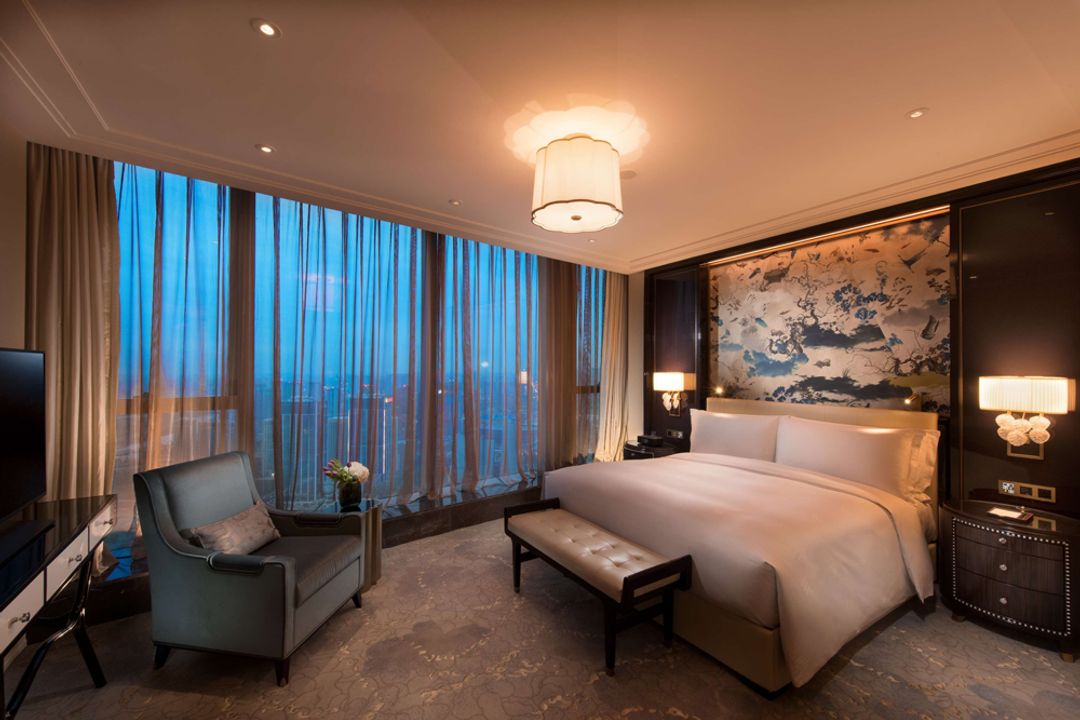
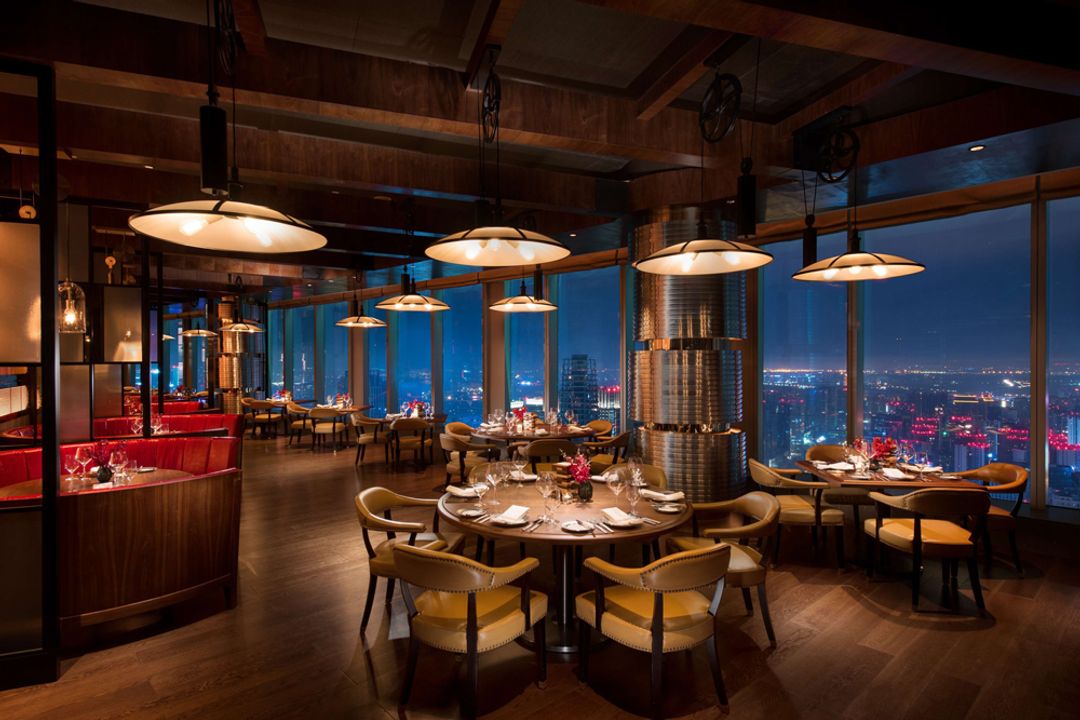
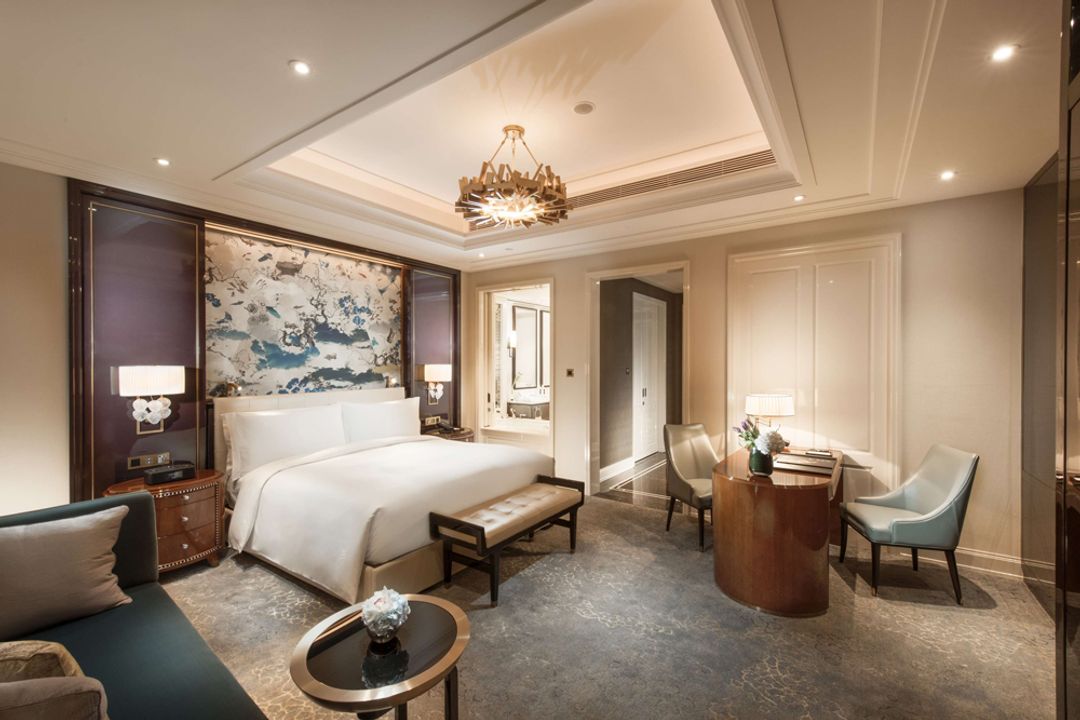
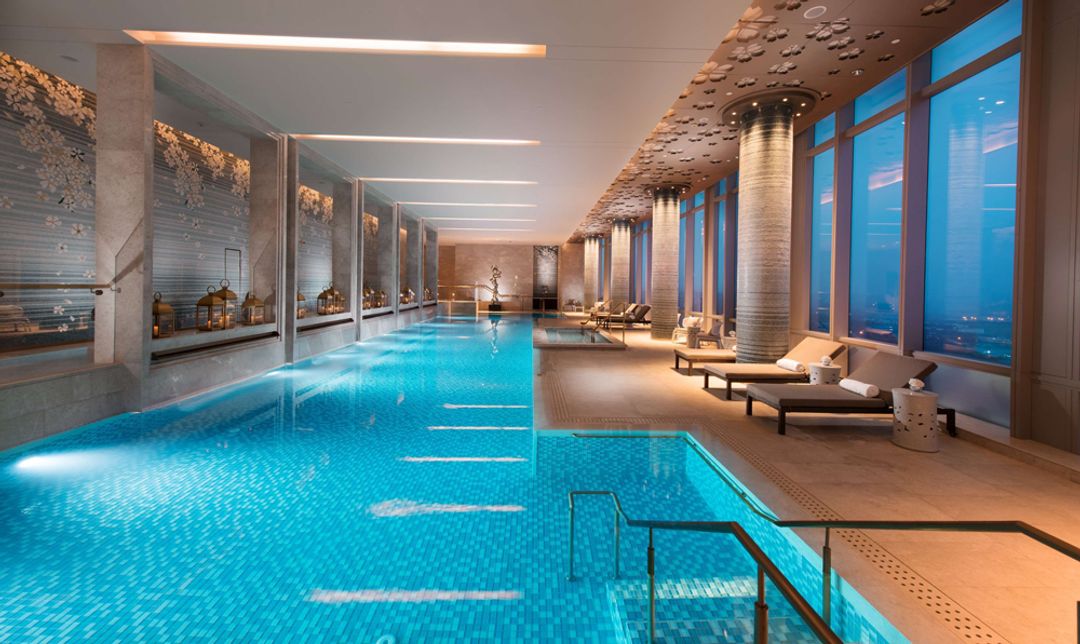
Rising from Chengdu's Financial City district on a tapering curtain-wall tower that crests above sixty floors, the Waldorf Astoria Chengdu sets a particular challenge for itself: how to carry one of hospitality's most historically freighted brands into a city whose relationship with luxury is entirely its own, shaped by Sichuan culture rather than borrowed from Shanghai or Beijing. The elliptical glass shaft visible in the exterior render — its massing tapering toward the upper floors with pronounced horizontal banding — plants the hotel firmly within the language of contemporary Chinese supertall commercial development, while the interiors work deliberately against that idiom. Inside, the design draws on a neo-classical framework softened by Chinese ink-wash motifs — the headboard panels in the guest rooms carry large-format floral murals in blue and grey that reference Song Dynasty painting traditions rather than period Waldorf grandeur. Dark lacquered furniture with nailhead detailing sits against patterned woolen carpets in muted silver-taupe, and a sculptural brass chandelier with branching geometric arms anchors the suite category. The upper-floor restaurant deploys walnut parquet, raw timber ceiling beams, industrial pulley-hung pendant lights, and hammered metal column cladding to achieve something closer to an American steakhouse atmosphere at altitude. The indoor pool, positioned high in the tower with floor-to-ceiling glazing, lines its ceiling with three-dimensional blossom relief work — the same floral vocabulary that threads through the property's entire decorative scheme, connecting the rooms to the wellness spaces through a consistent cultural signature.

Book with PB and get cash back
Niccolo Chengdu - Image 1
Niccolo Chengdu - Image 2
Niccolo Chengdu - Image 3
Niccolo Chengdu - Image 4
Niccolo Chengdu - Image 5

Niccolo Chengdu

Chengdu • Chun Xi Road • OPTIMIZE

avg. $232 / night

Includes $12 / night in cash back

Cash back is redeemable via Virtual Visa, Venmo, or bank transfer starting 24-48 hours after check-out

Niccolo Chengdu Design Editorial

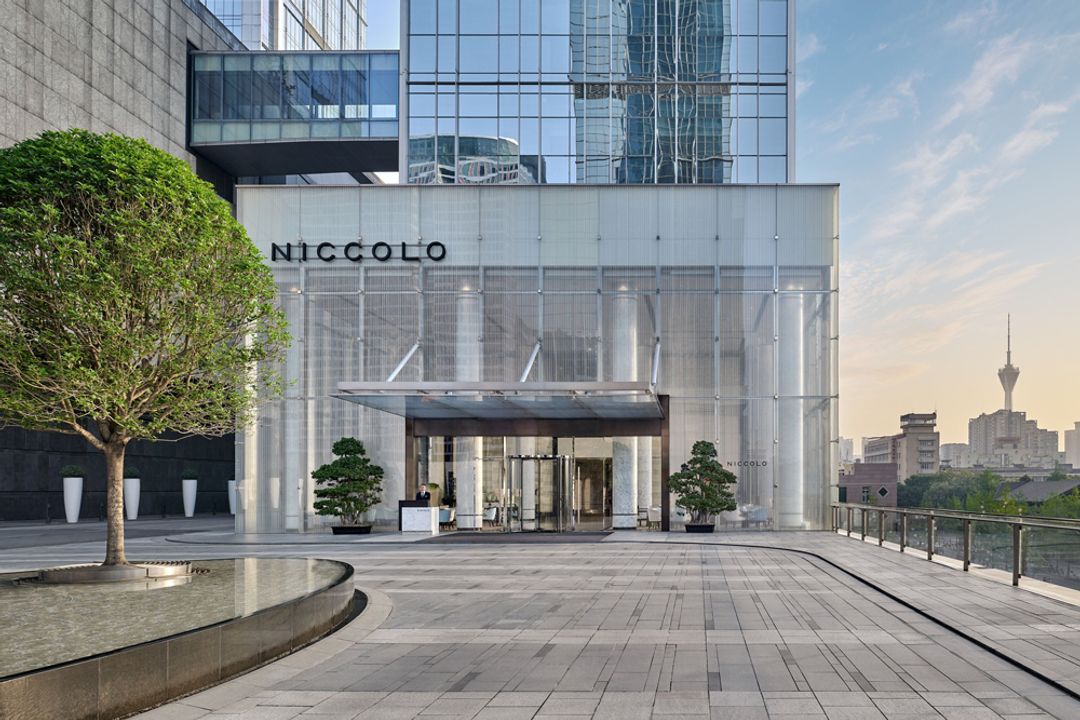
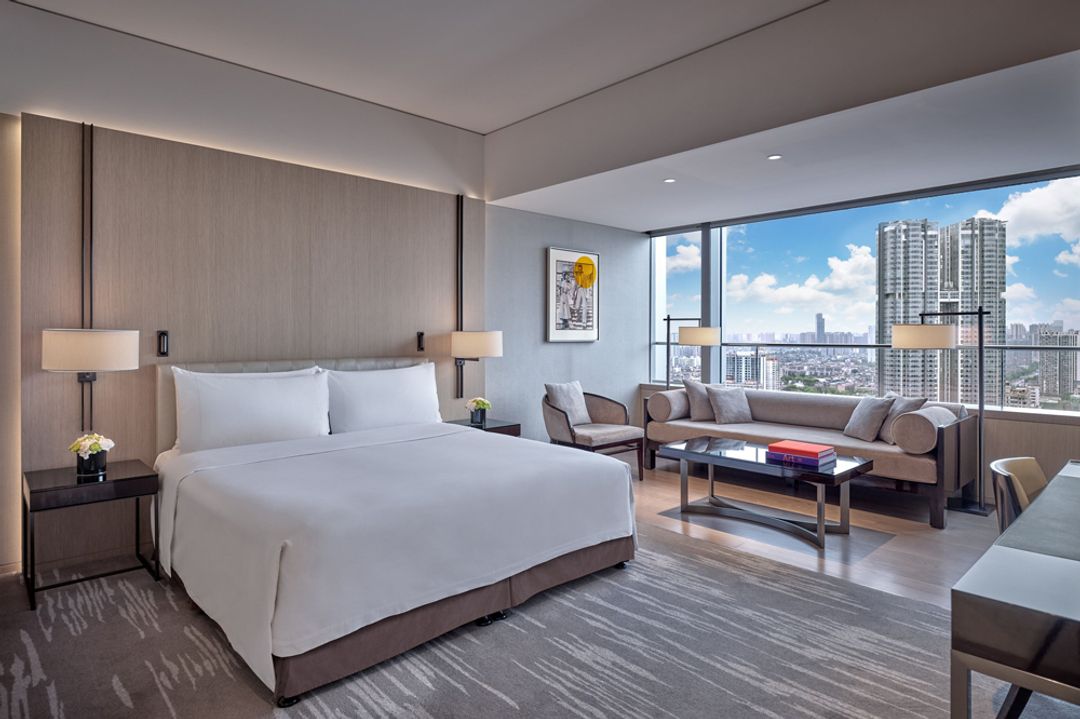
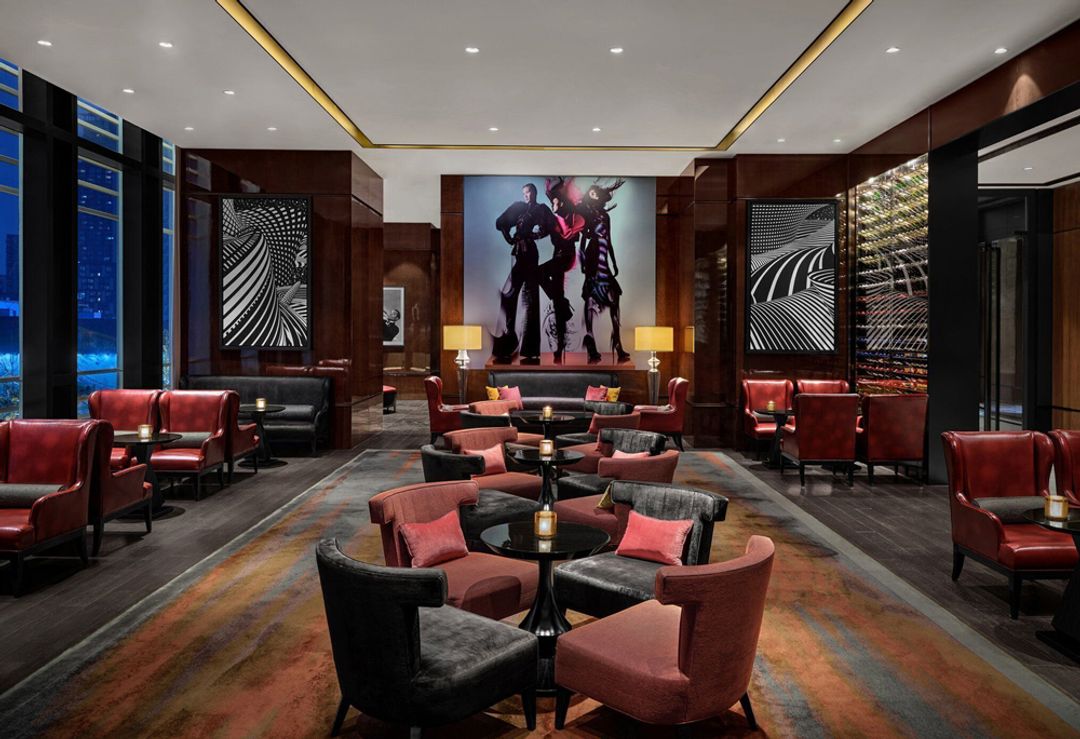
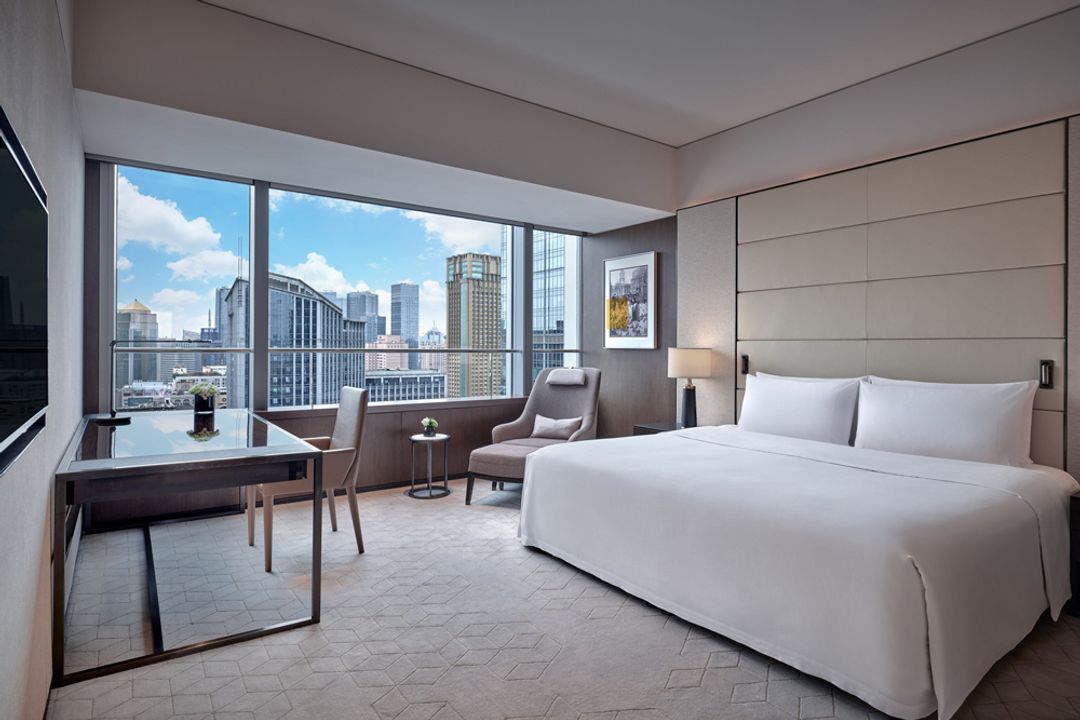
Fitted into the upper floors of Chengdu's landmark Hang Lung Plaza mixed-use tower on Chun Xi Road — the city's most commercially charged retail corridor — Niccolo Chengdu sets a studied quietness against the vertical ambition of its host building. The entry facade, visible in the images, is dressed in a fine corrugated glass screen that diffuses the tower's reflective curtain wall into something more textile in character, paired with manicured bonsai specimens flanking revolving doors in a gesture that tempers corporate scale with considered detail. Inside, the interiors carry the signature of the Niccolo brand's house aesthetic: oak-toned wall panelling with recessed LED coves framing upholstered headboards, herringbone and geometric-patterned carpets in taupe and grey, and floor-to-ceiling glazing that turns Chengdu's dense skyline — the Tianfu TV Tower visible on the horizon — into wallpaper of its own. The bar departs from this restraint entirely, leaning into a darker palette of deep walnut joinery, red leather wingback chairs, and large-format fashion photography that brings the energy of a late-night members' club. The indoor pool, clad in smooth limestone-toned concrete with floor-to-ceiling glass on the city-facing elevation, achieves the kind of mineral austerity that recalls Milanese spa design more than Chinese hospitality convention. The hotel holds around 230 rooms across its high-rise floors, and manages the considerable challenge of making a tower address feel, from within, genuinely intimate.

Book with PB and get cash back
Fairmont Chengdu - Image 1
Fairmont Chengdu - Image 2
Fairmont Chengdu - Image 3
Fairmont Chengdu - Image 4
Fairmont Chengdu - Image 5

Fairmont Chengdu

Chengdu • Century City • OPTIMIZE

avg. $263 / night

Includes $14 / night in cash back

Cash back is redeemable via Virtual Visa, Venmo, or bank transfer starting 24-48 hours after check-out

ALL - Accor property

Fairmont Chengdu Design Editorial

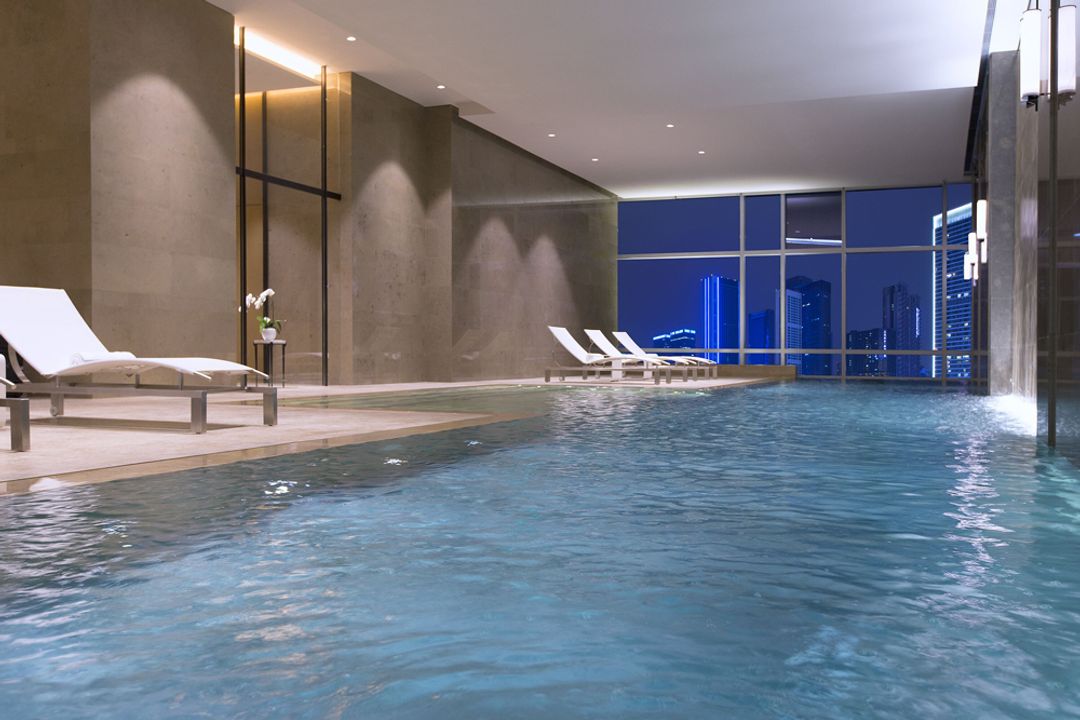
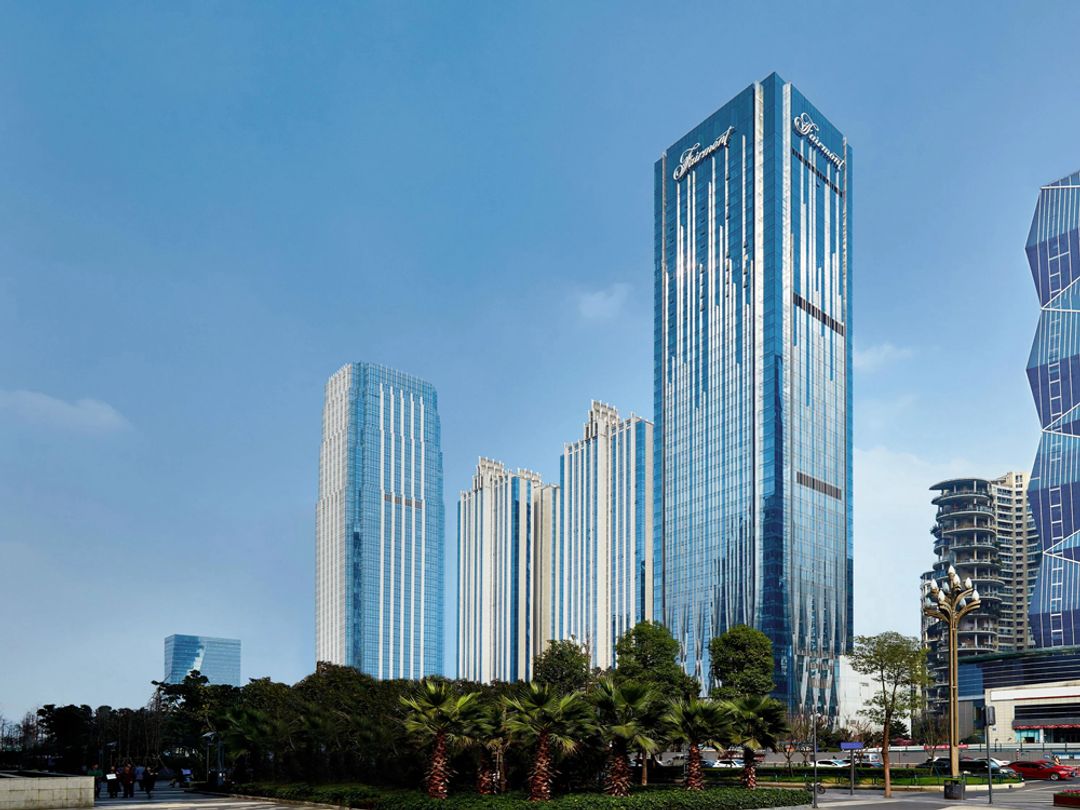
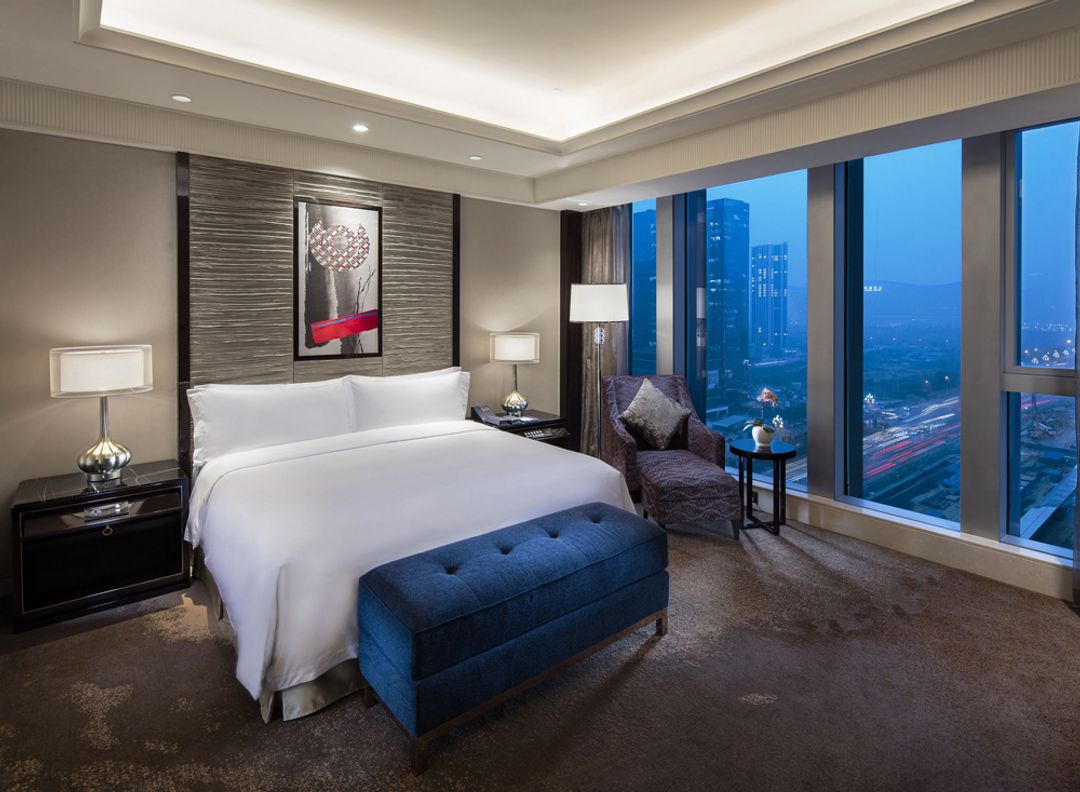
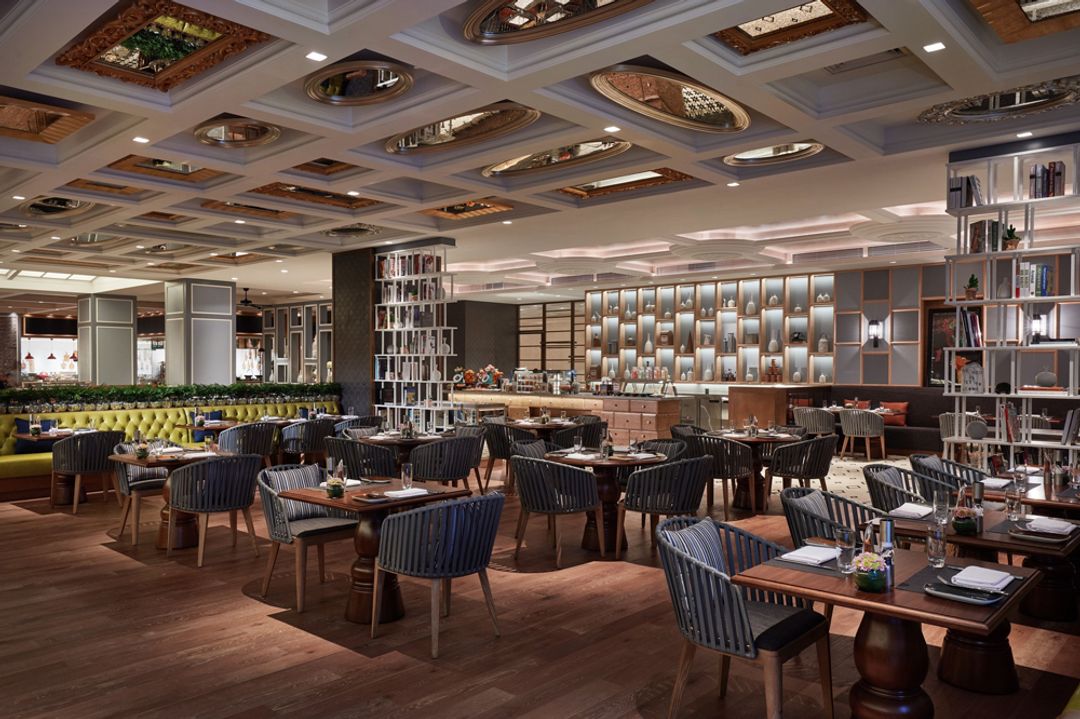
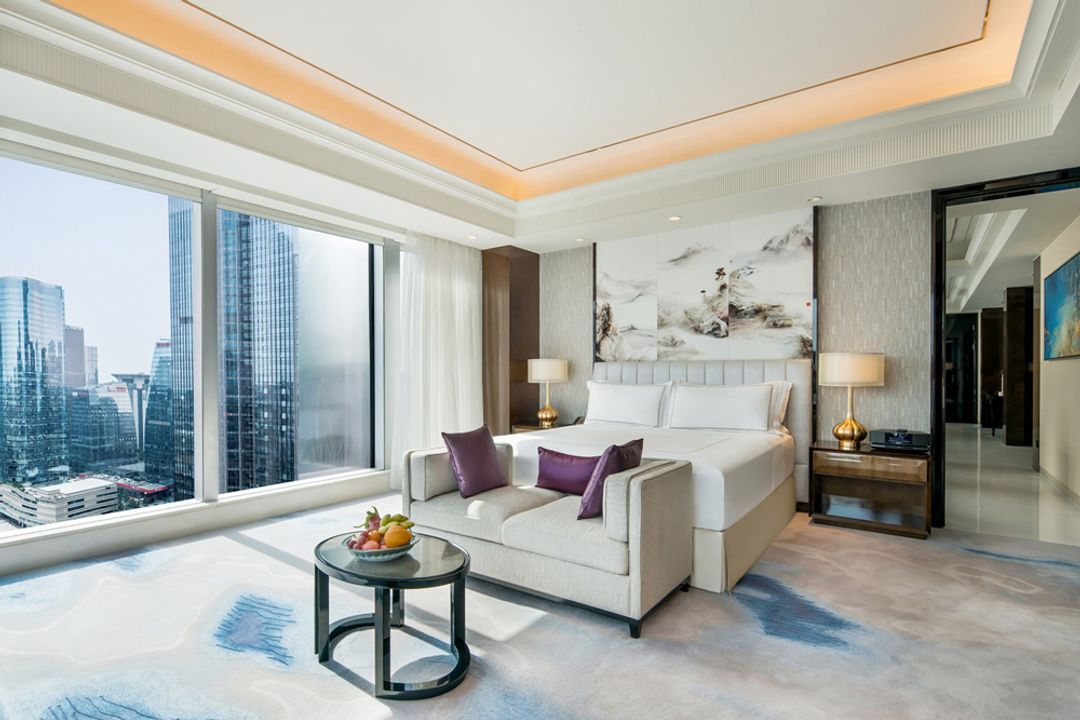
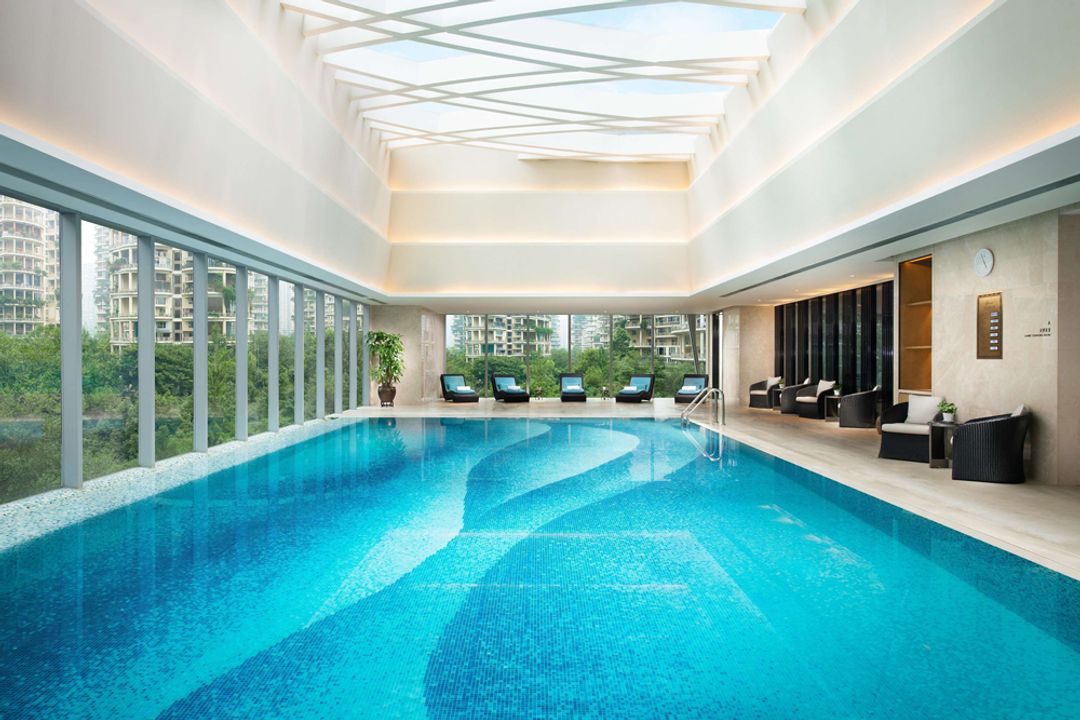
Rising from Chengdu's Century City business district, a curtain-wall tower of deep-blue reflective glass announced the Fairmont Chengdu's arrival in 2015 as one of the brand's most ambitious forays into China's rapidly urbanising interior. The tower climbs some 45 floors, its vertical aluminum fins catching light at different angles throughout the day and giving the facade a kinetic quality that distinguishes it from the cluster of residential and commercial slabs surrounding it on all sides. Inside, the 320 rooms and suites follow a palette that moves between two registers — darker, lacquered tones in the standard rooms, where navy tufted benches and charcoal textured headboard panels anchor the space, and a considerably lighter, more expansive mood in the suites, where ink-wash landscape paintings above the beds and pale cloud-patterned carpets draw a deliberate line back to the Chinese literati tradition. The all-day dining restaurant makes the property's most persuasive design argument, its coffered ceiling inlaid with ornate oval medallions and mirrored panels that sit in productive tension with the relaxed bistro furniture below — slatted oak dining chairs, chartreuse leather banquettes, and open shelving lined with ceramics and curated objects. The indoor pool, set within a skylit enclosure with floor-to-ceiling glazing overlooking a green canopy, uses a flowing wave mosaic across its floor to animate what might otherwise have been a purely functional space. Taken together, these interiors navigate the particular challenge facing luxury hotels in Chinese new-town developments: making a place feel grounded when the city around it is still being invented.

Book with PB and get cash back
The Temple House - Image 1
The Temple House - Image 2
The Temple House - Image 3
The Temple House - Image 4
The Temple House - Image 5

The Temple House

Chengdu • Chun Xi Road • SPLURGE

avg. $311 / night

Includes $16 / night in cash back

Cash back is redeemable via Virtual Visa, Venmo, or bank transfer starting 24-48 hours after check-out

The Temple House Design Editorial

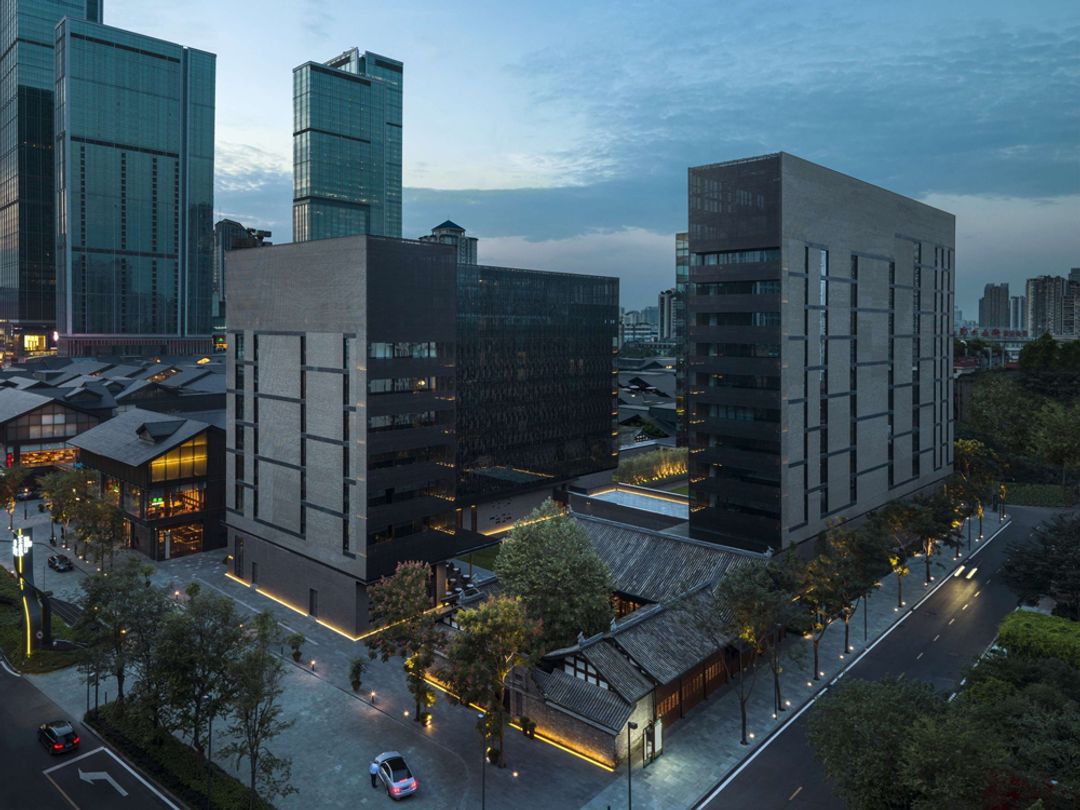
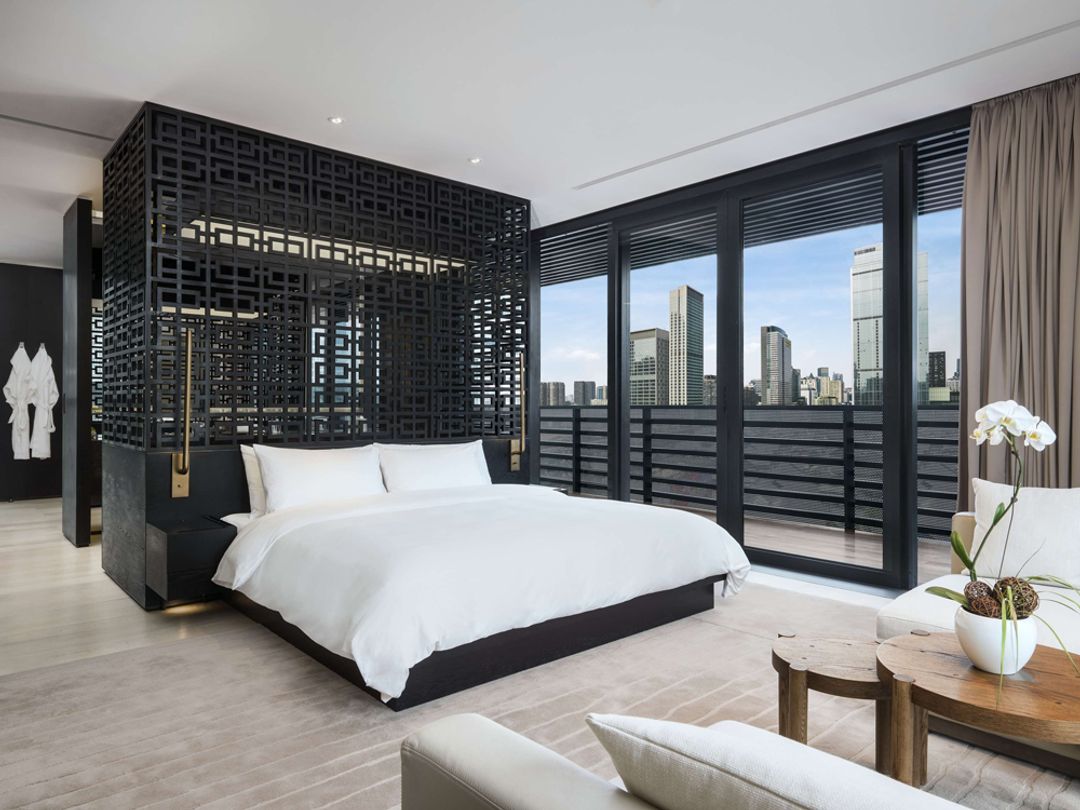
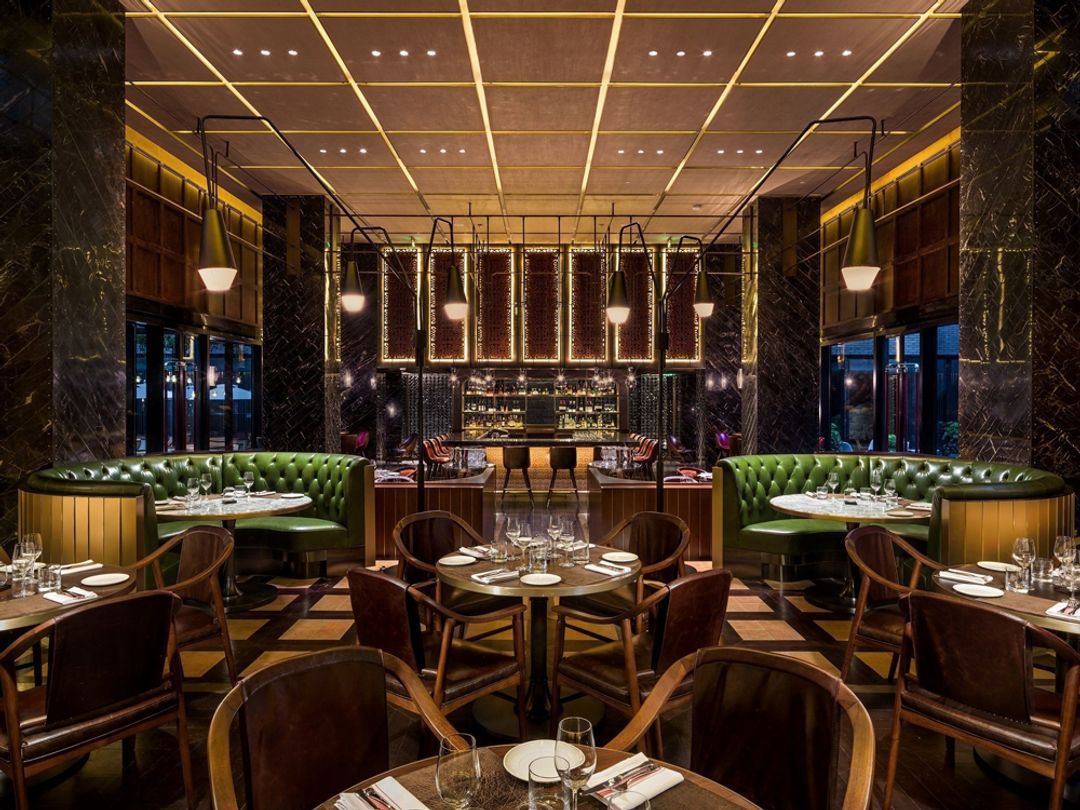
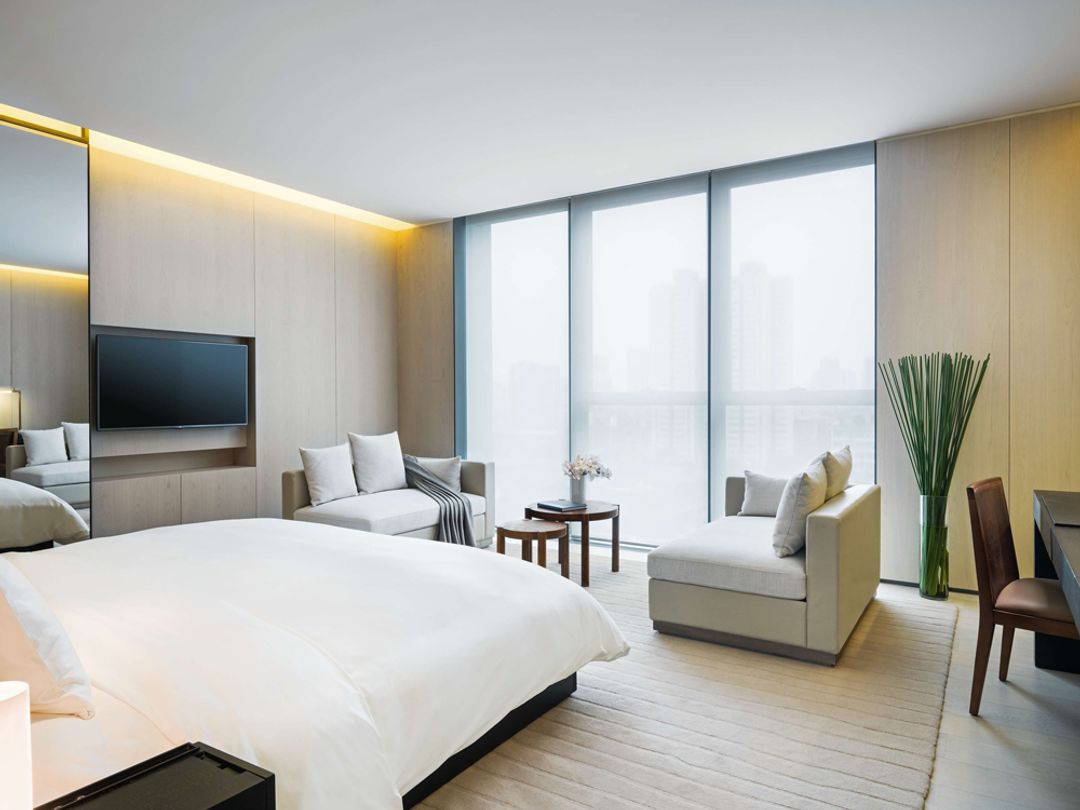
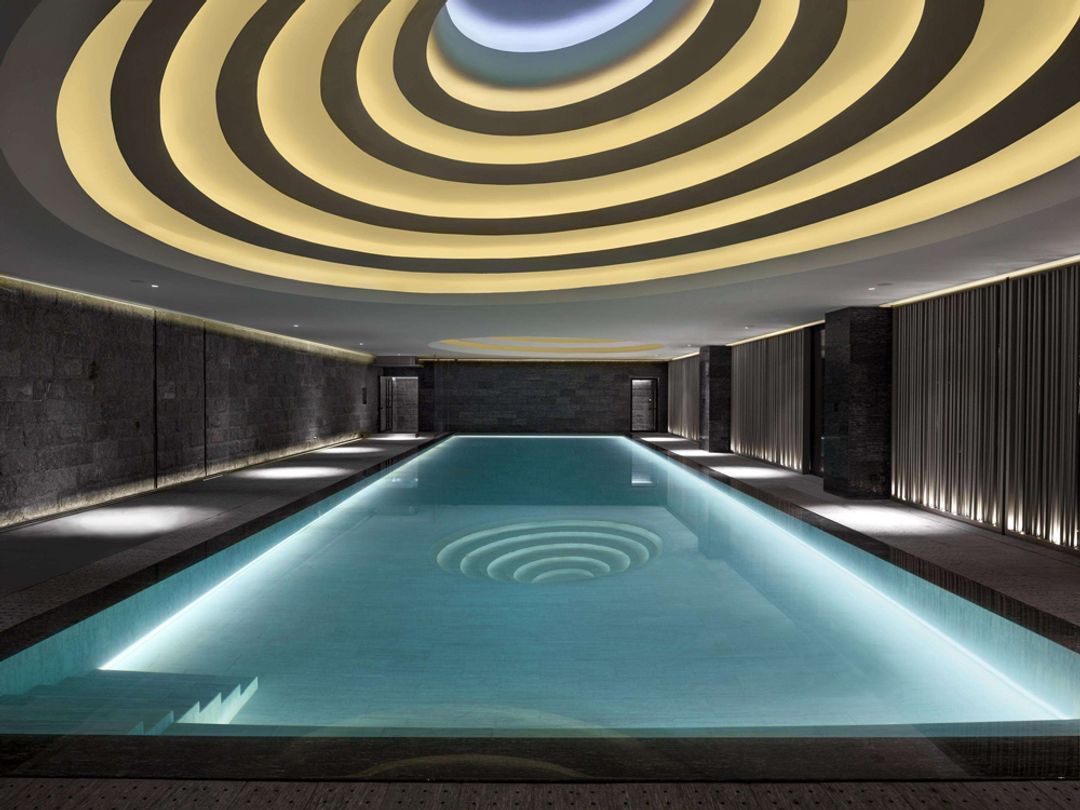
At the center of the development sits a cluster of restored Qing dynasty courtyard buildings, their grey-tiled sweeping roofs and timber-latticed facades pressed up against two contemporary stone towers that rise nine floors above Chengdu's Chunxi Road shopping district. This layered collision — ancient and new sharing a single site — is exactly the organizing idea behind The Temple House, the Swire Hotels property that opened in 2015 with architecture by Make Architects and interiors by the Hong Kong-based Joyce Wang Studio. The towers are clad in textured limestone panels divided by dark metal reveals, a massing that keeps the new construction in quiet dialogue with the historic structures below without pretending to mimic them. Joyce Wang's interiors translate that same conversation into furniture and material. Guest rooms in the contemporary tower range from spare and luminous — bleached oak panelling, off-white wool rugs, modular seating in pale linen — to the more theatrically Chinese register of the black-lacquered fretwork bed canopies visible in the upper-floor suites, their geometric lattice pattern lifted directly from traditional Sichuan joinery. The restaurant, by contrast, leans into a darkly glamorous mid-century mood: green leather Chesterfield banquettes, dark emperador marble columns, and a coffered brass ceiling grid that throws warm reflected light across walnut barrel chairs. Below grade, the pool chamber is among the more quietly dramatic spaces in any Chinese city hotel, its concentric elliptical ceiling ribs — illuminated in alternating bands of gold and shadow — echoing the ripple mosaic inlaid into the pool floor beneath.

Book with PB and get cash back
Shangri-La Hotel Chengdu - Image 1
Shangri-La Hotel Chengdu - Image 2
Shangri-La Hotel Chengdu - Image 3
Shangri-La Hotel Chengdu - Image 4
Shangri-La Hotel Chengdu - Image 5

Shangri-La Hotel Chengdu

Chengdu • Jinjiang River • OPTIMIZE

avg. $116 / night

Includes $6 / night in cash back

Cash back is redeemable via Virtual Visa, Venmo, or bank transfer starting 24-48 hours after check-out

Shangri-La Hotel Chengdu Design Editorial

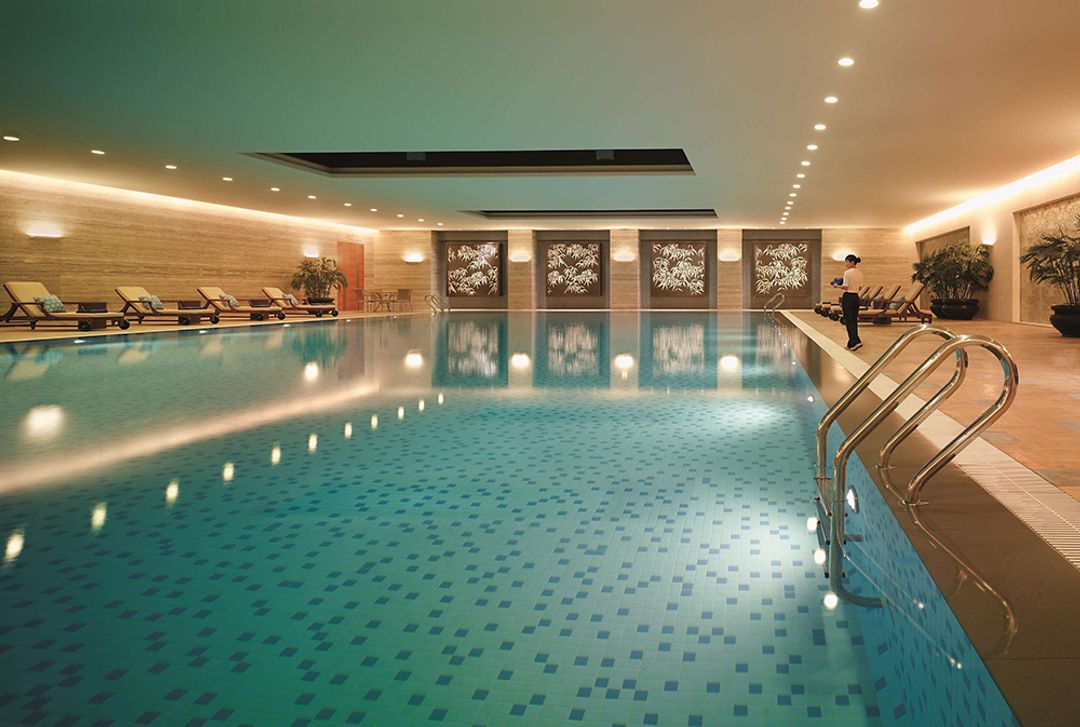
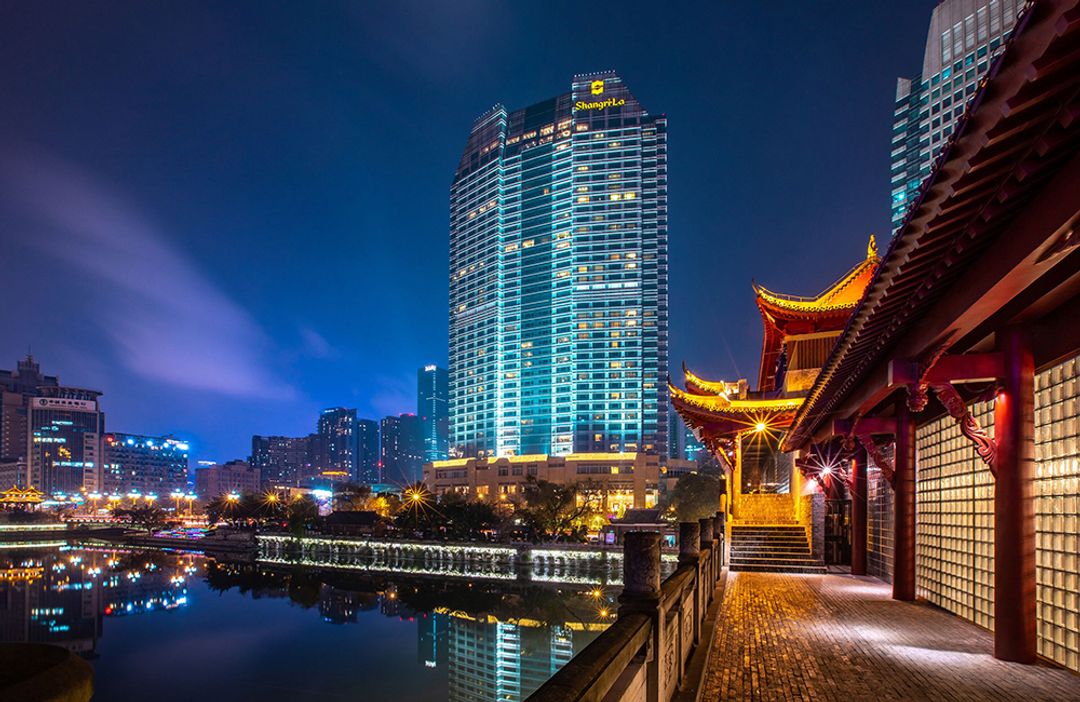
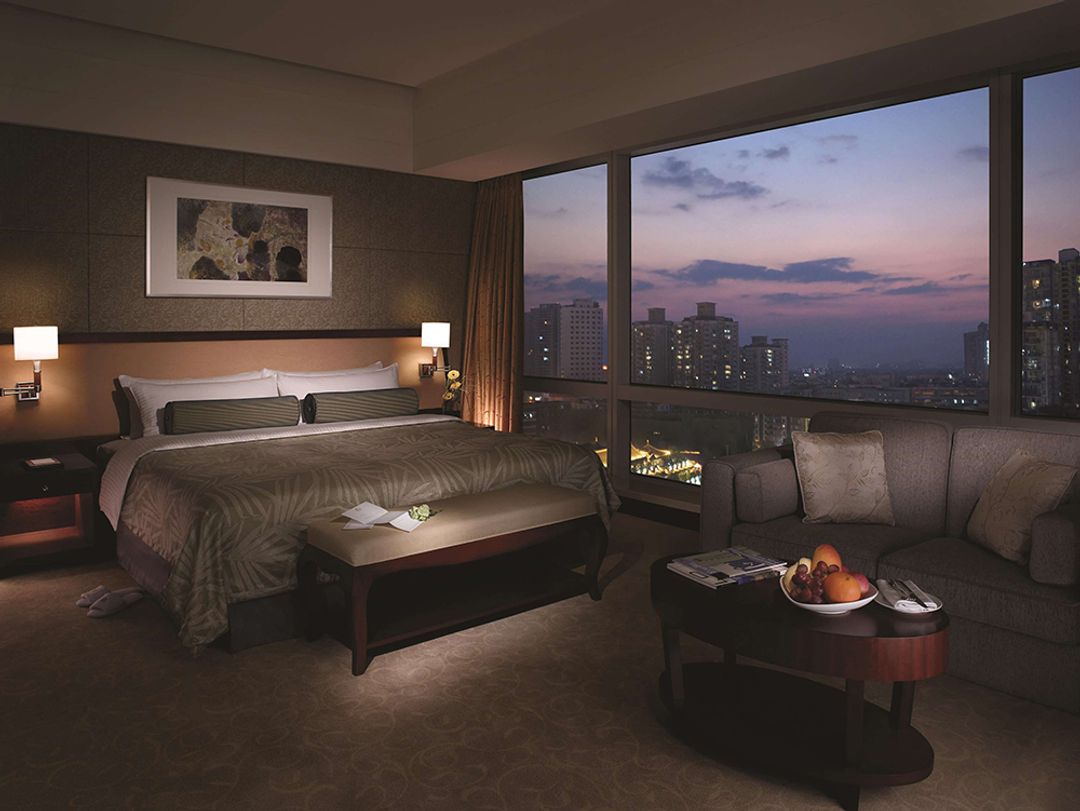
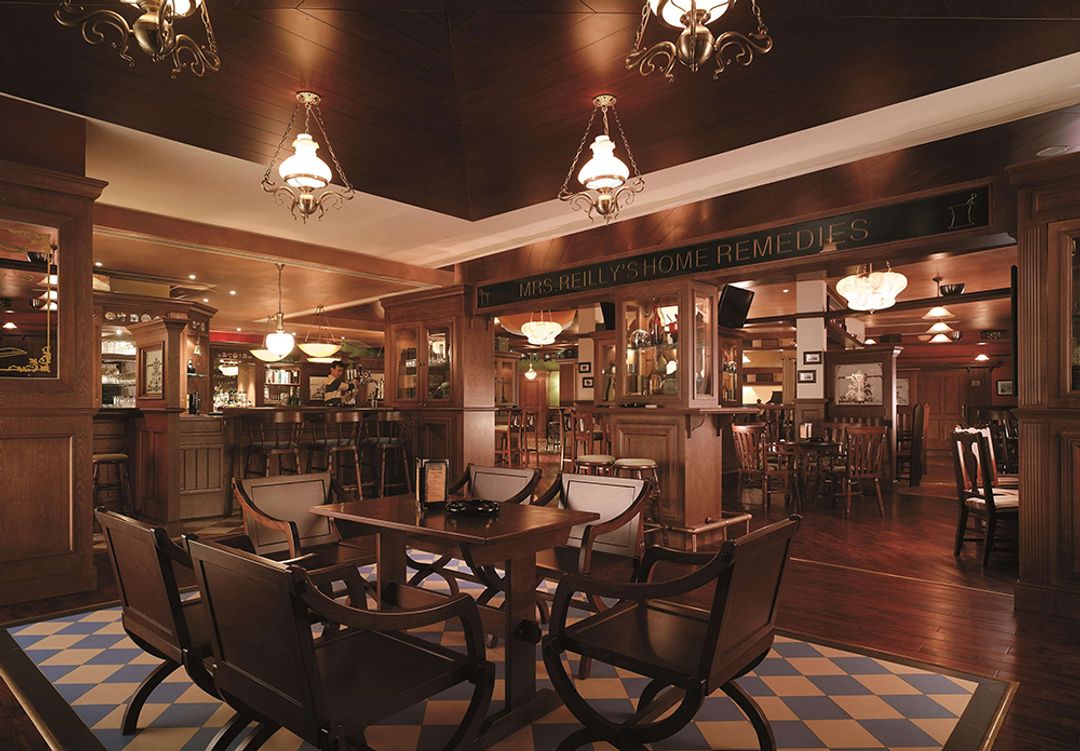
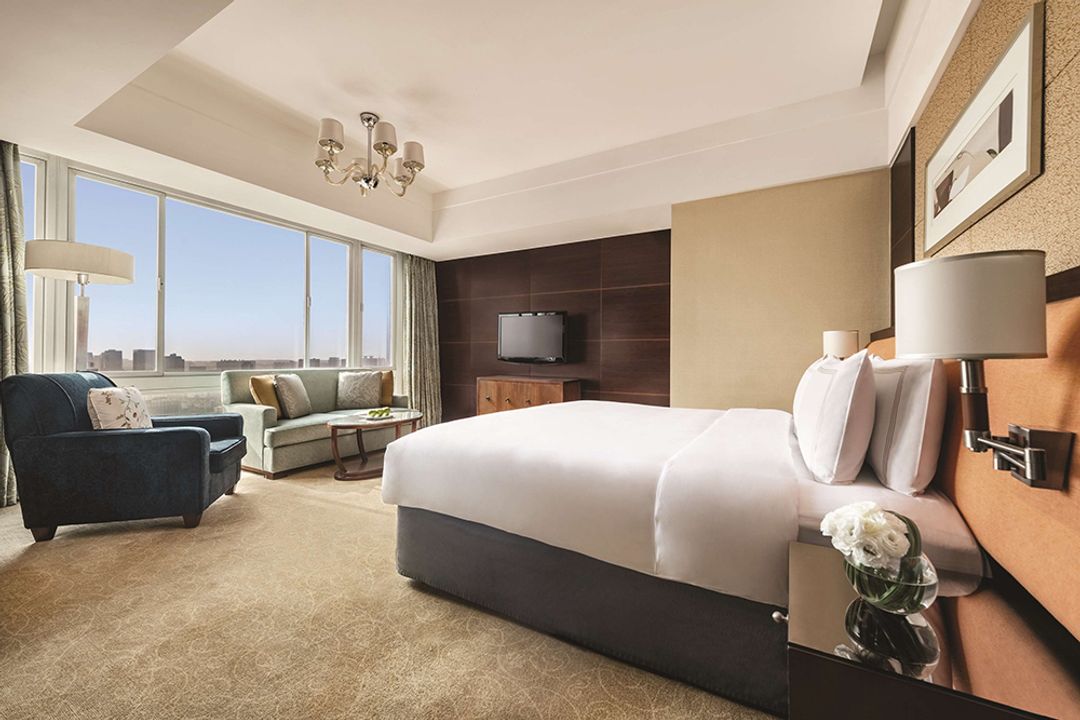
Across the Jinjiang River from Wenshu Monastery's gilded eaves and upswept rooflines, a 40-storey glass tower rises above central Chengdu with the cool confidence of a city that has spent two decades remaking itself as a metropolis of genuine international weight. The Shangri-La Hotel Chengdu, which opened in 2006, sits within this charged adjacency — ancient Buddhist heritage on one bank, contemporary hospitality architecture on the other — and the night photographs make this dialogue impossible to ignore: amber lantern-light against teal curtain-wall glazing, carved timber brackets beside floor-to-ceiling glass. The 390 rooms carry the brand's characteristic register of warm neutrals and dark-stained timber veneers, headboards upholstered in caramel tones set against walls panelled in chocolate-brown lacquered wood, the city spreading out below through full-height windows. The renovated rooms show a lightened palette — sage velvet club chairs, Murano-style glass chandeliers, patterned wool carpets in sand and ochre — that updates the original scheme without abandoning its essential seriousness. The indoor pool deck introduces a more specifically regional note: backlit panels etched with bamboo motifs line the travertine-clad surround, referencing Sichuan's landscape in a register quiet enough not to tip into pastiche. The Irish pub, Mrs. Reilly's, handles the brand's longstanding tradition of Western dining outlets with dark-stained oak millwork and diamond-pattern floor tiles — its own kind of period conviction, entirely at odds with everything outside the windows.

Book with PB and get cash back
YiuTeung Mansion - Image 1
YiuTeung Mansion - Image 2
YiuTeung Mansion - Image 3
YiuTeung Mansion - Image 4
YiuTeung Mansion - Image 5

YiuTeung Mansion

Chengdu • Wuhou District • OPTIMIZE

avg. $166 / night

Includes $9 / night in cash back

Cash back is redeemable via Virtual Visa, Venmo, or bank transfer starting 24-48 hours after check-out

Hilton Honors™ property

YiuTeung Mansion Design Editorial

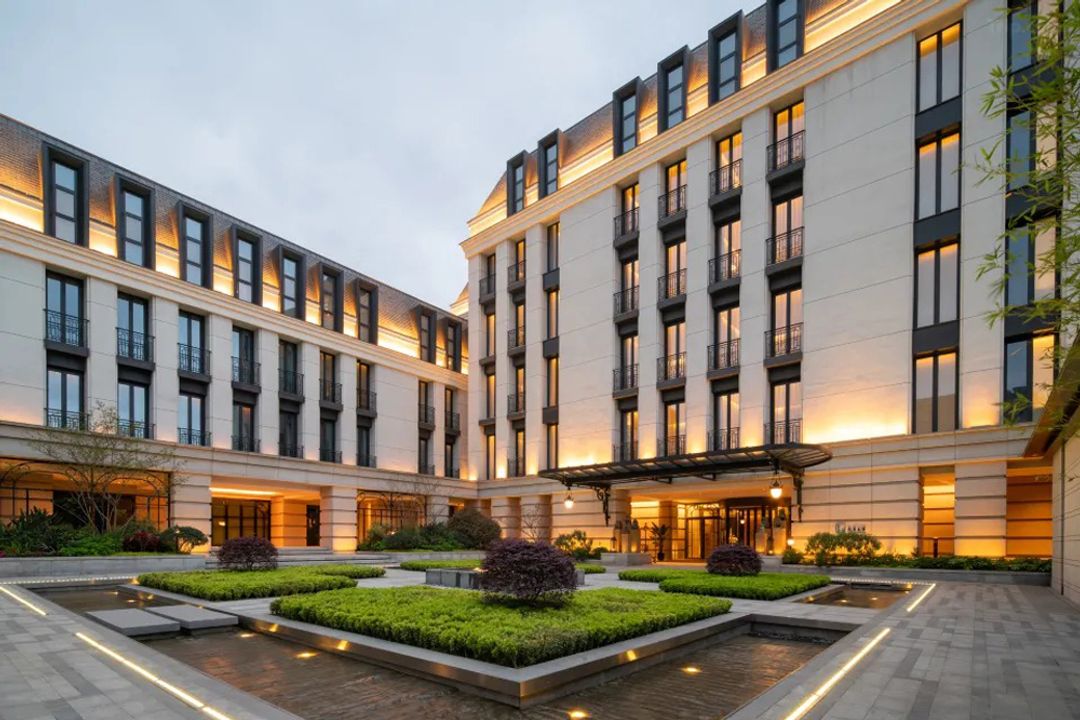
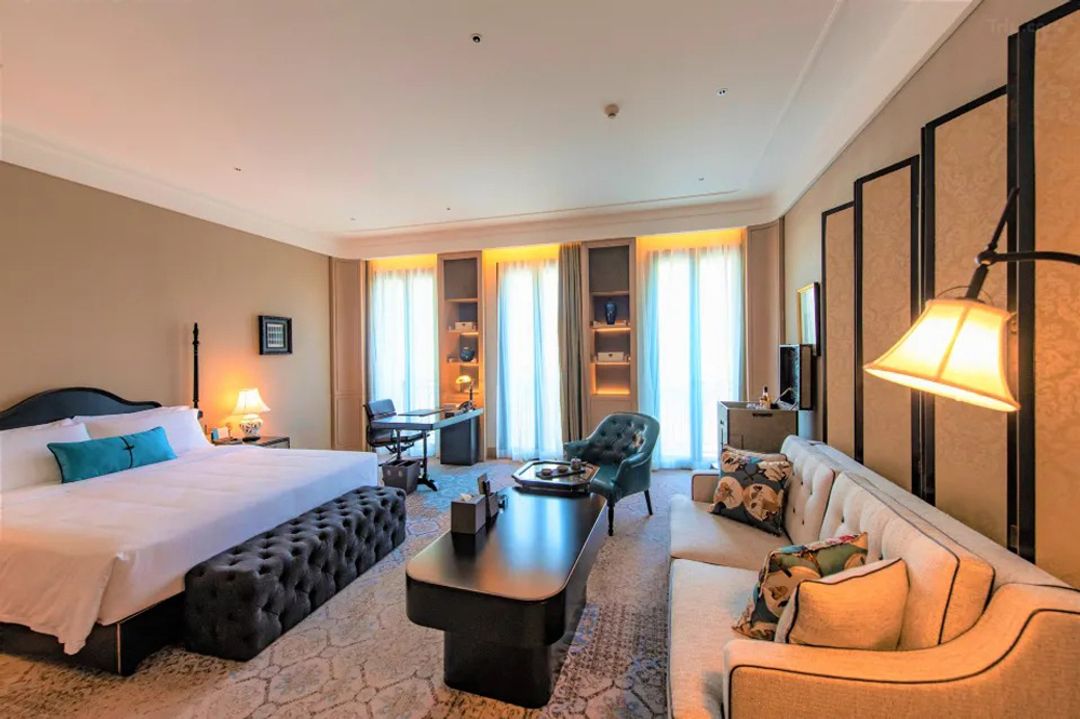
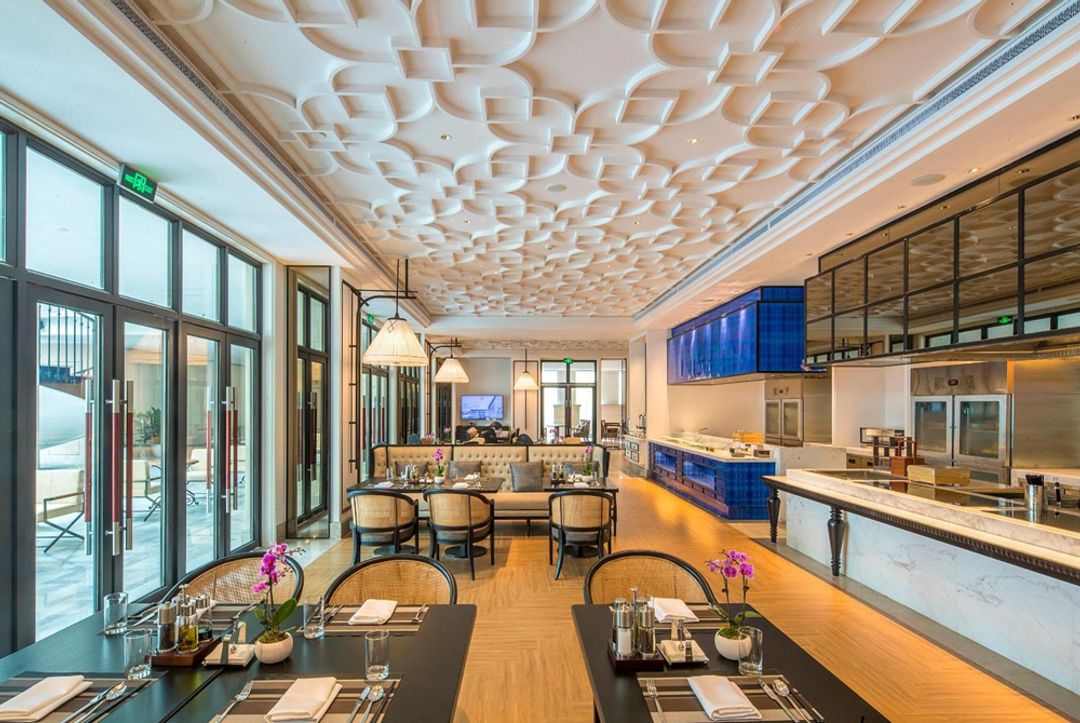
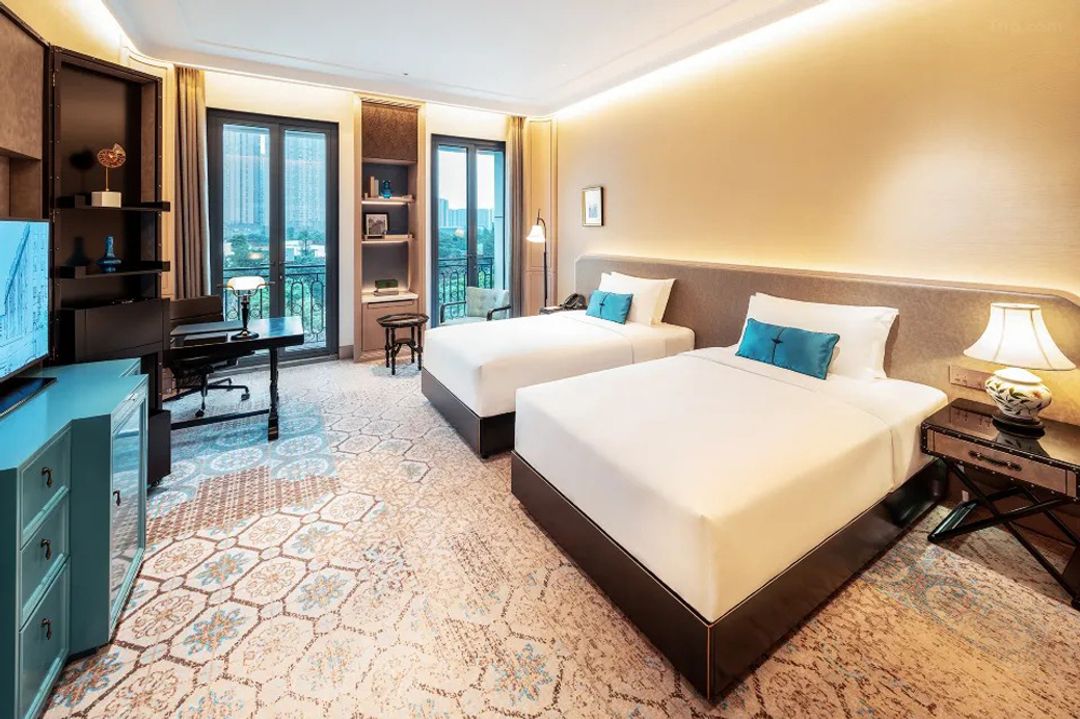
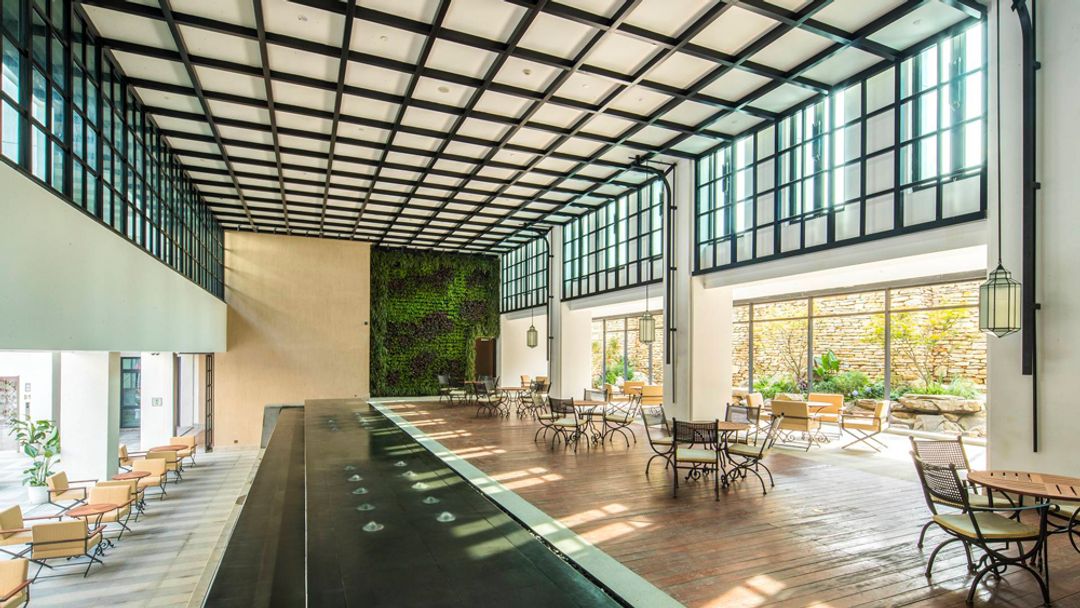
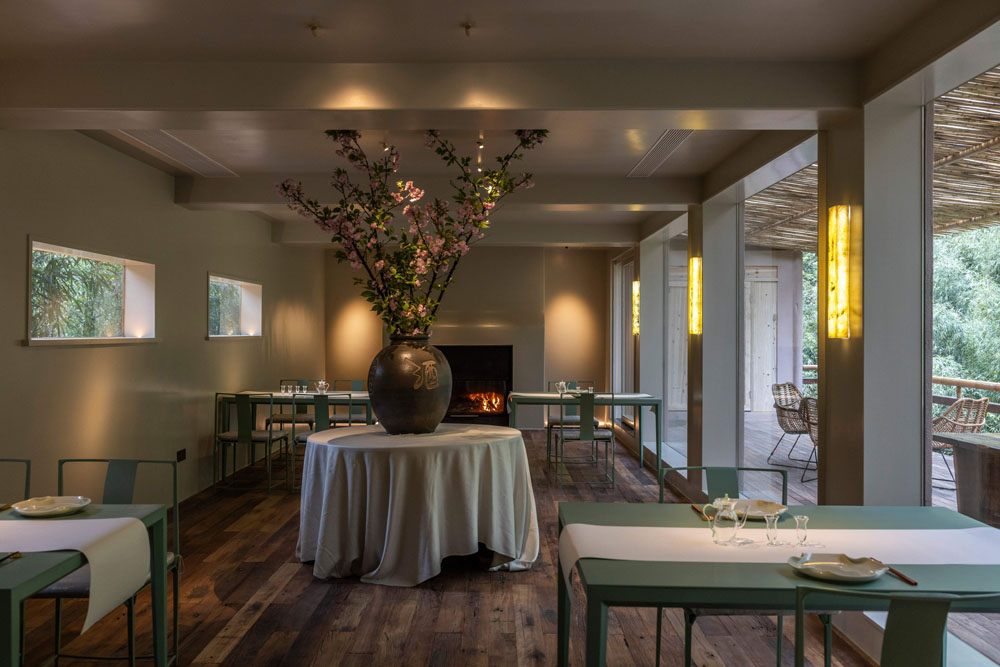
The courtyard garden at dusk tells you everything about the ambition behind YiuTeung Mansion: a formally composed parterre of clipped box hedging, Japanese maples, and stone-edged water channels set within a U-shaped building whose cream limestone facade borrows the cornice lines and wrought-iron balconies of early twentieth-century European neoclassicism — reinterpreted for Chengdu's Wuhou District with considerable confidence. The six-storey structure, arranged around this sheltered forecourt, uses recessed lighting at the base of the building to warm the stone at dusk, giving the massing an almost residential quality that larger convention hotels in the city rarely achieve. Inside, the design shifts registers without losing coherence. Guest rooms carry patterned carpets in warm terracotta and teal, dark-stained four-poster beds and tufted velvet ottomans sitting alongside lacquered cerulean storage pieces — a palette that gestures toward Shanghai Art Deco without quite committing to period pastiche. The restaurant is the most architecturally resolved space in the building: an organic sculptural ceiling in interlocking white plaster forms floats above marble-topped counters and cane-backed bistro chairs, the cobalt-tiled open kitchen providing the room's only strong chromatic note. A double-height atrium elsewhere in the property, glazed in a steel-and-glass grid and anchored by a vertical moss wall and a long reflecting channel, gives the hotel its most contemporary moment — closer in spirit to a botanical garden than a lobby.

Book with PB and get cash back
Six Senses Qing Cheng Mountain - Image 1
Six Senses Qing Cheng Mountain - Image 2
Six Senses Qing Cheng Mountain - Image 3
Six Senses Qing Cheng Mountain - Image 4
Six Senses Qing Cheng Mountain - Image 5

Six Senses Qing Cheng Mountain

Chengdu • Qing Cheng Mountains • SPLURGE

avg. $368 / night

Includes $19 / night in cash back

Cash back is redeemable via Virtual Visa, Venmo, or bank transfer starting 24-48 hours after check-out

IHG® One Rewards property

Six Senses Qing Cheng Mountain Design Editorial

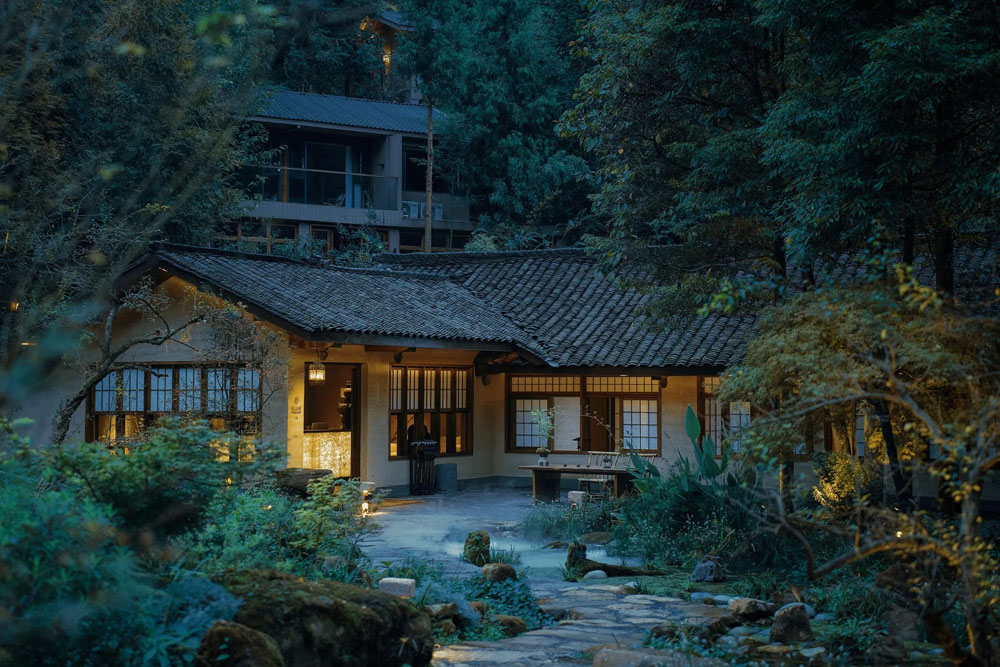
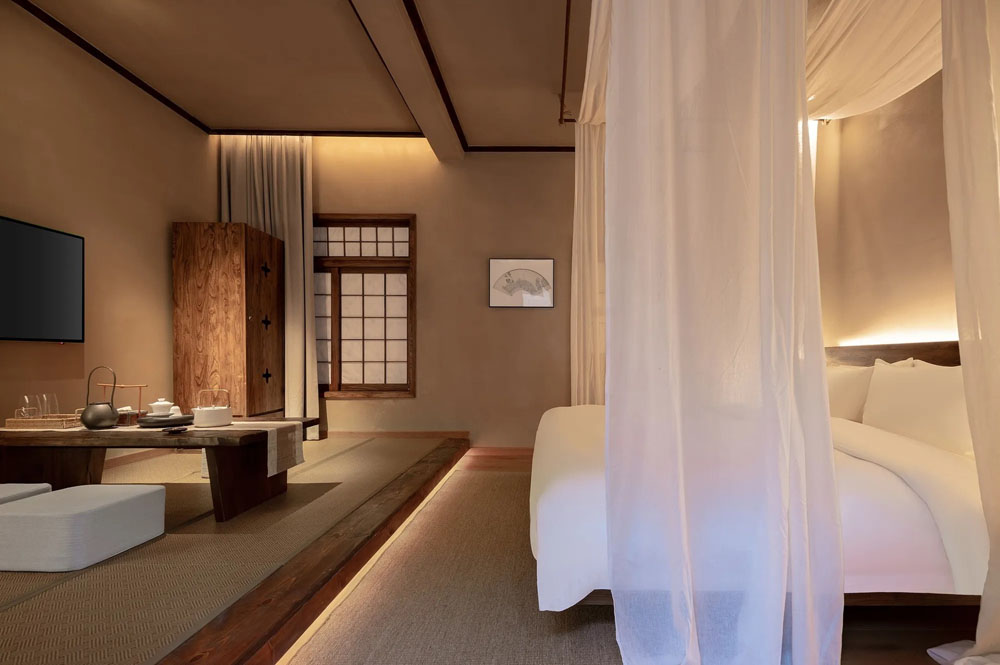
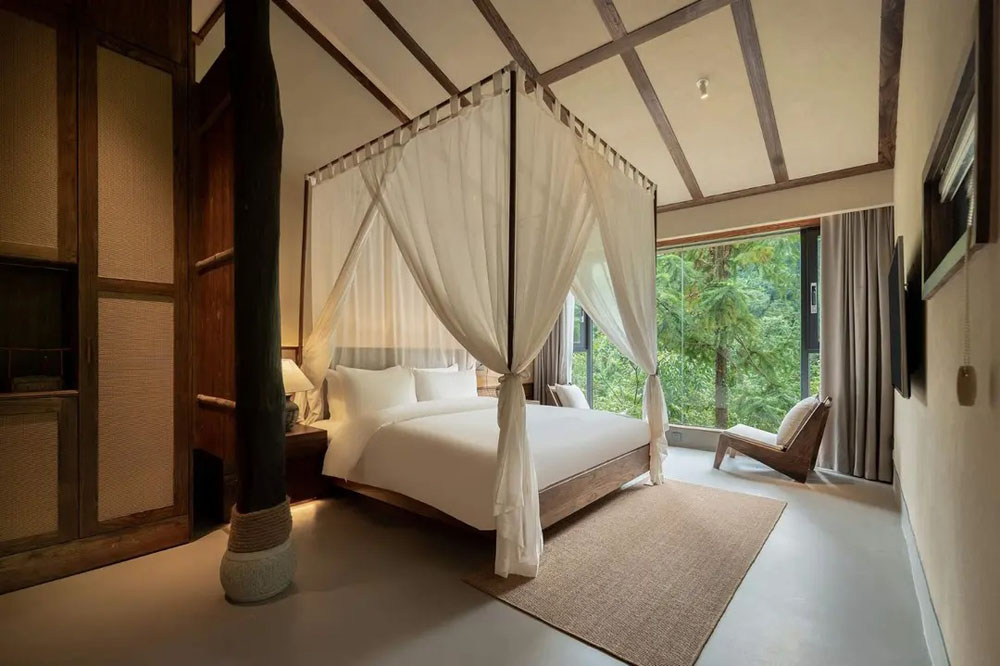
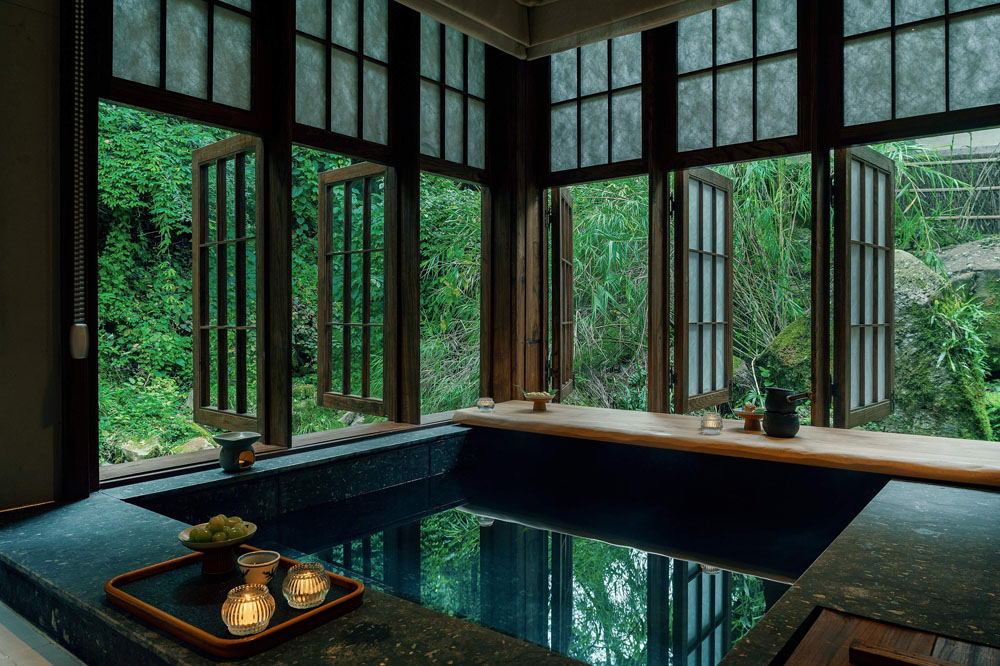
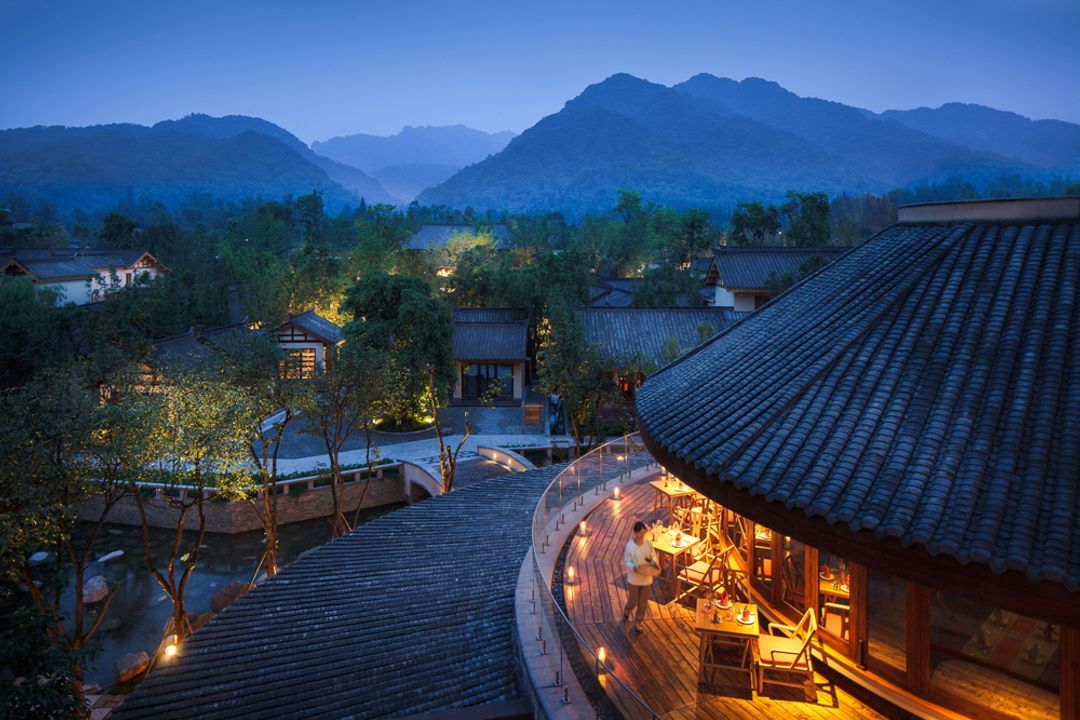
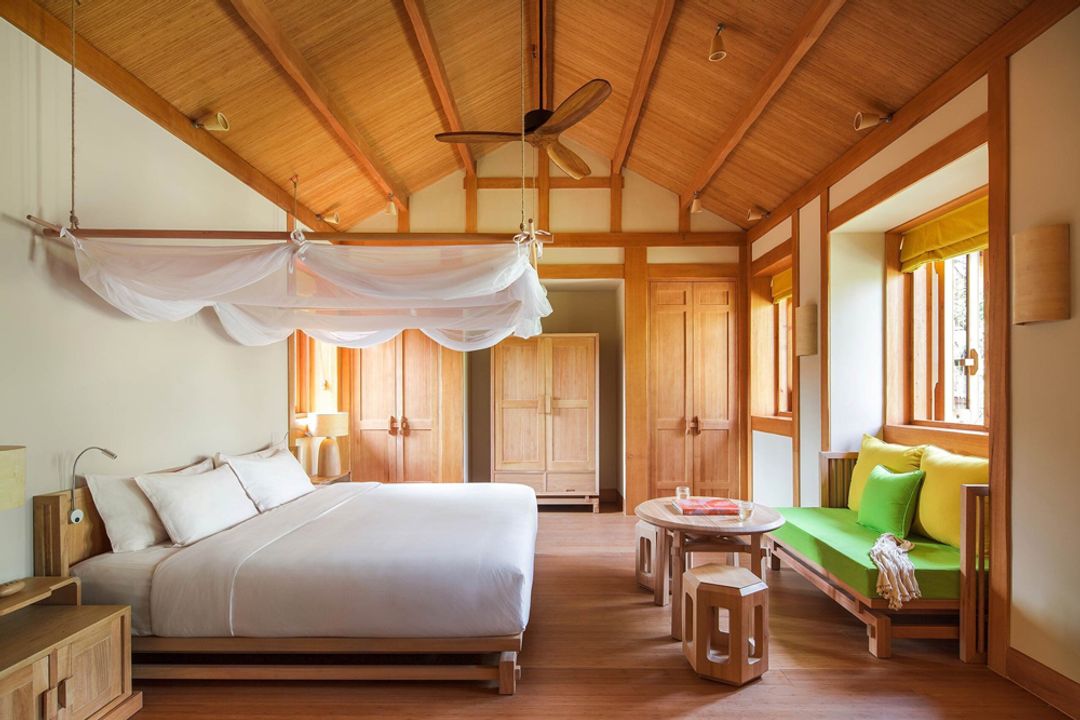
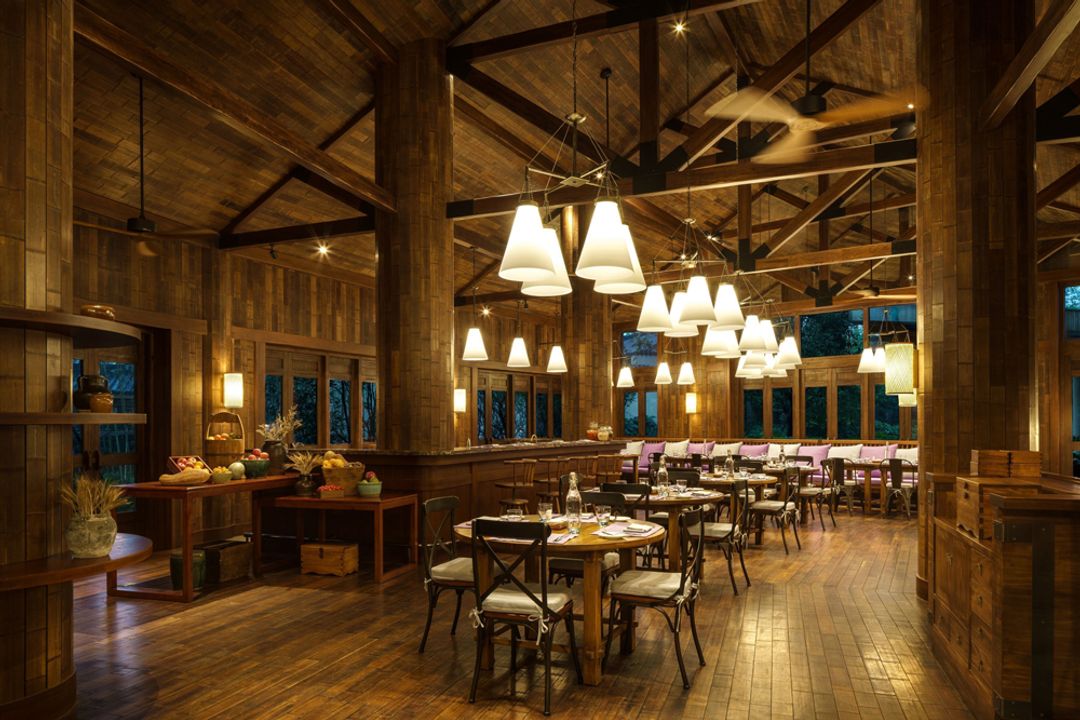
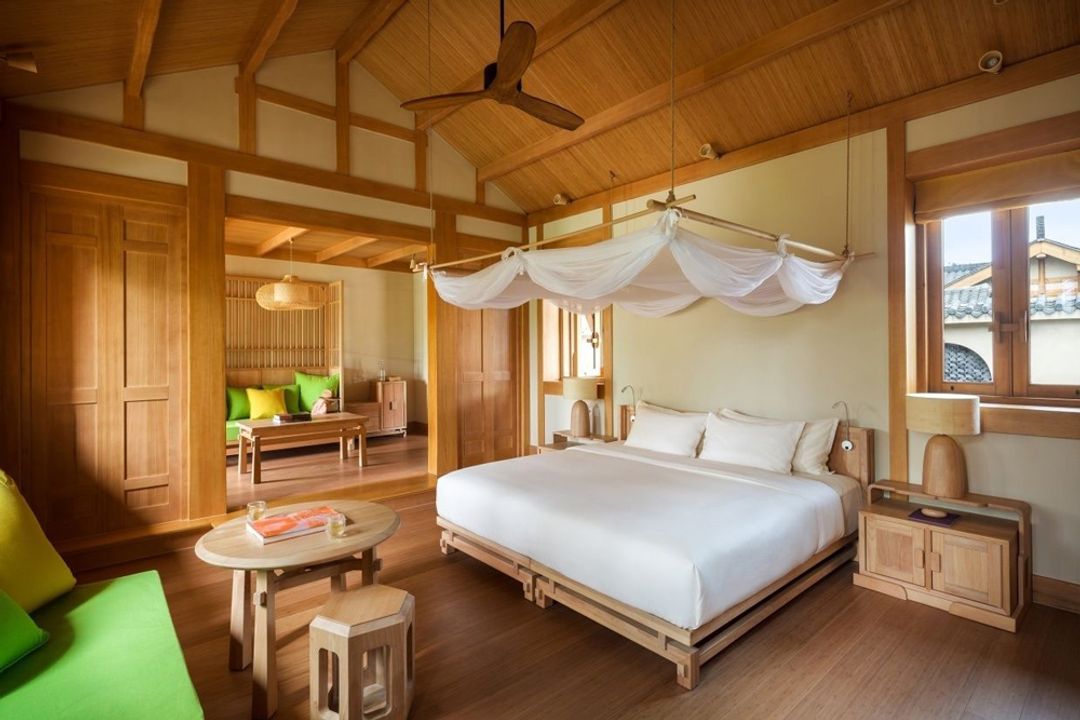
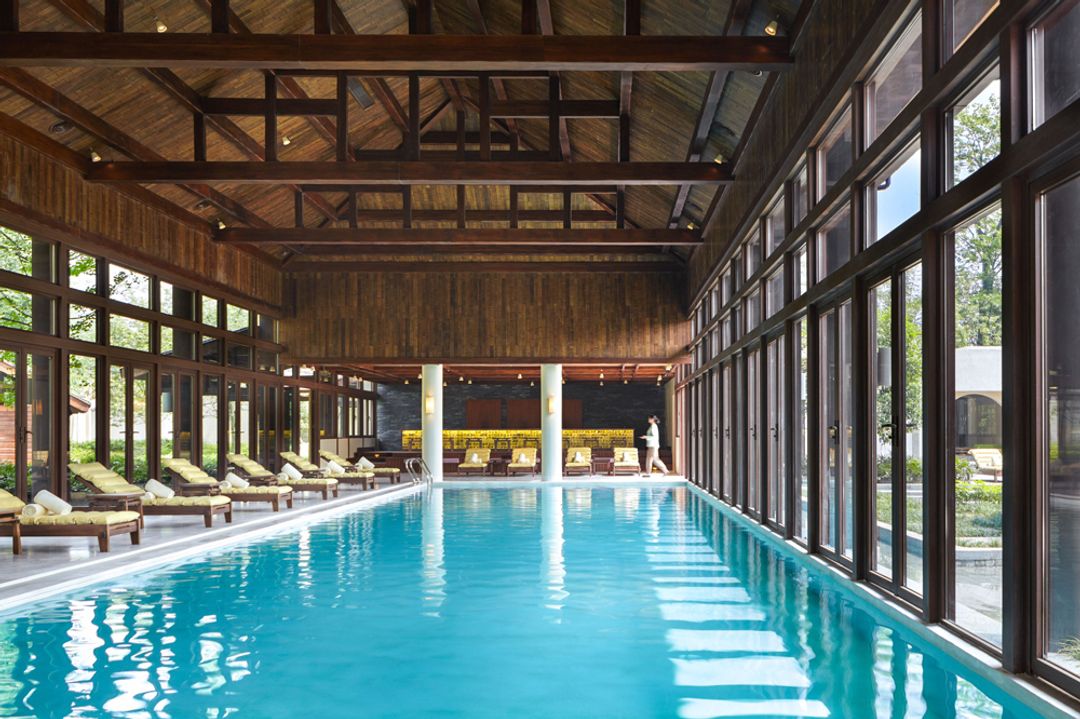
At the foot of Qing Cheng Mountain in Sichuan province — one of Taoism's most sacred sites, its forested slopes home to temples dating back nearly two thousand years — Six Senses Qing Cheng Mountain makes the case that contemporary resort design and ancient spiritual landscape are not merely compatible but mutually reinforcing. The property spreads across roughly 35 acres as a low-rise village of grey-tiled pavilions connected by curved timber walkways and water channels, the massing kept deliberately modest so the ridgeline always dominates. Traditional Sichuan architectural forms govern the structures throughout: bracketed timber frames, upswept eave profiles, and clay roof tiles laid in the regional manner sit alongside lily ponds and stone-paved courtyards that move through the site in a sequence closer to classical garden design than resort planning. Inside the 102 villas and suites, exposed ridge-and-rafter ceilings in warm teak give the rooms the atmosphere of carefully built vernacular structures rather than hotel accommodation. Draped muslin canopies hang from bamboo poles above low platform beds, while custom furniture in pale elm — hexagonal stools, round side tables, rectilinear daybeds upholstered in chartreuse and citron — introduces a quietly contemporary touch against the cream-washed walls. The indoor pool pavilion extends the same timber-and-glass vocabulary, dark hardwood trusses framing a wall of steel-mullioned windows that draw the surrounding bamboo grove directly into the space. Throughout, the design resists ornament in favour of material honesty, letting the grain of the wood and the weight of the tile carry the conversation.

Best hotels in Chengdu | A Curated Visual Guide to Top Stays