Where

PressBeyond Logo

Best hotels in Bali | A Curated Visual Guide to Top Stays

Welcome to PressBeyond, the ultimate curated visual guide for design-driven hotels! My name is Will Miller and these are my recommendations for the best boutique and luxury hotels in Bali.

I am the founder of PressBeyond and I am an ultra-meticulous hotel curator who loves clean visuals. I have individually analyzed and tiered each hotel included in this guide based on a variety of criteria (architecture & design, location, brand & brand affiliation, existing reviews, and my own personal experiences), and importantly, I have hand-selected the leading imagery for each hotel to provide you with easily-digestible, yet detailed and complete, like-for-like, high-level visual profiles. I felt this summarization step was a critical missing piece across existing guides, blogs, and booking platforms. My aim is to make it easier for people to identify hotel environments that resonate with them, along with enabling them to visualize the types of social experiences that those environments help foster. My brain doesn't work when exposed to cluttered content, so my goal was to create the opposite.

Underneath this, we are also a full booking engine offering 5% Venmo cash back along with other exclusive perks. For all of you design-obsessed hotel enthusiasts out there, I hope this guide helps get you to where you see yourself!

An Overview of the Boutique & Luxury Hotel Landscape in Bali

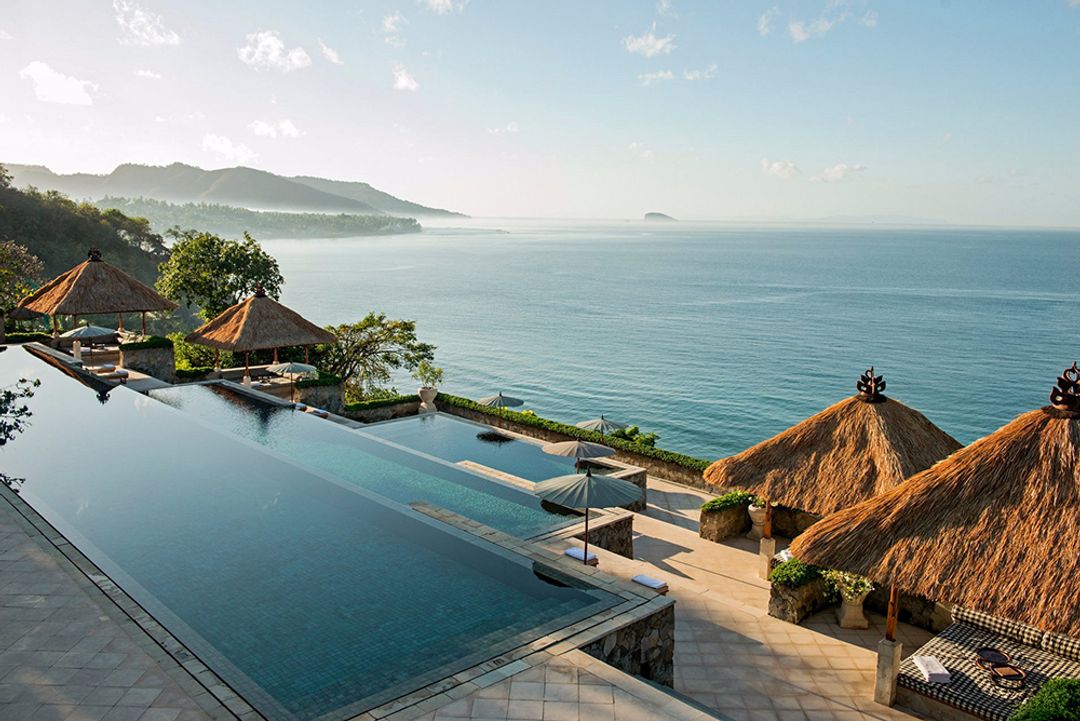
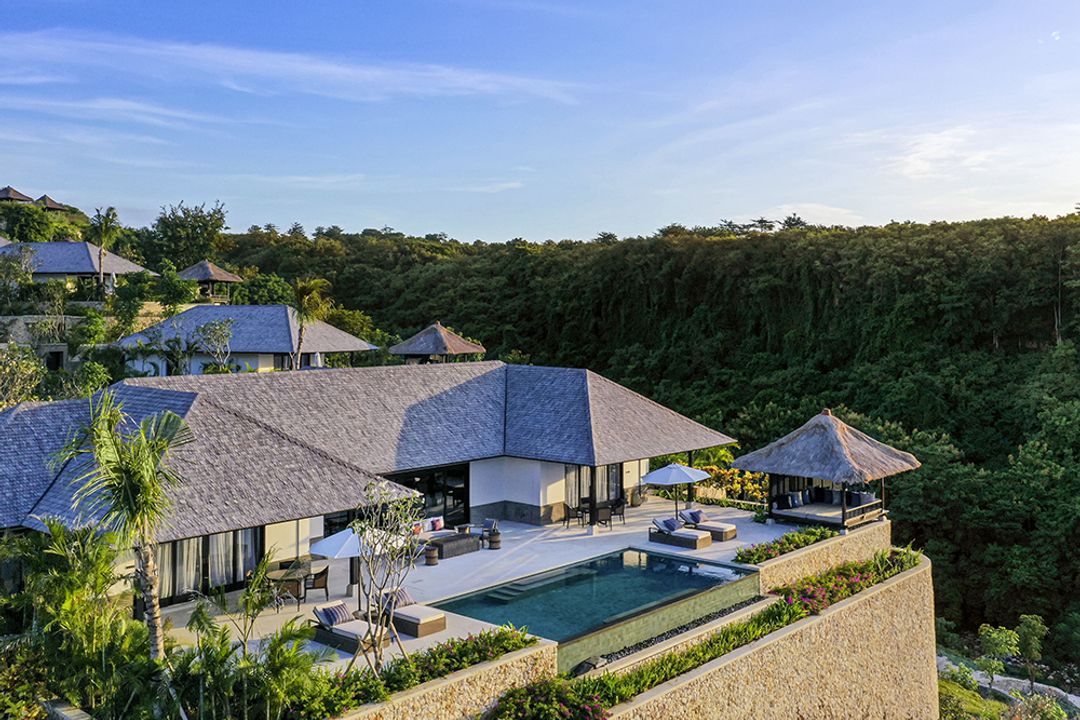
The limestone cliffs of Uluwatu and the river valleys around Ubud represent fundamentally different propositions — not just in geography but in what each demands of architecture. At Uluwatu, the Bulgari Resort (Antonio Citterio Patricia Viel, completed 2006) makes the cliff itself the argument, with pavilions cantilevered over the Indian Ocean in a language that owes more to Italian rationalism than to anything vernacular. Nearby, Alila Villas Uluwatu, designed by WOHA Architects, takes the opposite position: its terraced concrete forms read as landscape rather than object, earning a LEED Platinum certification that was genuinely unusual for Bali hospitality at the time. Hidden Hills Villas occupies the same coastal ridge at a quieter register. Down at Jimbaran Bay, the Four Seasons operates with an entirely different sensibility — a village-scale compound of thatched pavilions that architect Peter Muller conceived in the early 1990s as a meditation on Balinese spatial ritual rather than international luxury. Raffles Bali, also on the bay, arrived later and more theatrically, its hilltop infinity pool functioning as the primary design gesture. Ubud concentrates the island's most architecturally considered properties within a relatively small radius. Amandari, the 1989 Ed Tuttle commission for Amanresorts, remains the quiet benchmark — its stone courtyards and rice terrace views established a grammar that subsequent Ubud hotels have spent decades negotiating with or against. Capella Ubud took the boldest departure: Bill Bensley's 2018 project planted a camp of tented villas on a forested hillside above the Ayung River, treating the jungle as theatrical backdrop rather than something to be tamed. The Four Seasons Bali at Sayan, with its elliptical lotus pond rooftop arrival sequence, occupies a bend in the same river. Mandapa and COMO Shambhala Estate both lean into wellness as organizing principle, though with different tonal registers — Mandapa as sanctuary, COMO as something more empirical about the body. The beach corridor from Seminyak to Canggu operates at a different pace entirely. The Legian Seminyak holds its position as the strip's most architecturally restrained address, its austere beachfront tower a deliberate counterpoint to the surrounding noise. Alila Seminyak, designed by WOHA, channels a similar seriousness into a tighter urban footprint. La Reserve 1785 in Canggu arrives with a French curatorial sensibility that feels genuinely specific rather than imported. Across all of these registers — cliff, valley, coast — the common thread is that the best properties here treat Bali's landscape as a collaborator, not a backdrop.
Book with PB and get cash back
Gdas Bali Health and Wellness Resort - Image 1
Gdas Bali Health and Wellness Resort - Image 2
Gdas Bali Health and Wellness Resort - Image 3
Gdas Bali Health and Wellness Resort - Image 4
Gdas Bali Health and Wellness Resort - Image 5

Gdas Bali Health and Wellness Resort

Bali • Ubud • OPTIMIZE

avg. $230 / night

Includes $12 / night in cash back

Cash back is redeemable via Virtual Visa, Venmo, or bank transfer starting 24-48 hours after check-out

Hilton Honors™ property

Gdas Bali Health and Wellness Resort Design Editorial

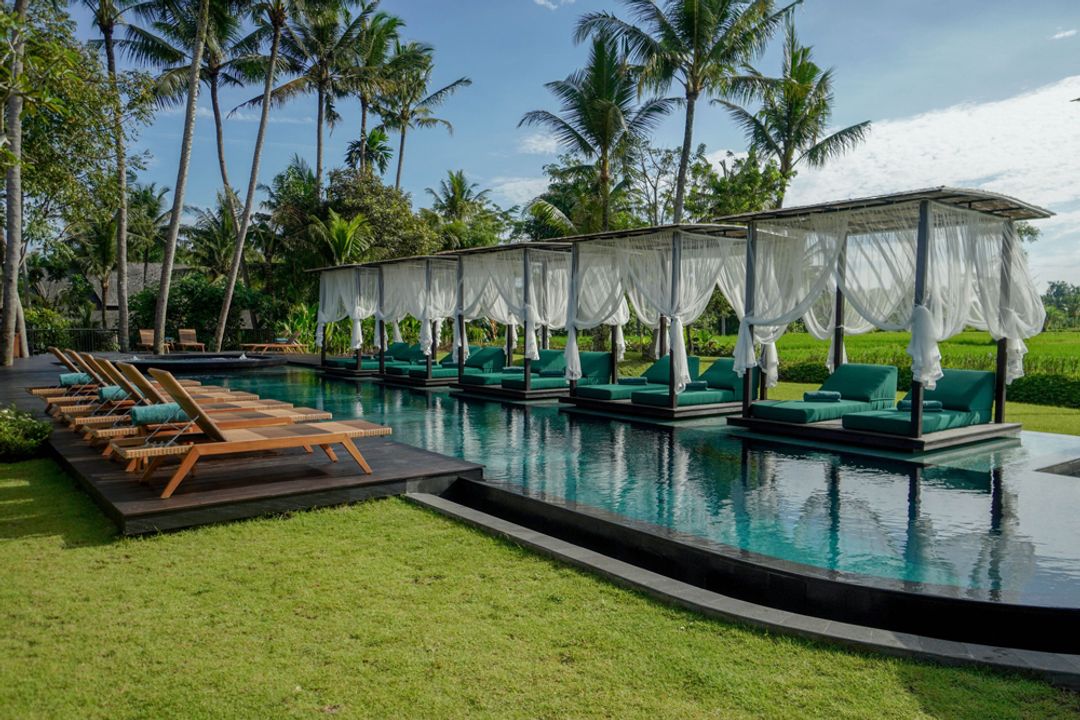
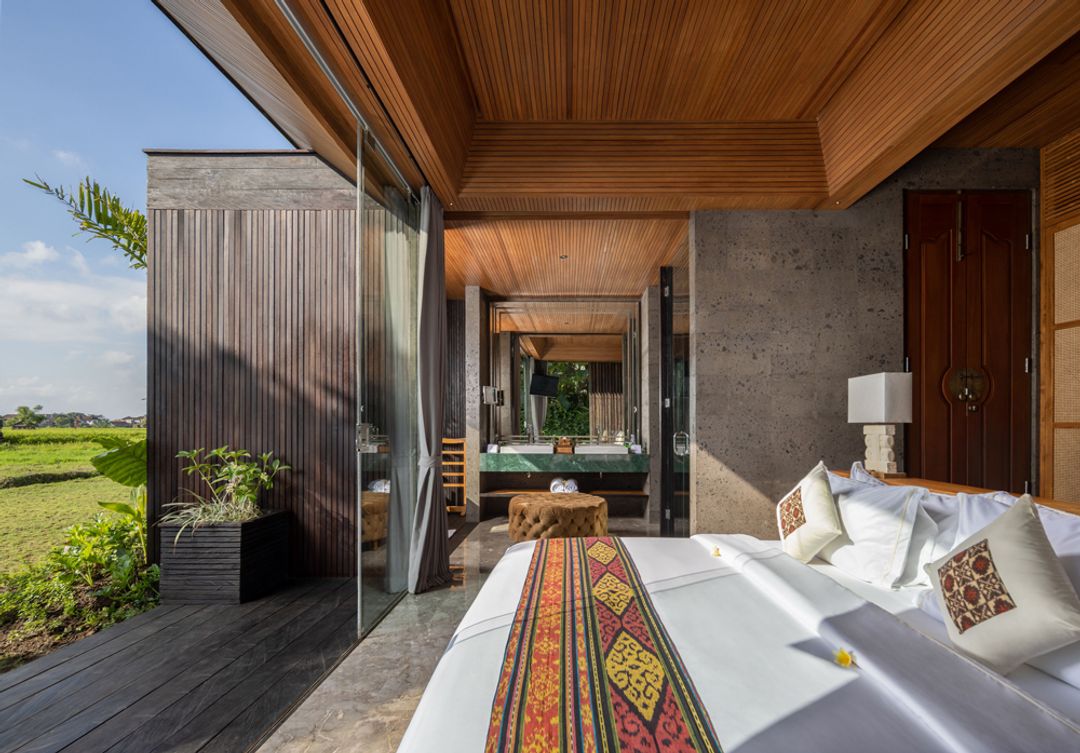
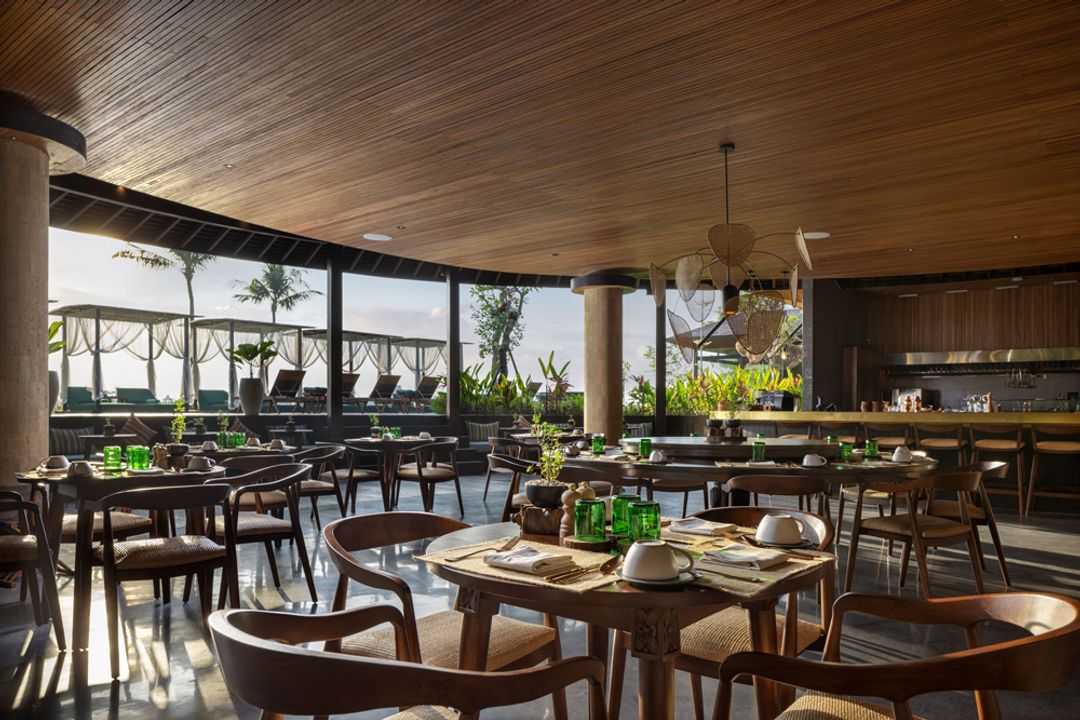
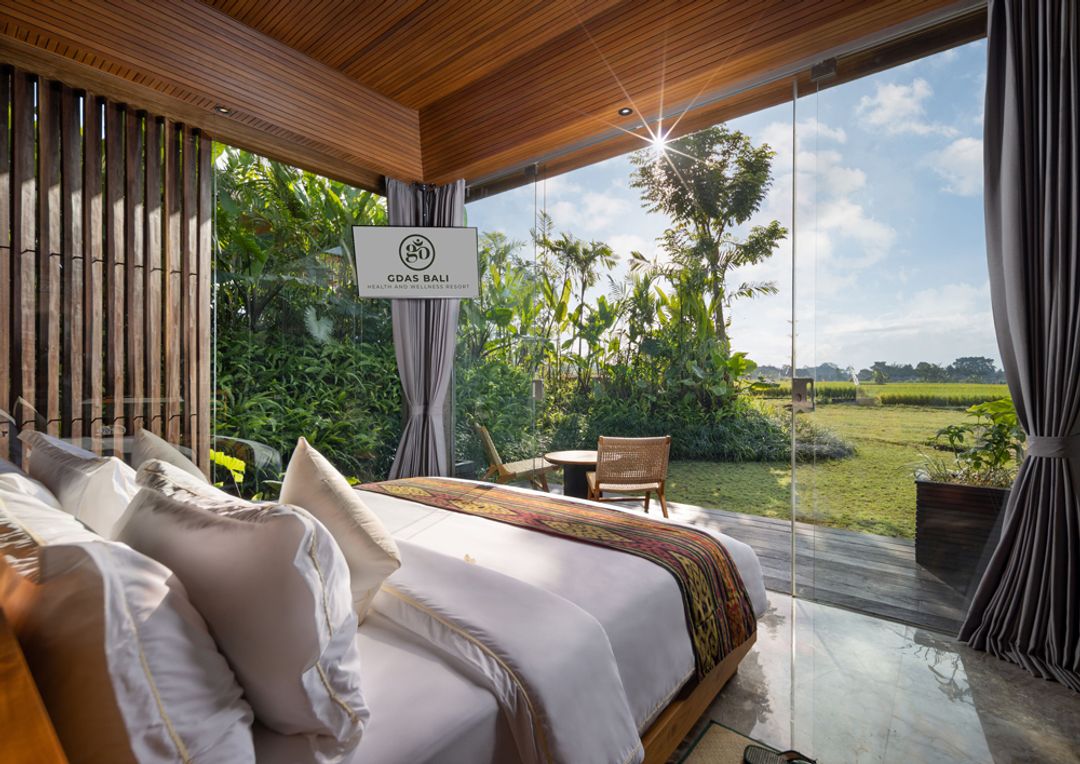
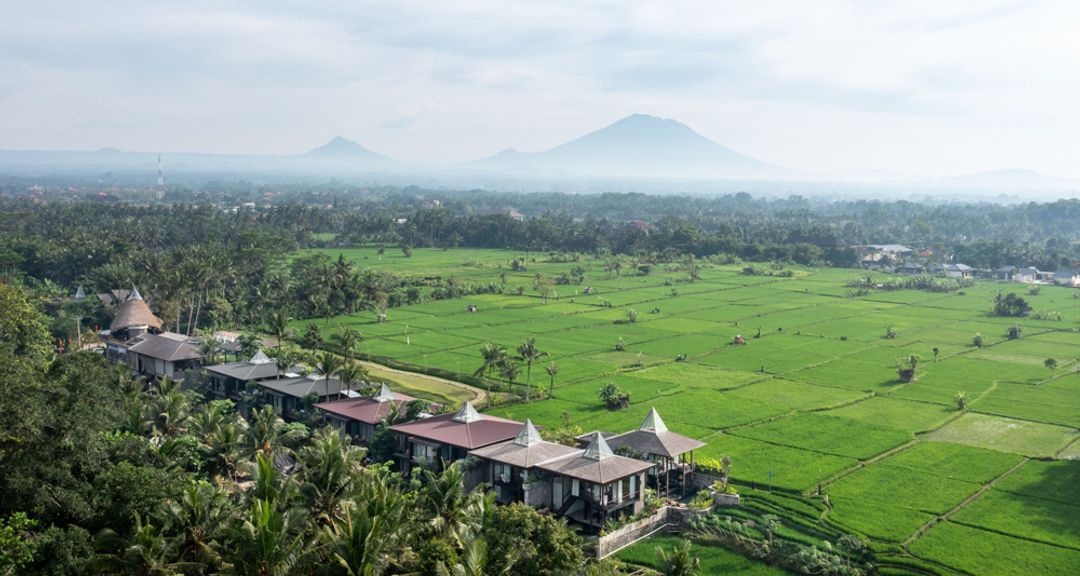
Spread across a ridgeline above the sawah fields of Ubud's Kelusa district, with Gunung Agung and Gunung Batur rising through morning haze on the horizon, the property that became Gdas Bali Health and Wellness Resort was shaped around a single governing idea: that the landscape itself is the primary therapeutic agent. The architecture earns that ambition. Villa pavilions step down the hillside in a linear sequence, their dark-stained timber louvred screens and volcanic paras stone walls absorbing rather than imposing on the surrounding green. Pointed metal roof forms punctuate the ridge in a contemporary riff on traditional Balinese thatched meru profiles, while full-height frameless glazing dissolves the boundary between sleeping quarters and the paddies that extend to the horizon. Inside, the material palette runs to warm teak strip ceilings, polished grey volcanic stone floors, and verde marble washbasins — textures that feel locally grounded without resorting to pastiche. Ikat-weave bed runners in saffron and crimson introduce Balinese textile culture as the single decorative gesture against otherwise restrained linen and timber surfaces. The restaurant's curved timber-lined ceiling and floor-to-ceiling glazing give the room the atmosphere of a pavilion suspended between terrace and canopy, furnished with low-backed teak chairs and rattan pendants. At the pool terrace, teak sun loungers and white-draped cabana frames line a dark-edged lap pool, the rice fields beginning immediately where the lawn ends — a boundary so deliberate it feels designed to remind guests exactly where they are.

Book with PB and get cash back
Alila Seminyak - Image 1
Alila Seminyak - Image 2
Alila Seminyak - Image 3
Alila Seminyak - Image 4
Alila Seminyak - Image 5

Alila Seminyak

Bali • Seminyak Beach • OPTIMIZE

avg. $235 / night

Includes $12 / night in cash back

Cash back is redeemable via Virtual Visa, Venmo, or bank transfer starting 24-48 hours after check-out

World of Hyatt property

Alila Seminyak Design Editorial

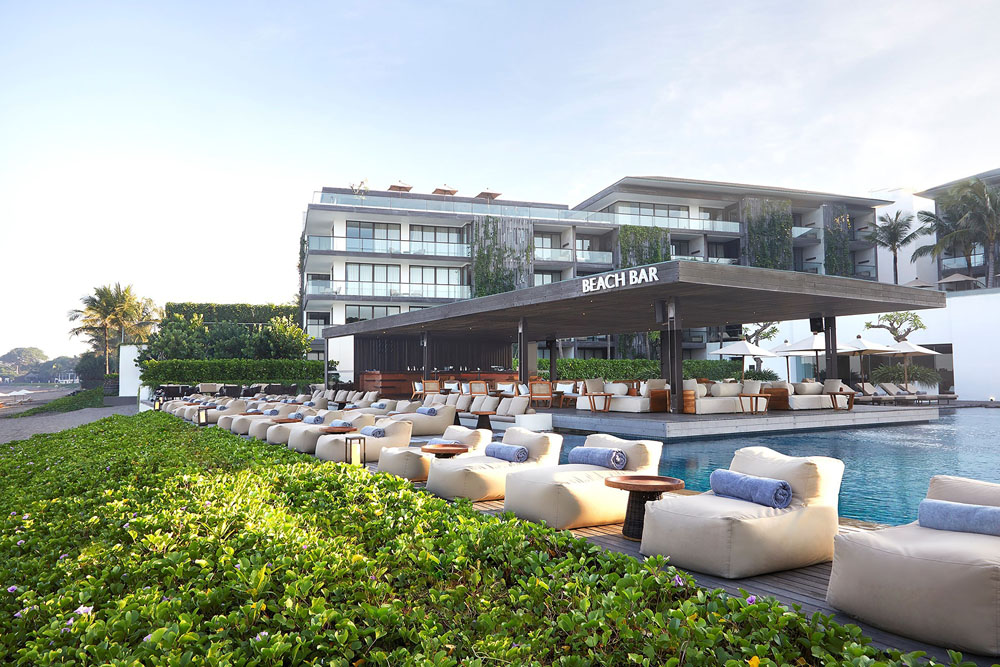
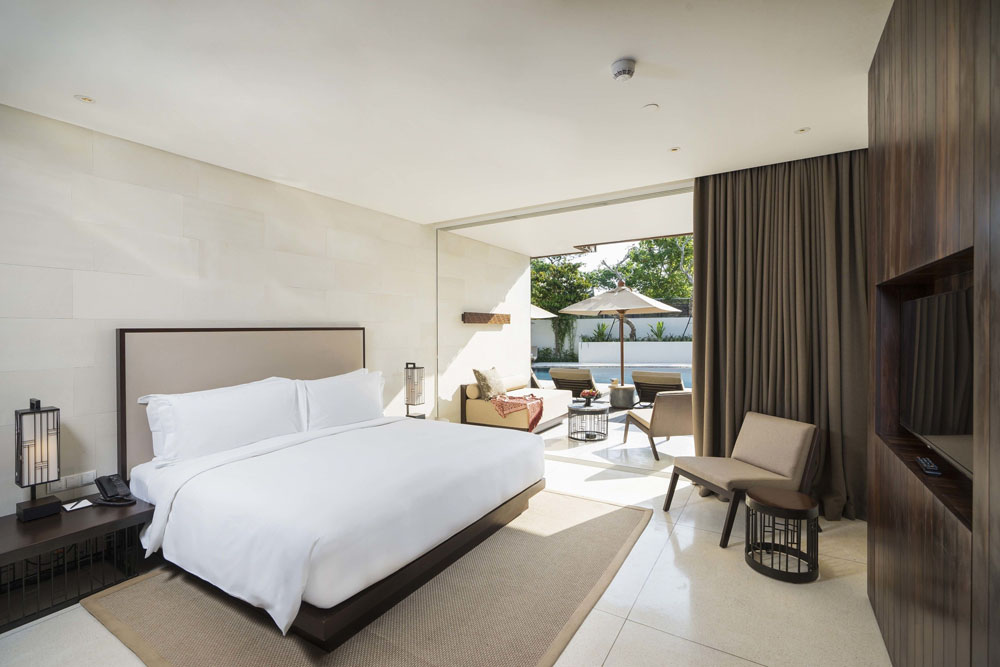
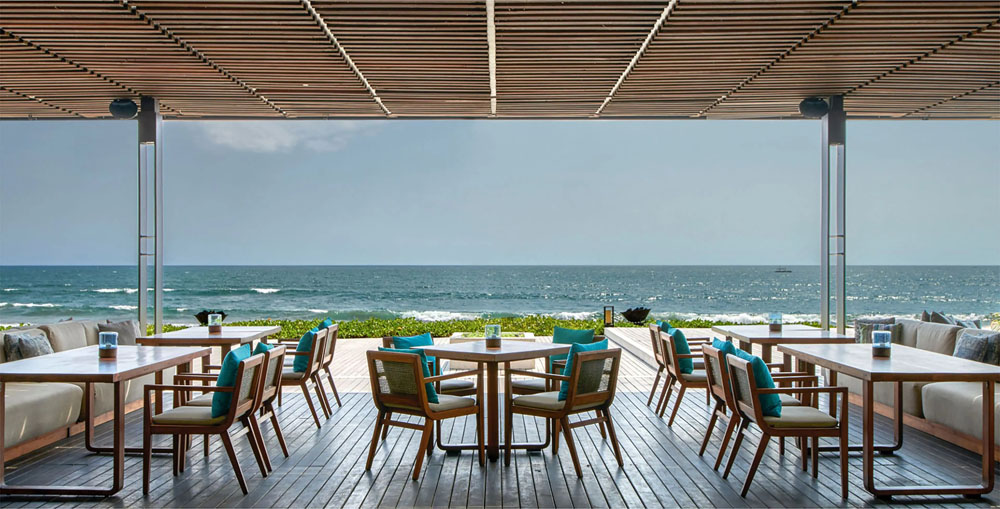
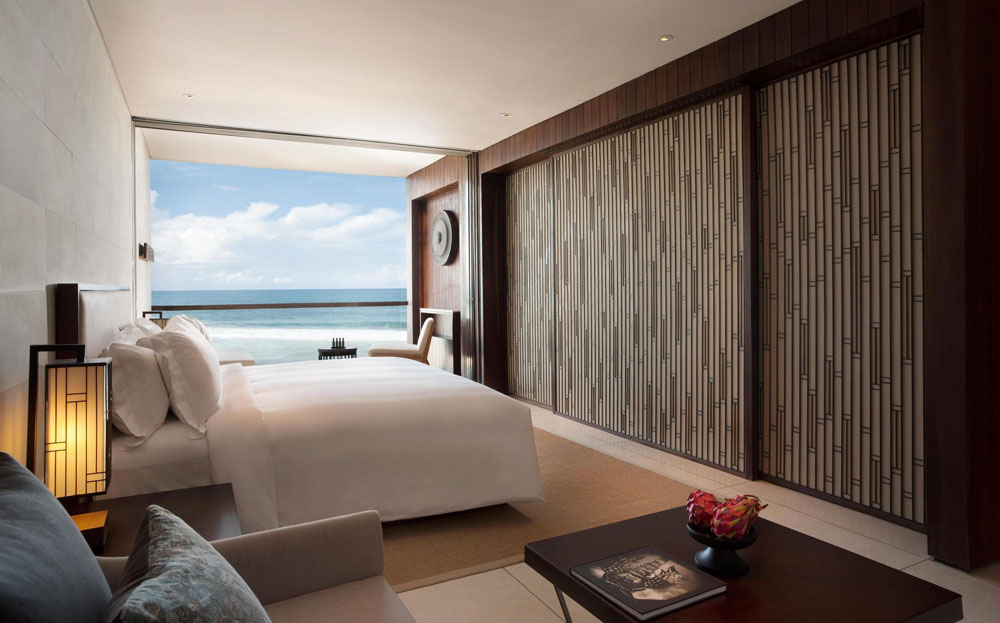
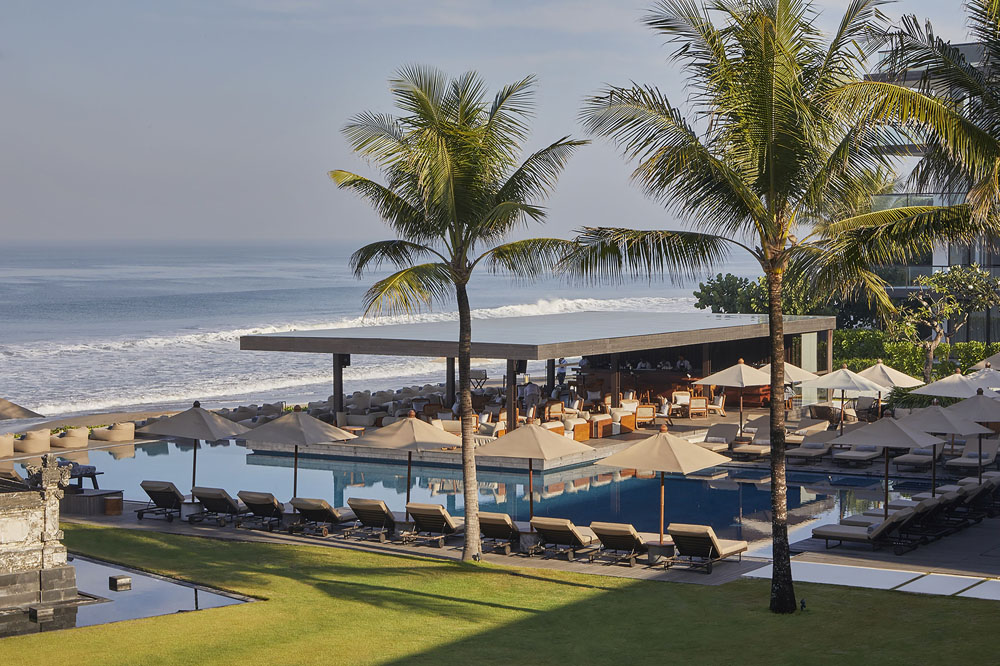
Holding the line between Seminyak's increasingly dense shoreline and the Indian Ocean's open surf, Alila Seminyak presents one of Bali's more considered attempts at contemporary beach architecture. Designed by Singapore-based WOHA Architects and completed in 2015, the four-storey building deploys broad cantilevered overhangs and deep-set glazed terraces across a facade that lets tropical vegetation colonise its surface — climbing plants softening what might otherwise read as a hard concrete gesture against the beach. The 240 rooms and villas are distributed across the main tower and a separate villa compound, the latter organised around private plunge pools visible in the images as intimate outdoor courts framed by rendered white walls and mature garden planting. Interiors by HBA Singapore work a palette of dark-stained timber, pale limestone tile, and woven rattan screen panels — the bamboo-motif sliding screens in the oceanfront rooms are a particularly deft move, filtering direct light while maintaining the Pacific horizon as the room's dominant focal point. The beach-level restaurant structure, open on three sides beneath a slatted timber ceiling, channels the breeze across weathered hardwood deck boards and teak dining chairs cushioned in teal — a deliberate contrast to the muted sand-and-espresso tones that govern the rest of the property. The infinity pool terrace, anchored by a flat-roofed beach bar pavilion, establishes the horizontal datum that ties the whole composition to the waterline.

Book with PB and get cash back
Desa Hay Canggu - Image 1
Desa Hay Canggu - Image 2
Desa Hay Canggu - Image 3
Desa Hay Canggu - Image 4
Desa Hay Canggu - Image 5

Desa Hay Canggu

Bali • Canggu • OPTIMIZE

avg. $262 / night

Includes $14 / night in cash back

Cash back is redeemable via Virtual Visa, Venmo, or bank transfer starting 24-48 hours after check-out

Desa Hay Canggu Design Editorial

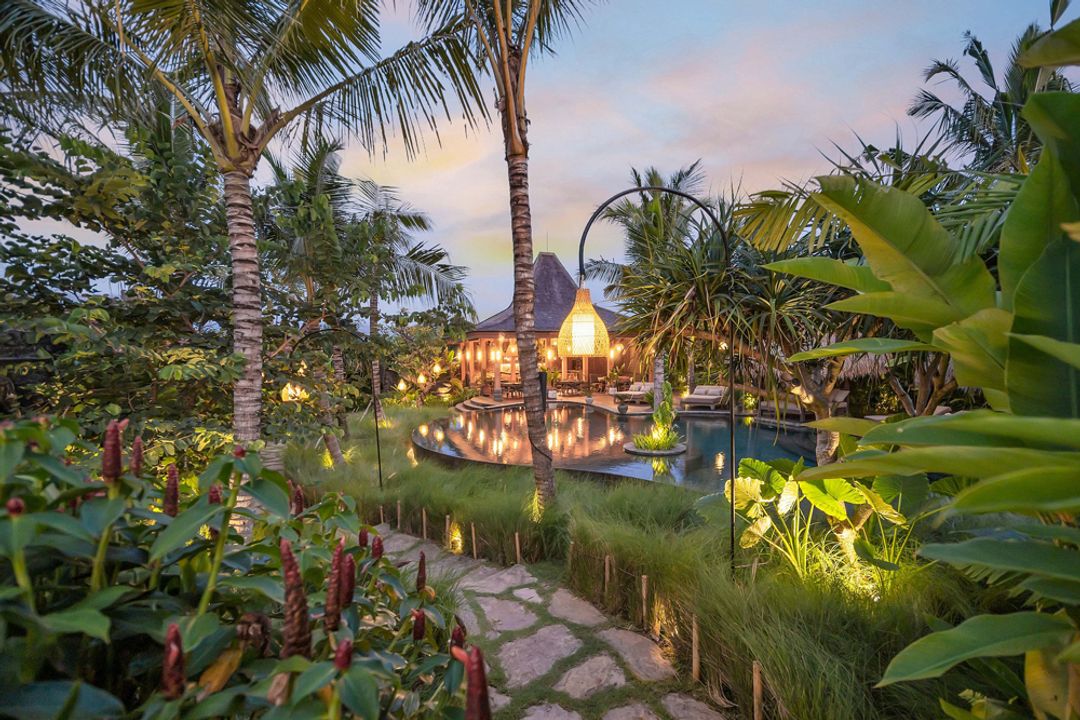
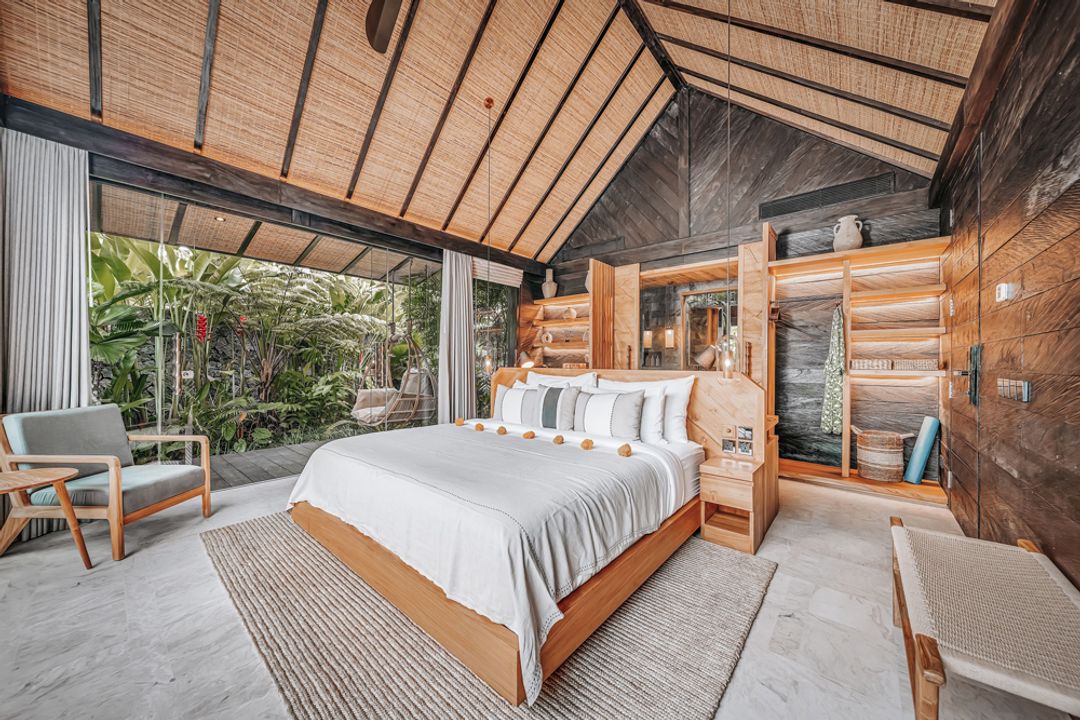
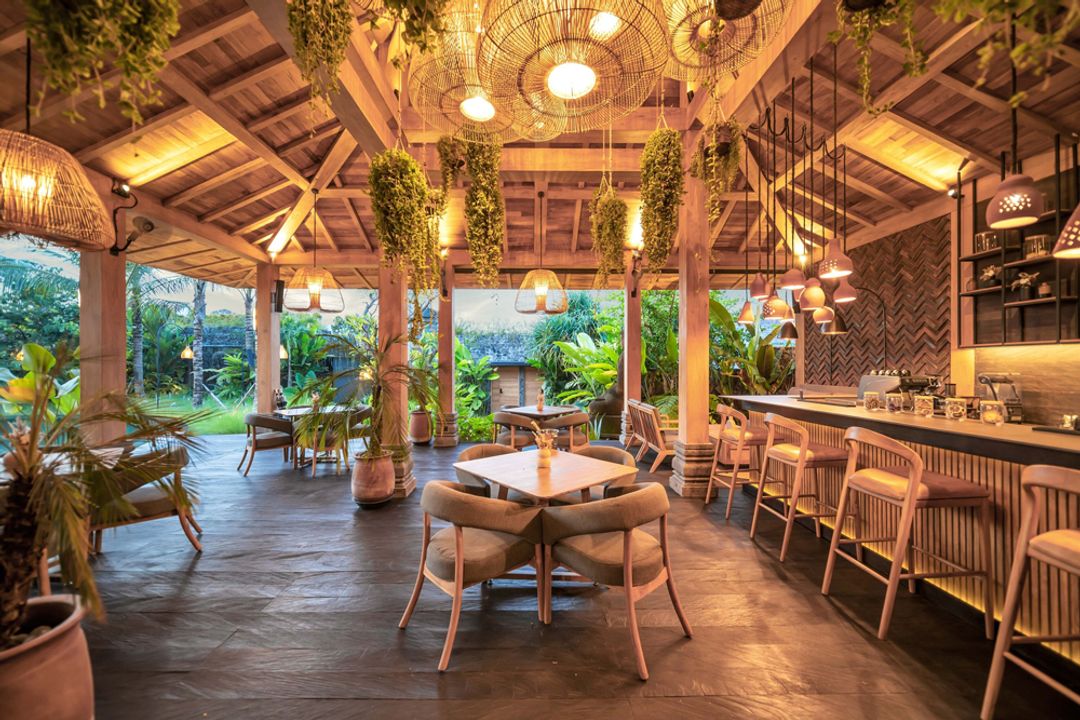
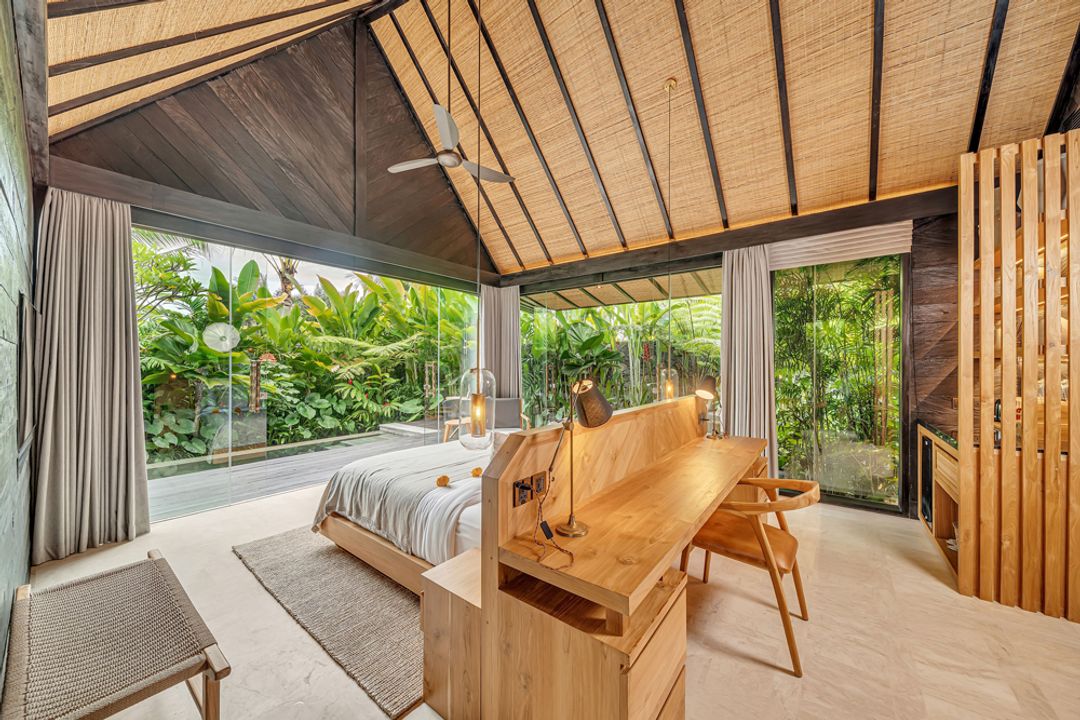
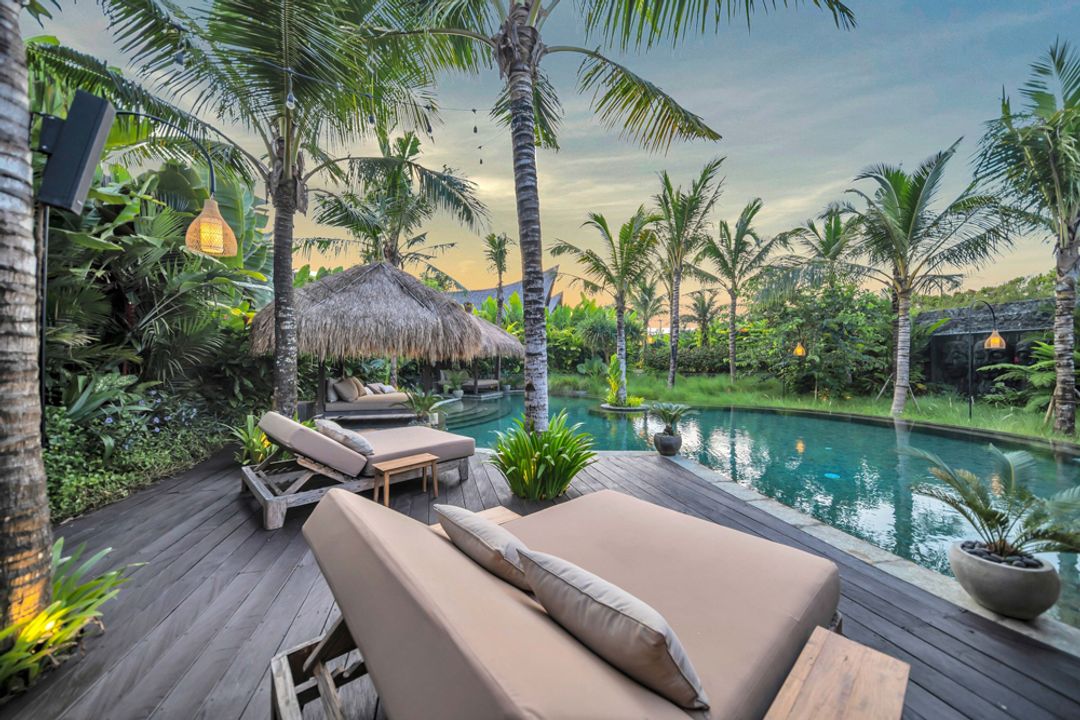
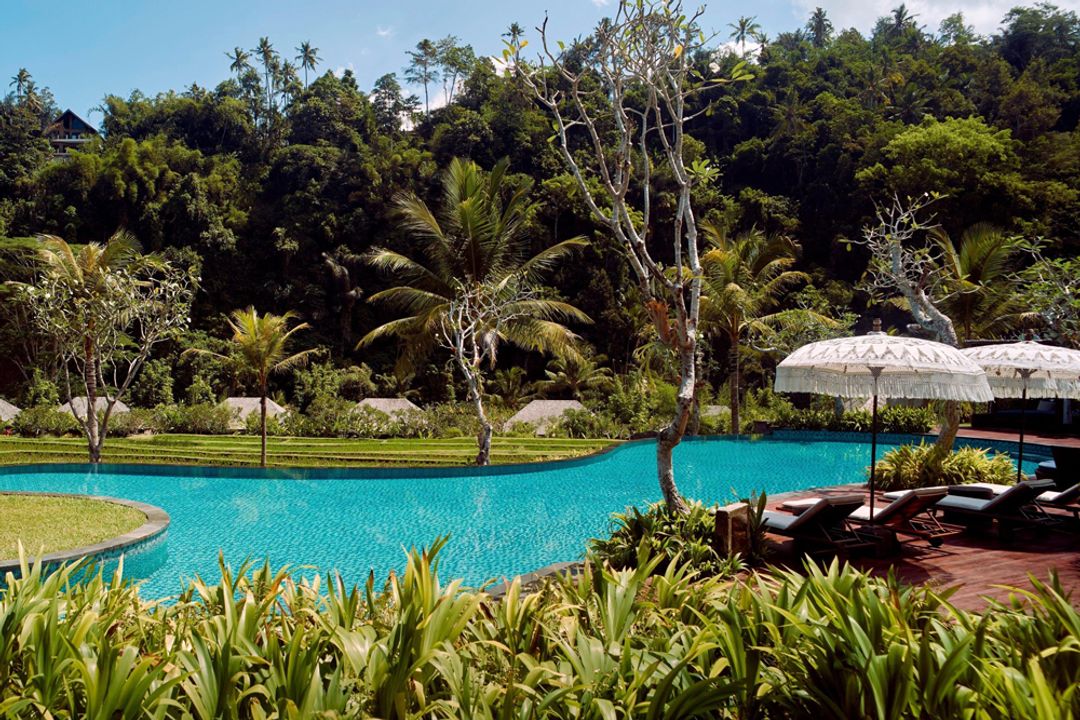
Woven deep into the coconut groves and paddy-edge gardens of Canggu's increasingly crowded creative quarter, Desa Hay announces itself not through architectural ambition but through the quality of its stillness — a compound of thatched pavilions and torched-timber villas arranged around a sinuously shaped pool that curves through tropical planting like a slow-moving river. The landscaping, dense with elephant ear, ornamental grasses, torch ginger, and mature palms, does the heaviest design work here, creating a sense of remove from the surf-town energy just beyond the garden walls. The interiors carry the same considered restraint. Bedroom pavilions are built on a steep Joglo-inspired pitch, their structural rafters lined in woven bamboo matting that absorbs both sound and afternoon heat, while floor-to-ceiling glass walls dissolve the boundary between room and garden entirely. Warm teak and reclaimed timber furnishings — platform beds, slab-top writing desks, open-shelf joinery finished in natural oil — keep the palette grounded and tactile against polished concrete floors. The open-sided restaurant takes its cue from a traditional Balinese bale, timber columns supporting an exposed truss ceiling hung with woven rattan pendants and cascading potted ferns, the bar counter clad in a herringbone-pattern dark tile that provides the one note of graphic contrast in an otherwise organic material story.

Book with PB and get cash back
The Ritz-Carlton, Bali - Image 1
The Ritz-Carlton, Bali - Image 2
The Ritz-Carlton, Bali - Image 3
The Ritz-Carlton, Bali - Image 4
The Ritz-Carlton, Bali - Image 5

The Ritz-Carlton, Bali

Bali • Nusa Dua • SPLURGE

avg. $285 / night

Includes $15 / night in cash back

Cash back is redeemable via Virtual Visa, Venmo, or bank transfer starting 24-48 hours after check-out

Marriott Bonvoy® property

The Ritz-Carlton, Bali Design Editorial

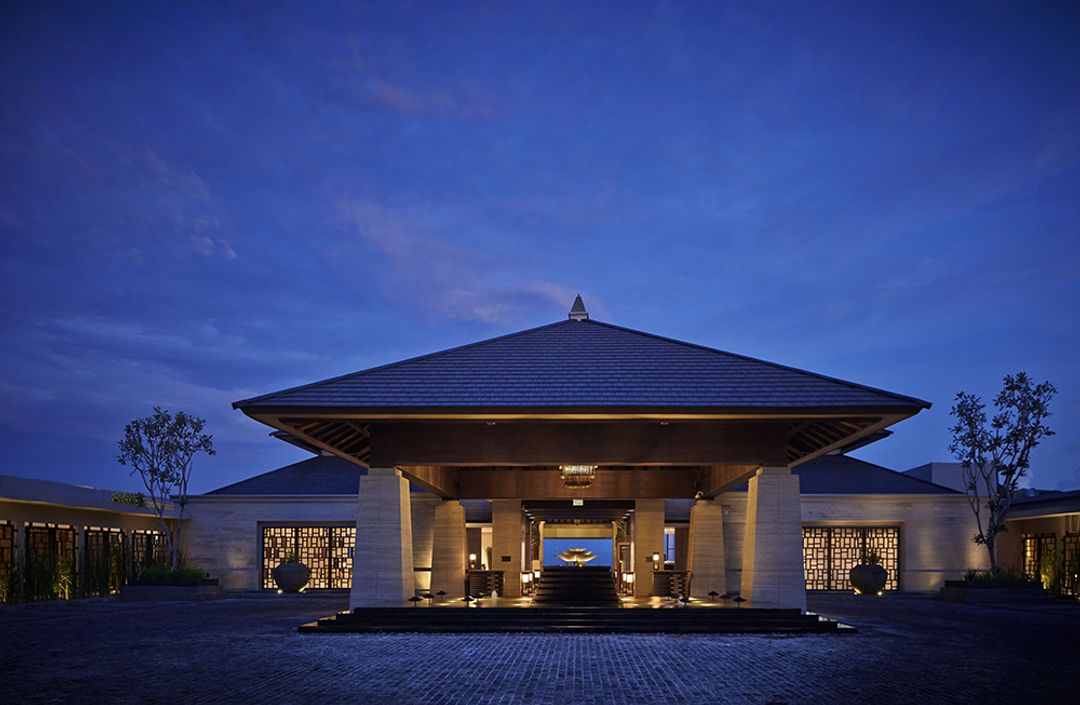
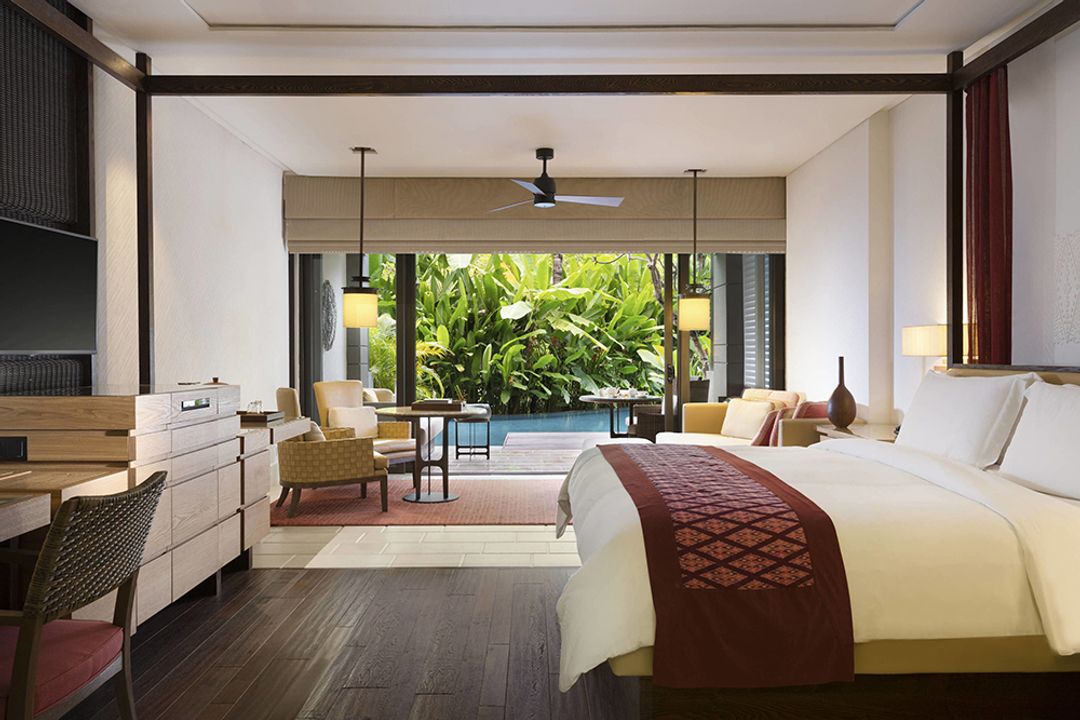
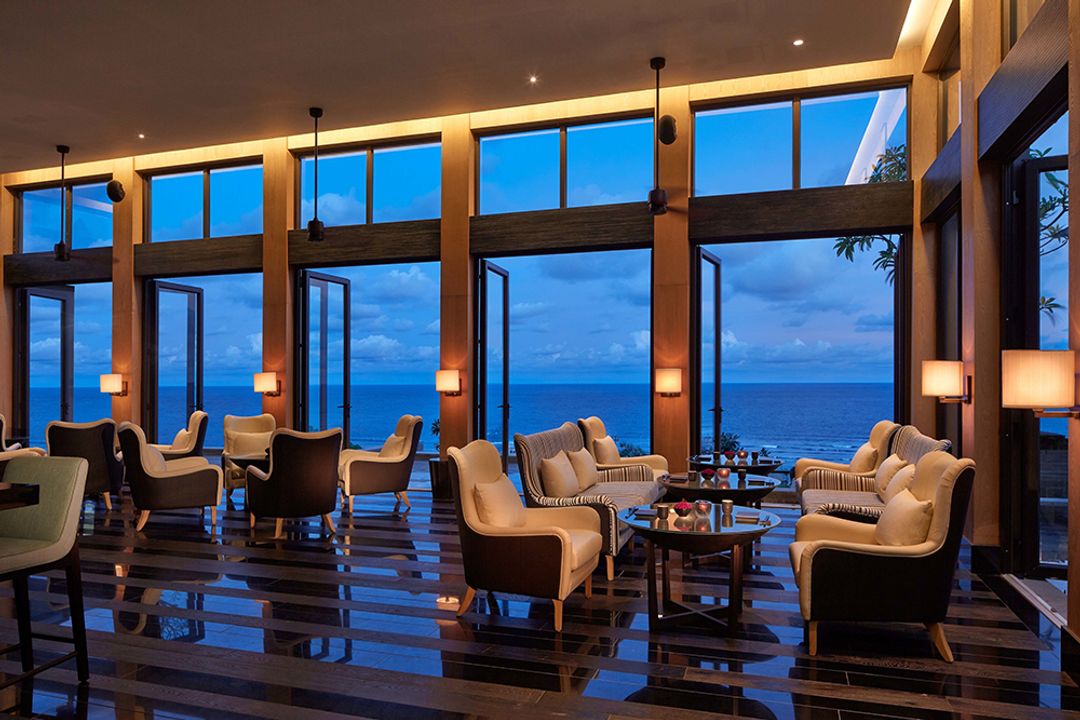
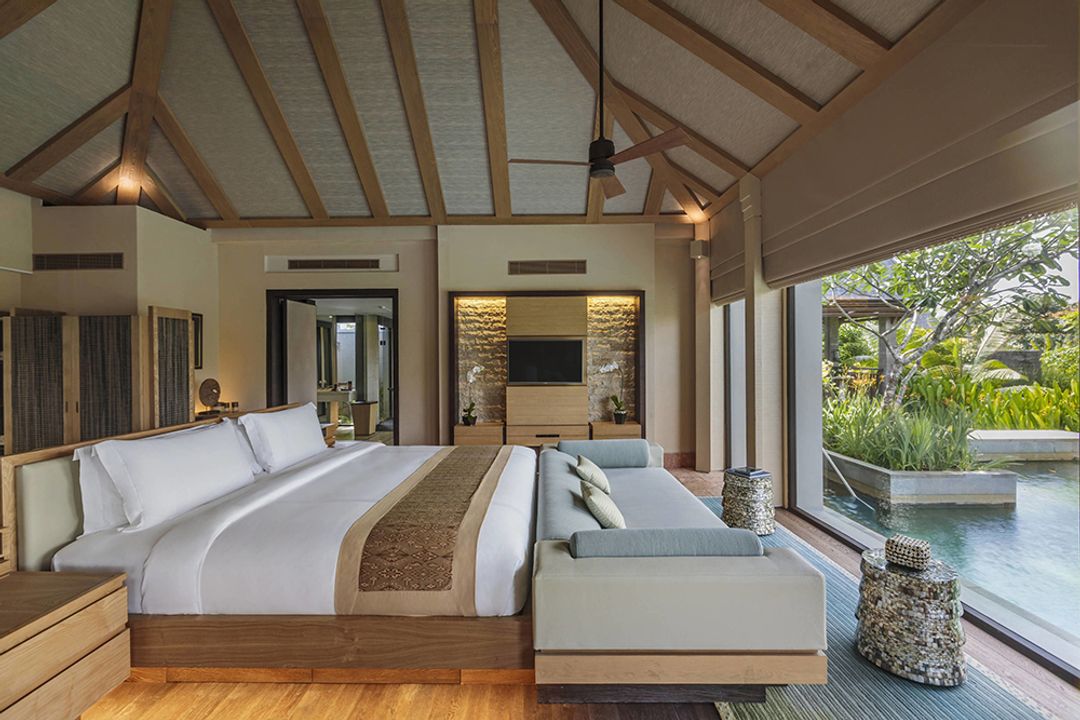
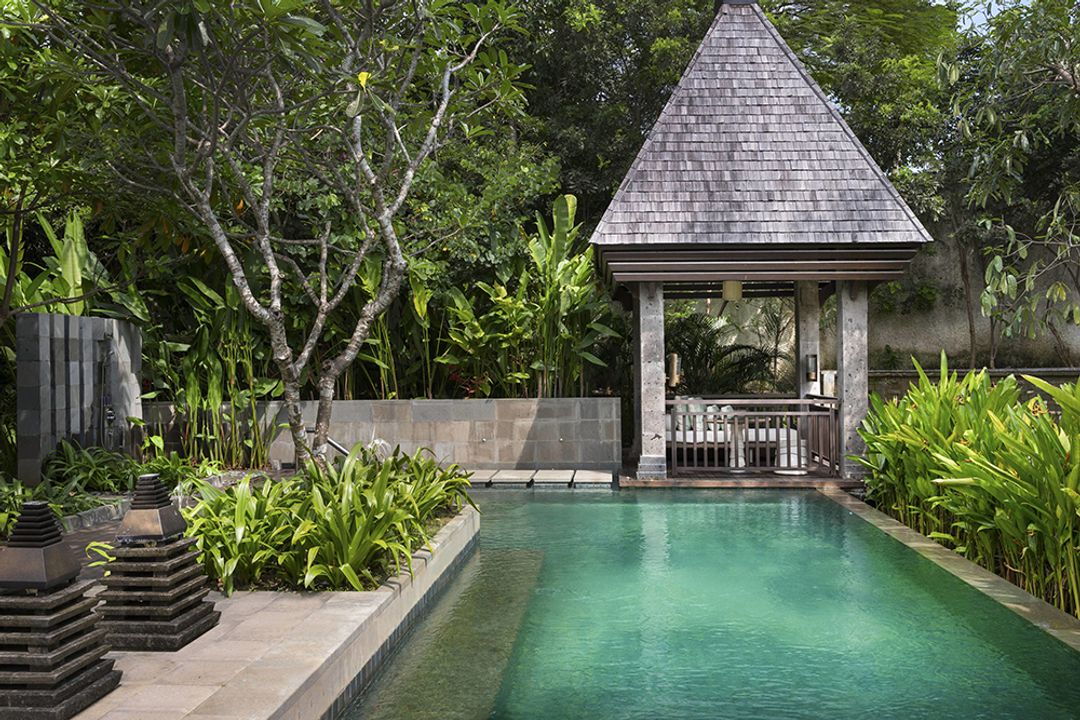
Perched on a clifftop above the Indian Ocean in Nusa Dua, where the land drops sharply toward the surf, the design brief for The Ritz-Carlton Bali asked a pointed question: how do you build a resort that references Balinese architectural tradition without lapsing into pastiche? The answer, spread across 68 pool villas and suites set within lushly planted grounds, lies in structural sincerity. The porte-cochère announces the approach clearly — a broad, hipped roof with a finial apex carried on paired stone columns, the silhouette drawn directly from traditional Balinese pavilion forms but rendered at resort scale without apology. The interiors calibrate a similar tension, moving between two registers depending on the accommodation type. In the hotel rooms, dark-stained timber four-poster frames against white-plastered walls give way to sliding glass panels and private plunge pools surrounded by tropical planting — heliconia and banana leaf pressing close enough to feel genuinely immersive. The villa category goes further still, with soaring exposed timber roof trusses, woven ceiling panels, and mosaic-topped side tables that reference local craft traditions. The clifftop bar delivers the property's most arresting spatial moment: floor-to-ceiling pivot-hinged glazed panels fold entirely open toward the ocean, a polished stone-striped floor reflecting the last of the evening light back toward upholstered lounge chairs in cream and dark chocolate — the effect closer to an elevated private residence than a conventional hotel bar.

Book with PB and get cash back
COMO Uma Ubud - Image 1
COMO Uma Ubud - Image 2
COMO Uma Ubud - Image 3
COMO Uma Ubud - Image 4
COMO Uma Ubud - Image 5

COMO Uma Ubud

Bali • Ubud • SPLURGE

avg. $336 / night

Includes $18 / night in cash back

Cash back is redeemable via Virtual Visa, Venmo, or bank transfer starting 24-48 hours after check-out

COMO Uma Ubud Design Editorial

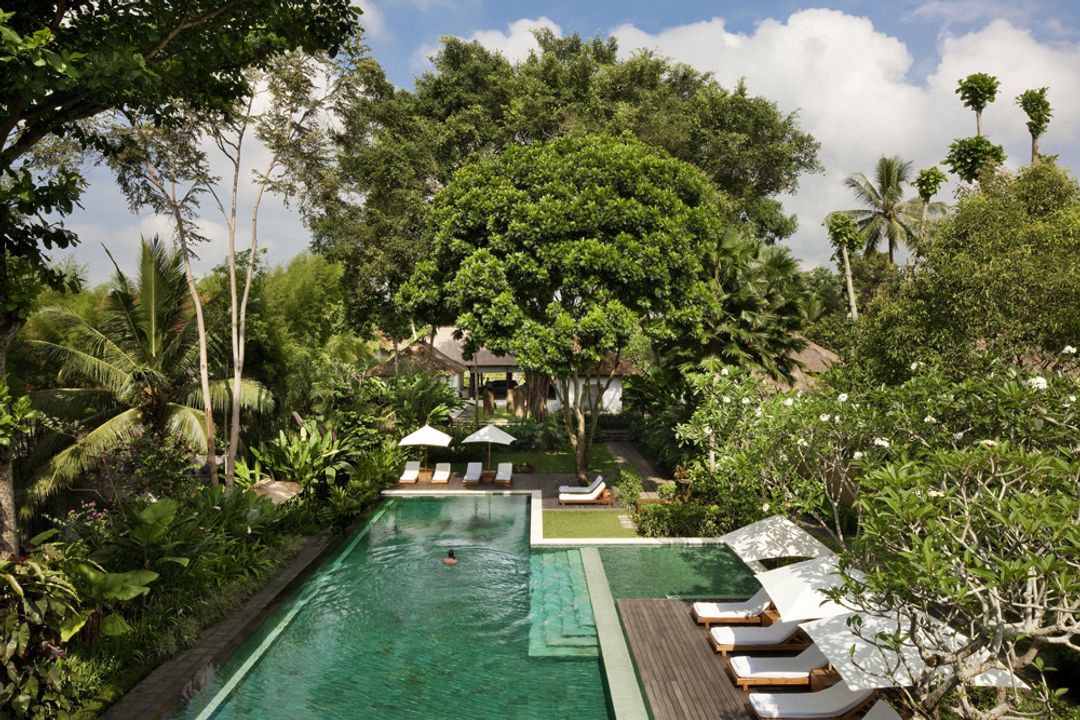
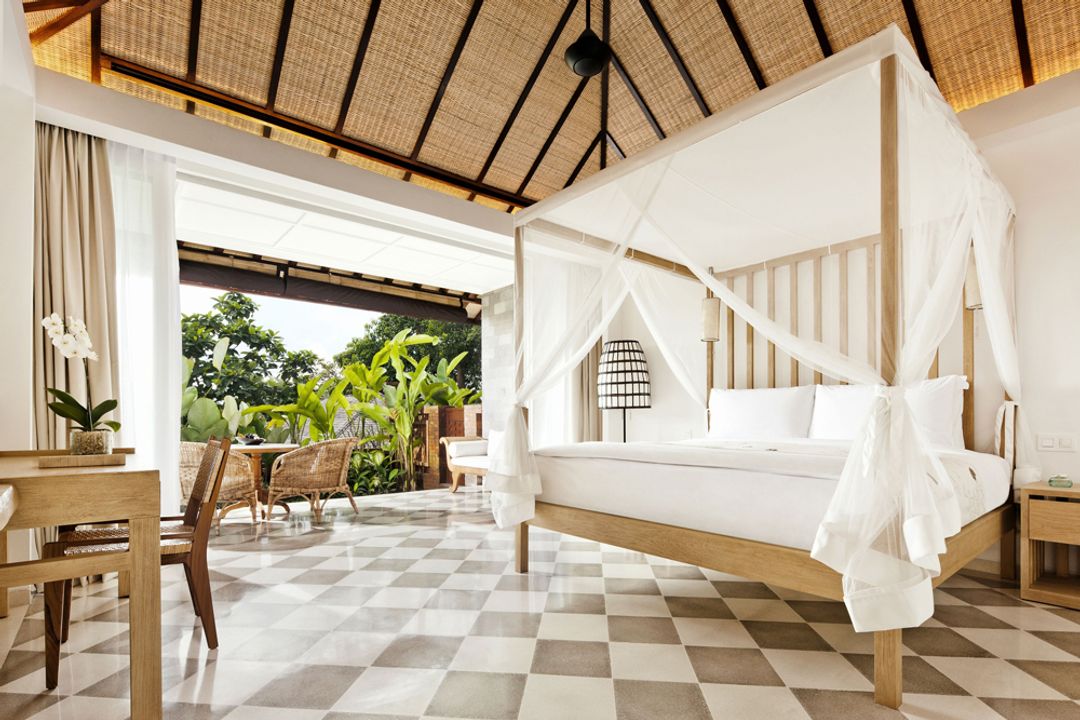
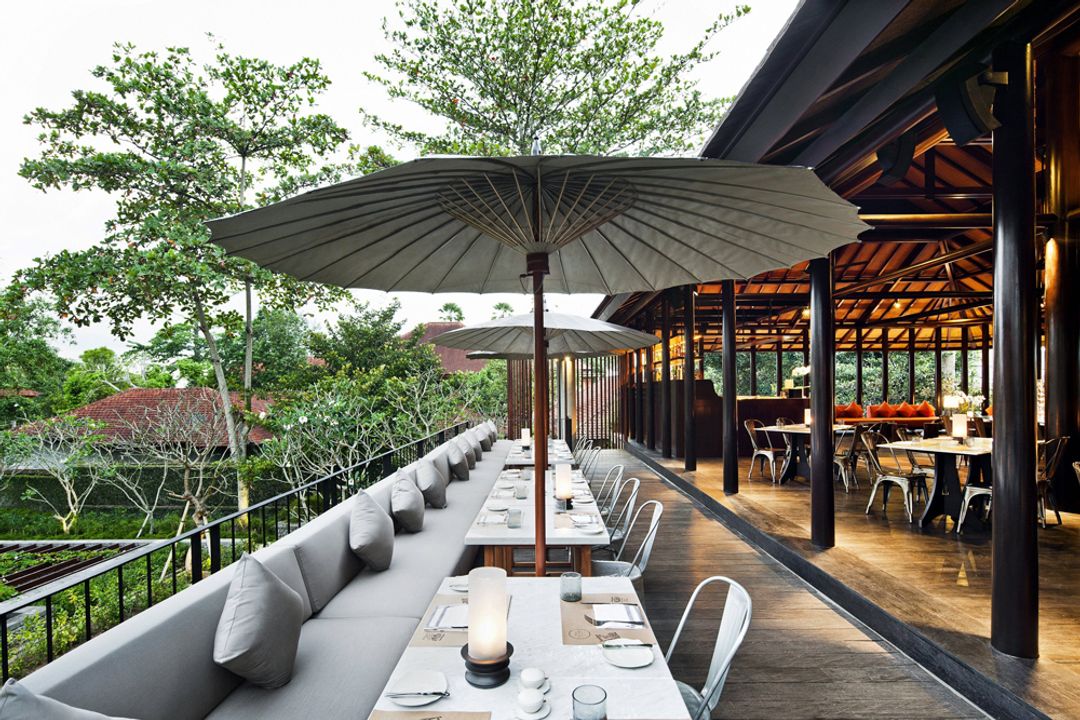
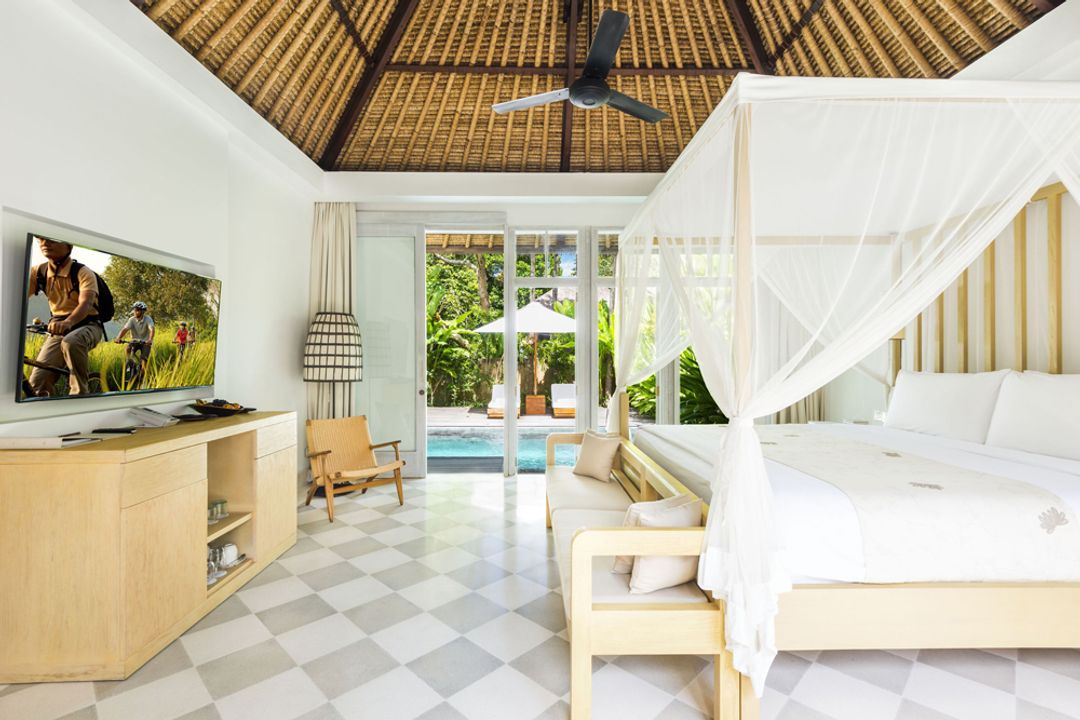
Perched above a river valley on the forested edges of Ubud, where the cultural heartland of Bali gives way to terraced rice fields and dense tropical canopy, COMO Uma Ubud was conceived as a village rather than a hotel — a loose arrangement of pavilions, villas, and open-sided bales that mirrors the compound logic of traditional Balinese domestic architecture. COMO Hotels worked with local design sensibilities to produce something that feels neither imported nor imitative: the alang-alang thatched roofs and deep timber columns of the main restaurant pavilion are authentically regional in structure, while the interiors apply a contemporary restraint that keeps the whole from tipping into pastiche. The 46 rooms and villas carry that discipline through consistently. Checkerboard-patterned cement tile floors in muted grey and white anchor each space with quiet geometry, while bleached timber four-poster beds draped in white voile muslin work in deliberate counterpoint to the woven bamboo ceilings overhead. Rattan loungers and teak bench seats, stripped of ornament, give the rooms an atmosphere closer to a considered private residence than to conventional resort design. The main pool cuts a long reflective lane through dense plantings of frangipani, banana palms, and tropical broadleaf — the garden managing its exuberance with just enough restraint. At the open-terrace restaurant, a continuous banquette in dove-grey upholstery lines the balcony rail, the tree canopy beyond functioning as both backdrop and boundary.

Book with PB and get cash back
La Reserve 1785 - Image 1
La Reserve 1785 - Image 2
La Reserve 1785 - Image 3
La Reserve 1785 - Image 4
La Reserve 1785 - Image 5

La Reserve 1785

Bali • Canggu • SPLURGE

avg. $407 / night

Includes $21 / night in cash back

Cash back is redeemable via Virtual Visa, Venmo, or bank transfer starting 24-48 hours after check-out

Hilton Honors™ property

La Reserve 1785 Design Editorial

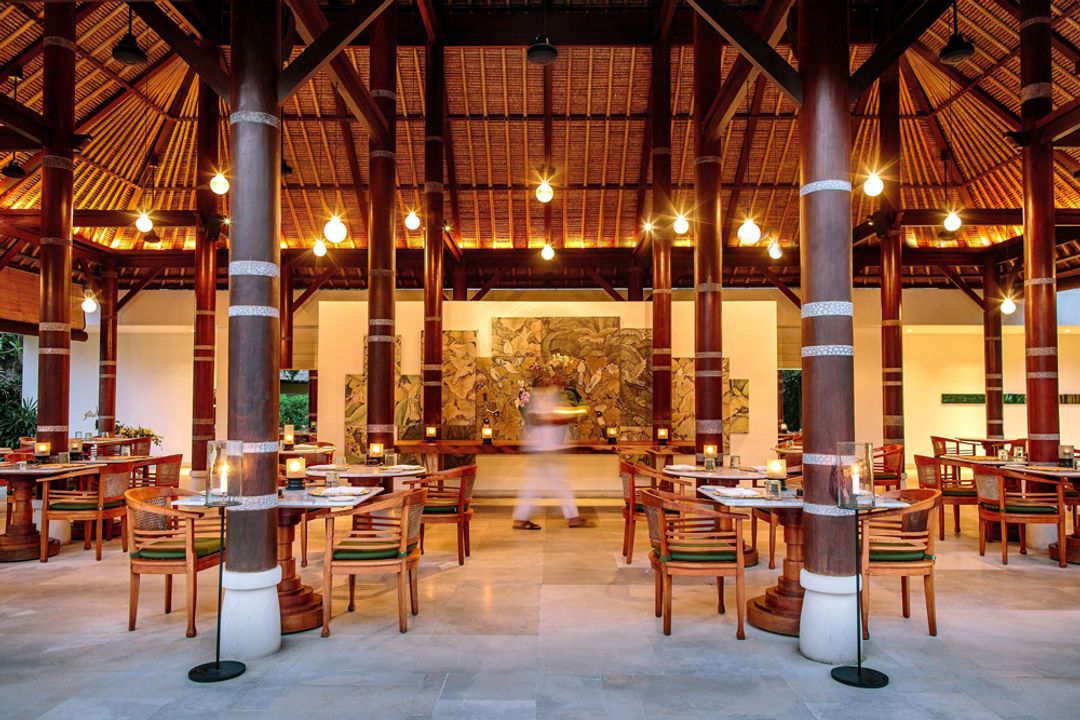
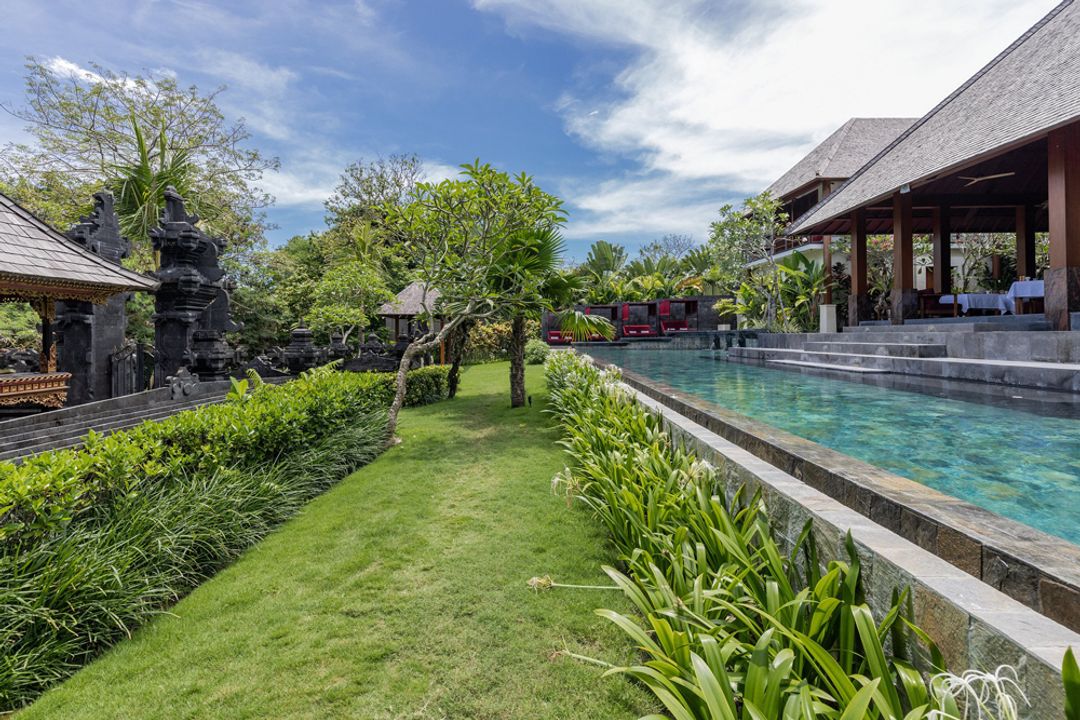
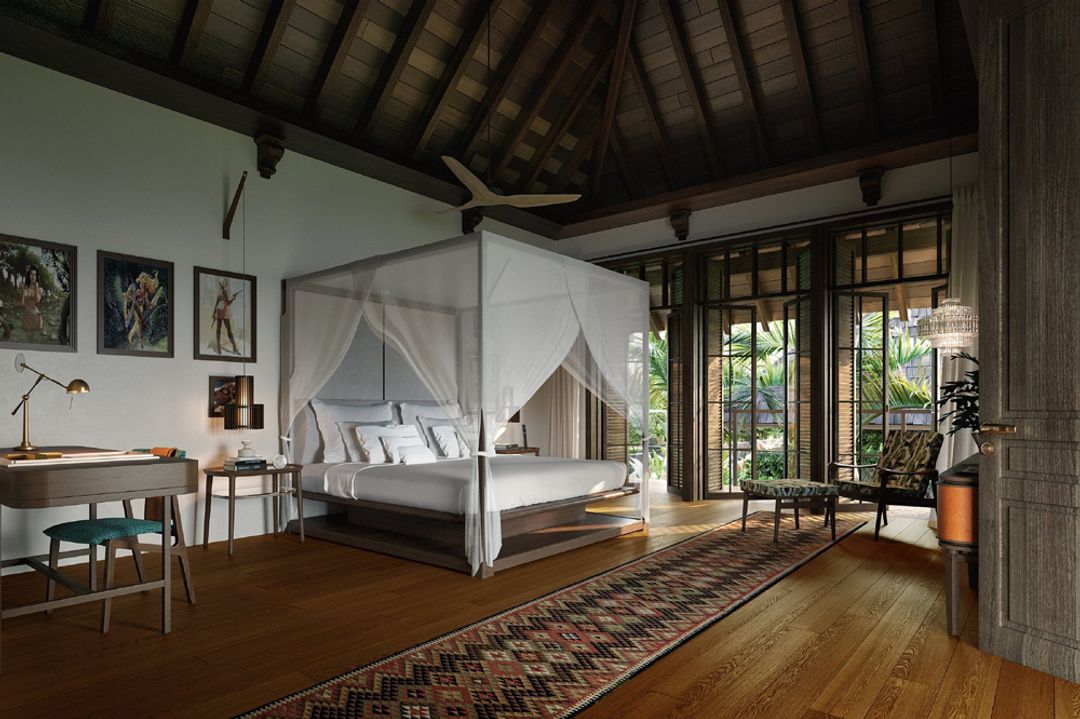
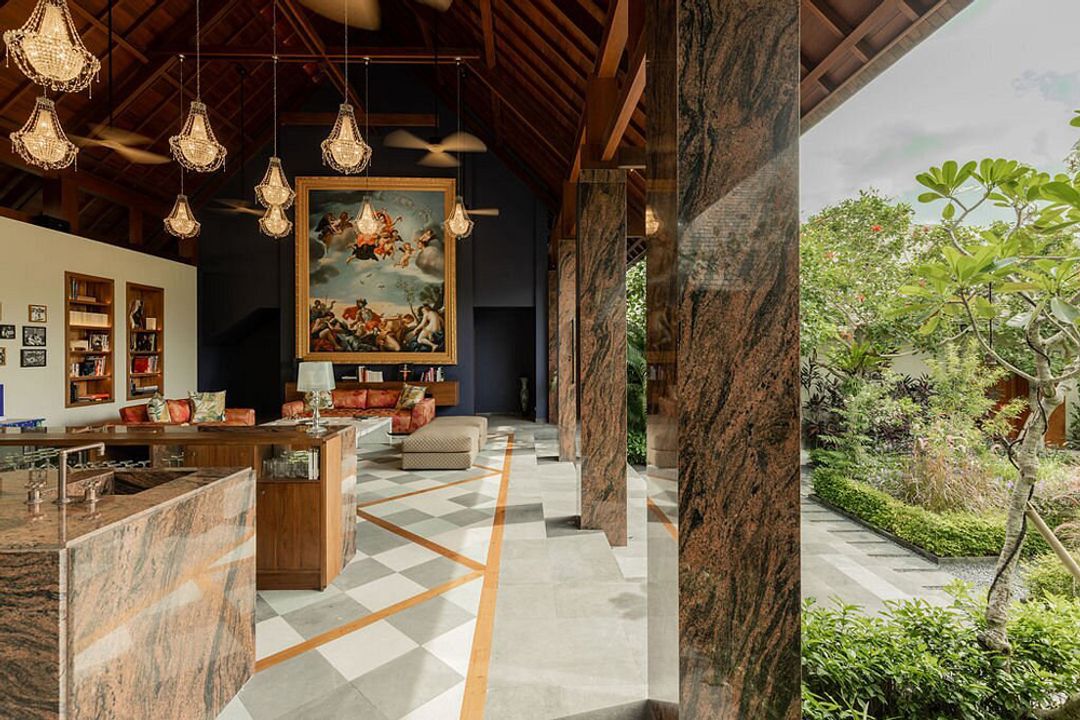
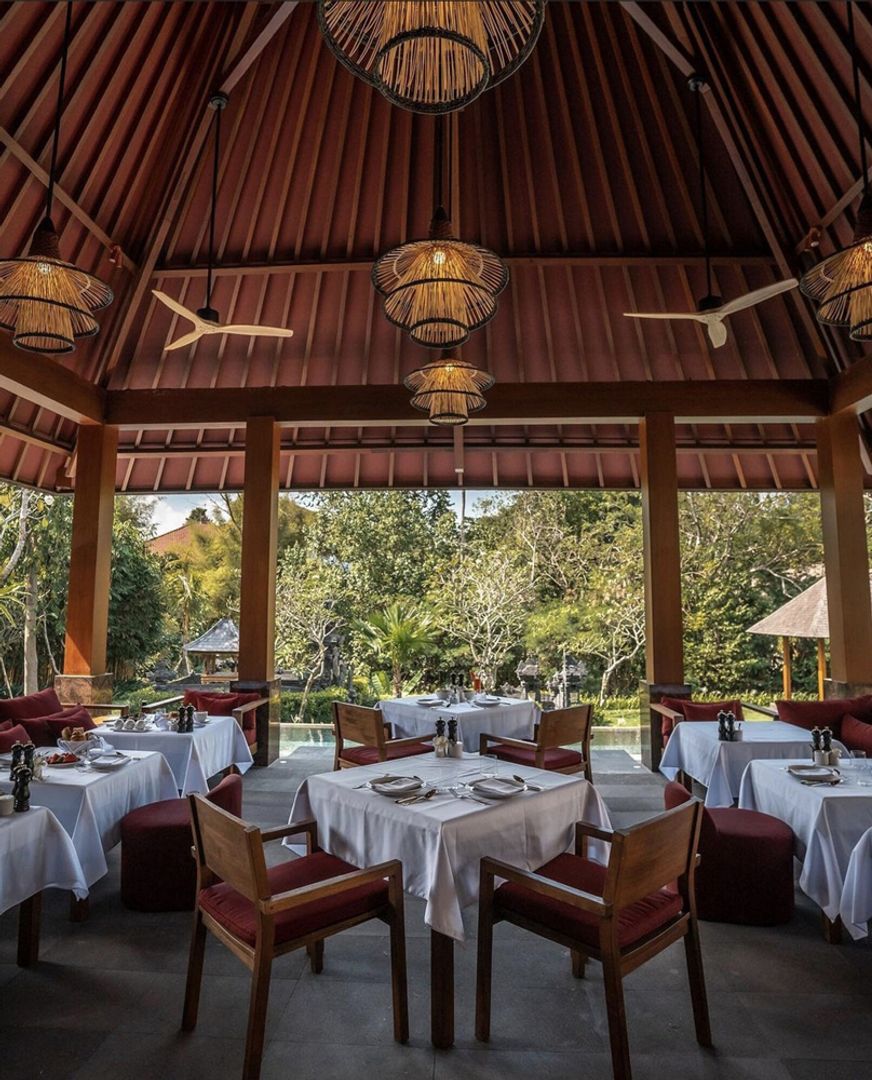
Collision is the operative word at La Réserve 1785 — a Canggu property that sets Balinese vernacular architecture in deliberate conversation with European decorative excess. Where most of the island's luxury hotels reach for a kind of reverent minimalism, this one hangs a large gilt-framed Baroque ceiling painting beneath hand-hewn timber trusses, surrounds it with crystal chandelier drops and veined Indian granite columns, and treats the juxtaposition not as contradiction but as curatorial intent. The reception pavilion's checkerboard floor inlaid with terracotta-toned stone bands anchors the visual drama, while the gardens beyond are laid out with the clipped formality of plumeria allées and reflecting pools edged in dark volcanic paras stone — the black split-gate candi bentar at the garden boundary a genuine gesture toward Balinese sacred architecture rather than resort pastiche. Guest pavilions shelter under steeply pitched alang-alang and timber roofs, the interiors furnished with white mosquito-canopied four-poster beds on wide-plank hardwood floors, geometric kilim runners, and a mix of brass task lighting and faceted crystal pendants that keeps the rooms from tipping into either pure tropicalia or studied European eclecticism. The restaurant pavilion, open on three sides to the pool and gardens, is structured around a traditional meru-derived octagonal roof with woven rattan pendant lights layered at different heights — simple enough framing for a dining room that lets the surrounding garden do the atmospheric work.

Book with PB and get cash back
The St. Regis Bali Resort - Image 1
The St. Regis Bali Resort - Image 2
The St. Regis Bali Resort - Image 3
The St. Regis Bali Resort - Image 4
The St. Regis Bali Resort - Image 5

The St. Regis Bali Resort

Bali • Nusa Dua • SPLURGE

avg. $487 / night

Includes $26 / night in cash back

Cash back is redeemable via Virtual Visa, Venmo, or bank transfer starting 24-48 hours after check-out

Marriott Bonvoy® property

The St. Regis Bali Resort Design Editorial

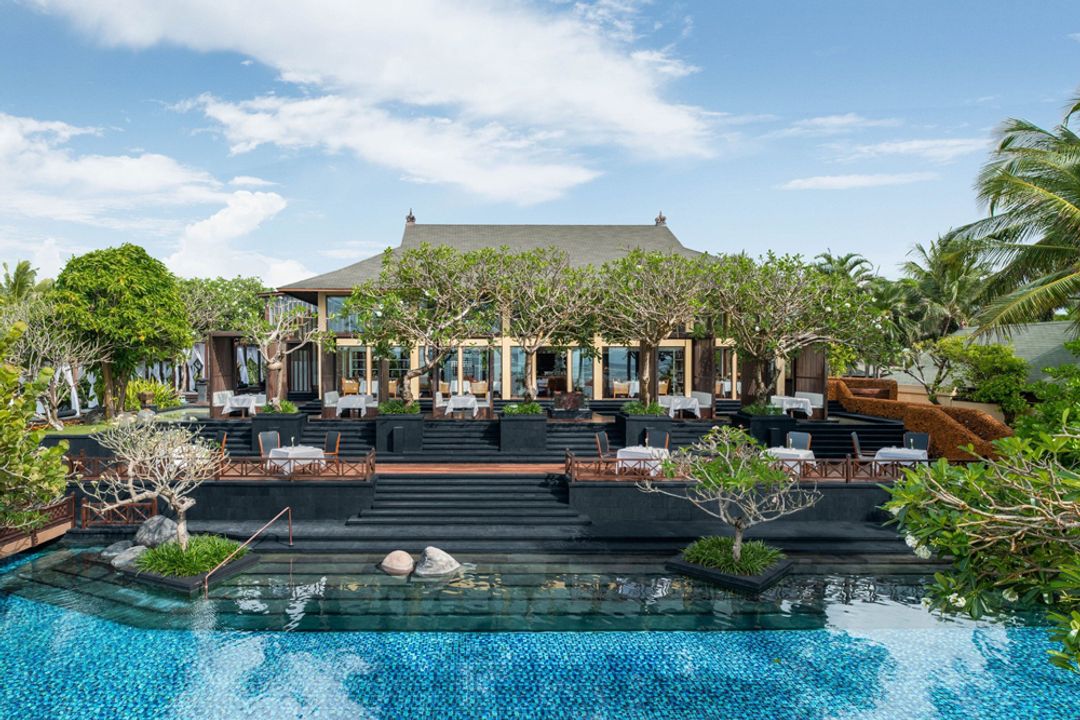
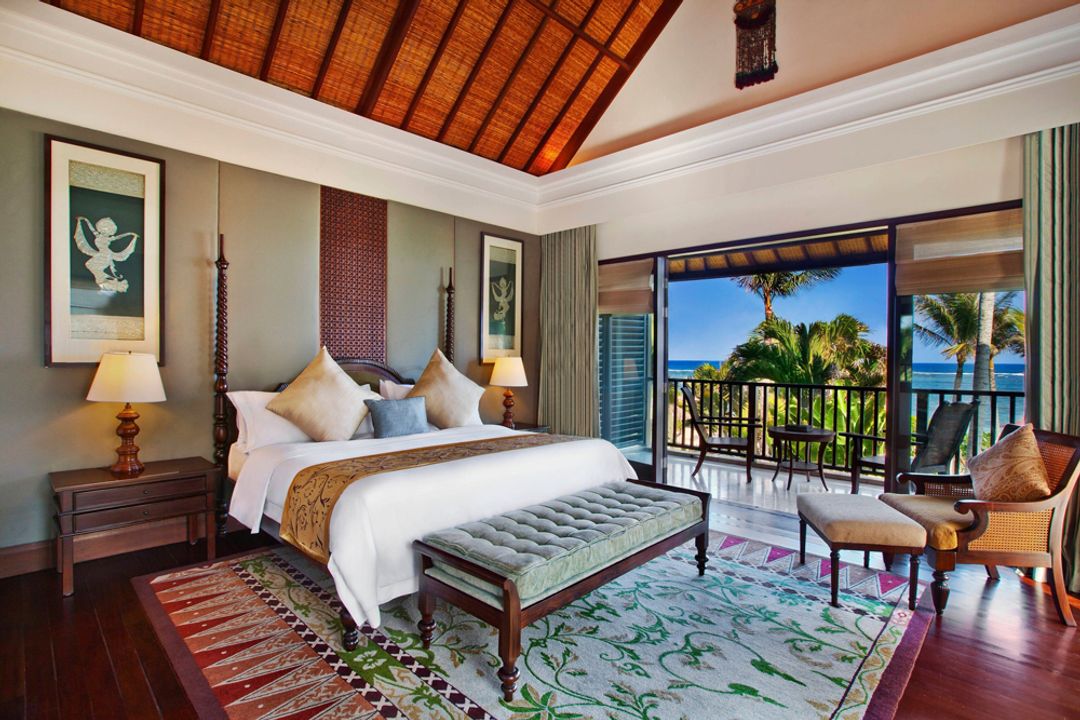
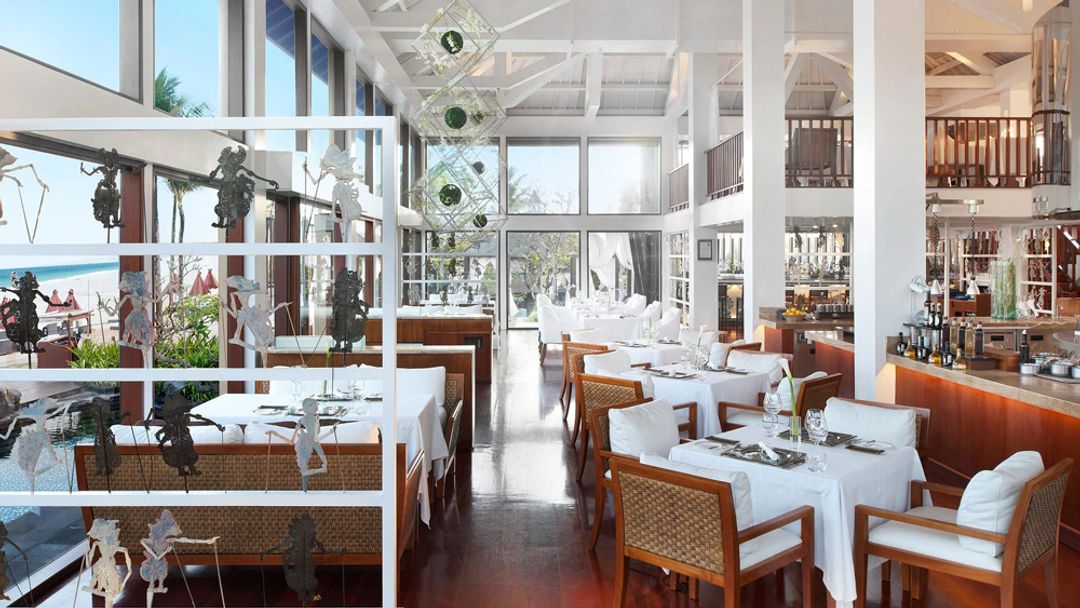
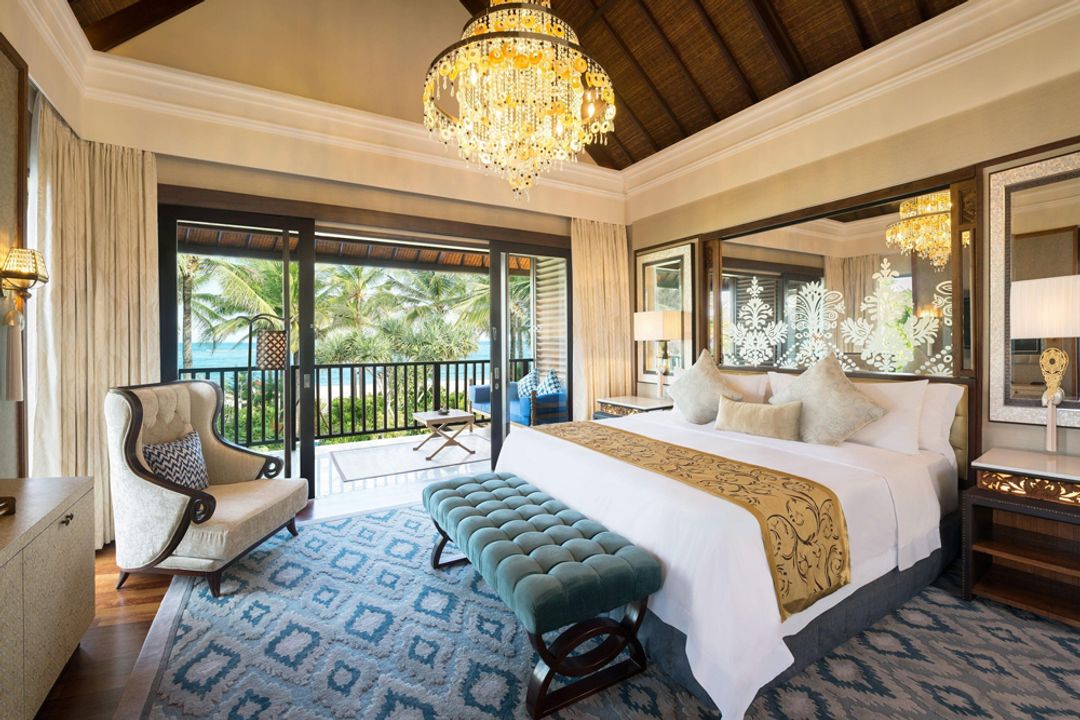
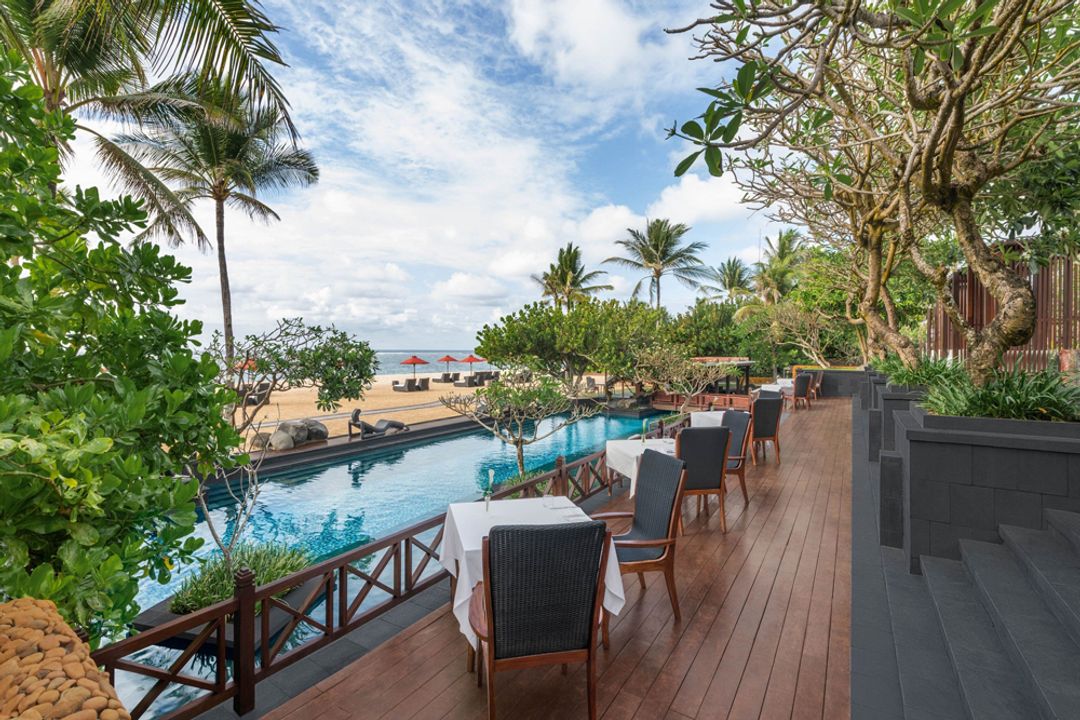
Balinese craftsmanship and the formal conventions of a St. Regis address make an unlikely but convincing alliance along the white-sand coastline of Nusa Dua. The St. Regis Bali Resort, which opened in 2008 across eleven hectares of beachfront gardens, resolves that tension through architecture that takes traditional alang-alang thatching and steeply pitched joglo-influenced rooflines seriously as structural grammar rather than decorative gesture. The landscaping, dense with frangipani, coconut palms, and mature tropical planting, gives the resort the feeling of a private estate that has been there considerably longer than it has — pools edged in dark volcanic stone descending in terraced steps toward the beach, red-umbrellaed sun loungers glimpsed through foliage rather than arranged in institutional rows. Inside, the 123 suites and villas move between two registers. Some rooms carry the warmth of hand-carved dark timber four-poster beds, woven bamboo ceiling panels, floral batik-printed rugs, and wayang kulit shadow puppet figures worked into room dividers — a thoroughly Balinese vocabulary applied with considerable care. Others shift toward a more international luxury idiom: tufted velvet ottomans in teal, gilded chandeliers dripping above woven-grass ceilings, etched mirror panels behind the headboard. The beachfront restaurant maintains the balance most successfully, floor-to-ceiling glazing flooding a white-painted double-height dining room with Indian Ocean light while traditional Javanese shadow puppets hang as sculptural screens between tables.

Book with PB and get cash back
COMO Shambhala Estate - Image 1
COMO Shambhala Estate - Image 2
COMO Shambhala Estate - Image 3
COMO Shambhala Estate - Image 4
COMO Shambhala Estate - Image 5

COMO Shambhala Estate

Bali • Ubud • SPLURGE

avg. $519 / night

Includes $27 / night in cash back

Cash back is redeemable via Virtual Visa, Venmo, or bank transfer starting 24-48 hours after check-out

COMO Shambhala Estate Design Editorial

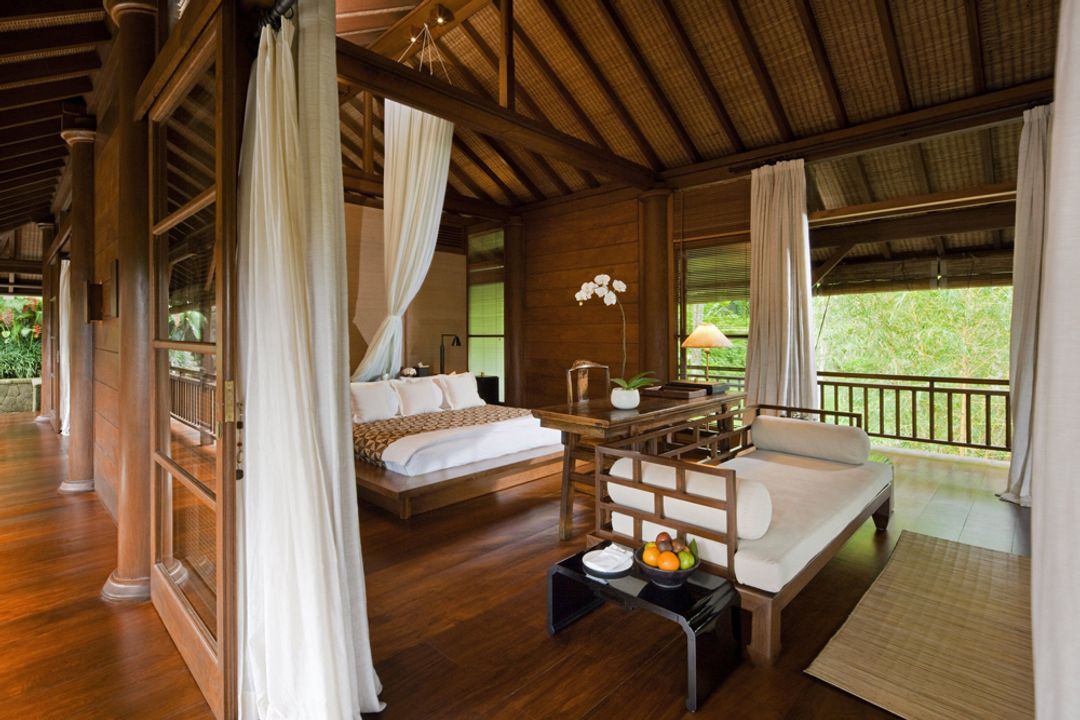
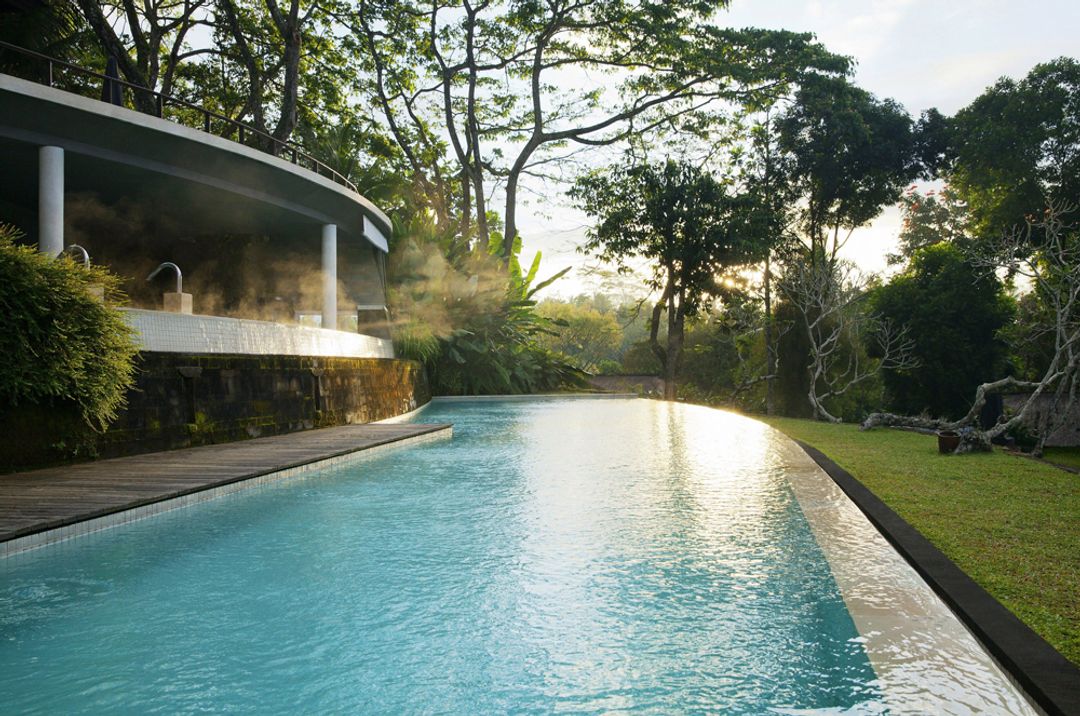
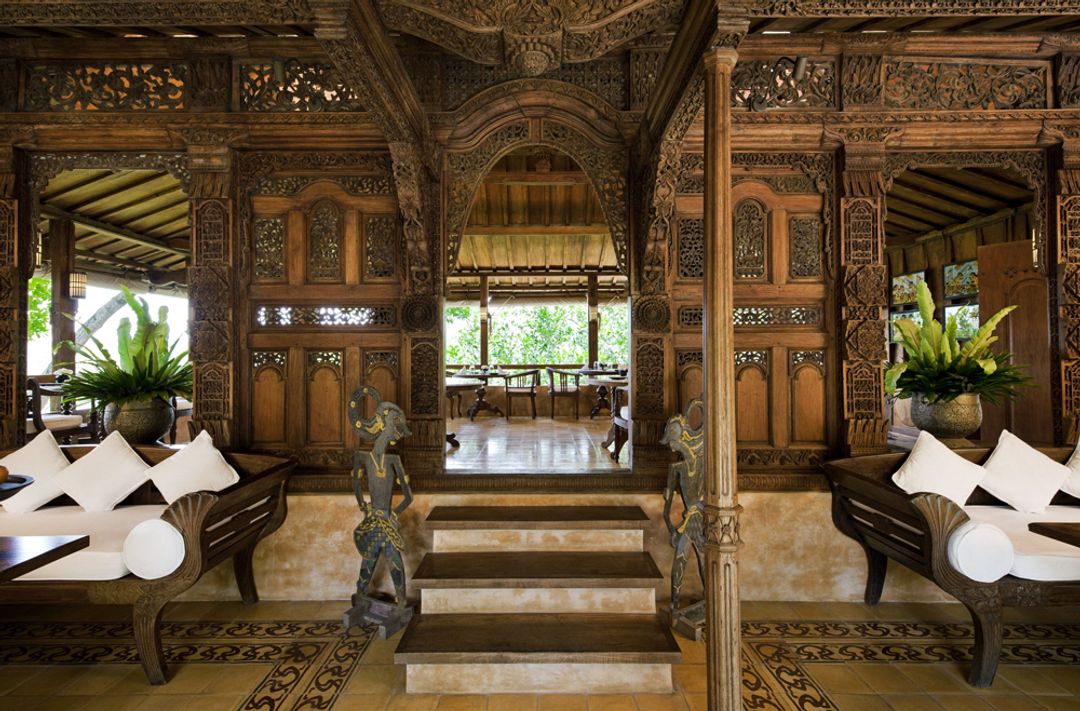
Carved into a steep river valley above Ubud, where the Ayung gorge cuts through the jungle at the heart of Bali, COMO Shambhala Estate was conceived not as a conventional hotel but as a residential wellness retreat built around the landscape itself. Architect Cheong Yew Kuan and interior designer Koichiro Ikebuchi shaped the 25-villa property — opened in 2005 — around the contours of the hillside, dispersing thatched-roof pavilions through eight hectares of tropical garden rather than imposing any unified formal plan. The carved Javanese joglo structures visible in the images are antique pieces, some centuries old, transplanted to the site and integrated into gathering spaces where dense teak fretwork screens frame views through to the jungle beyond. The guest villas draw on the same vernacular — polished ironwood floors, woven bamboo ceiling panels, open-sided verandahs suspended above the canopy — while keeping furnishings deliberately spare: low timber daybed frames, white linen canopy beds, and batik-trimmed bedding that registers as restraint rather than austerity. The curved lap pool at the property's wellness centre, its white-tiled basin catching morning mist off the valley, signals a different architectural register entirely — more modernist in plan, its cantilevered roof supported on cylindrical columns that step cleanly away from the surrounding organic abundance. Water runs throughout the grounds in long stone-edged channels bordered by frangipani, pulling the whole composition into a slow, meditative rhythm that is the estate's defining quality.

Book with PB and get cash back
Four Seasons Bali at Jimbaran Bay - Image 1
Four Seasons Bali at Jimbaran Bay - Image 2
Four Seasons Bali at Jimbaran Bay - Image 3
Four Seasons Bali at Jimbaran Bay - Image 4
Four Seasons Bali at Jimbaran Bay - Image 5

Four Seasons Bali at Jimbaran Bay

Bali • Jimbaran Bay • SPLURGE

avg. $565 / night

Includes $30 / night in cash back

Cash back is redeemable via Virtual Visa, Venmo, or bank transfer starting 24-48 hours after check-out

Four Seasons Bali at Jimbaran Bay Design Editorial

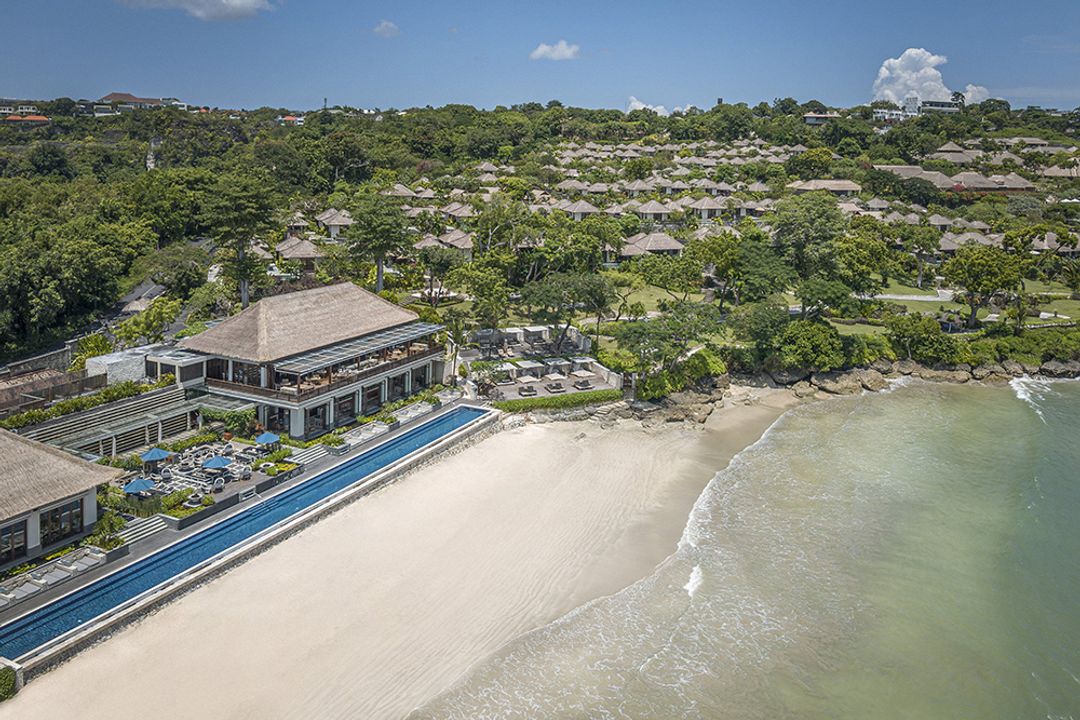
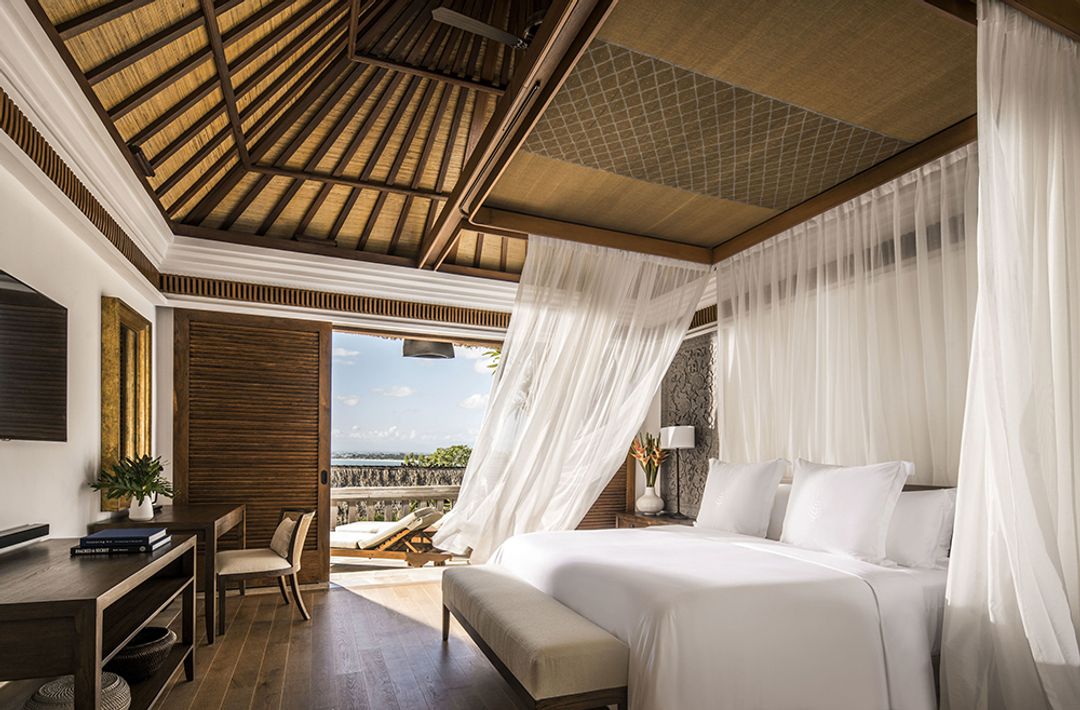
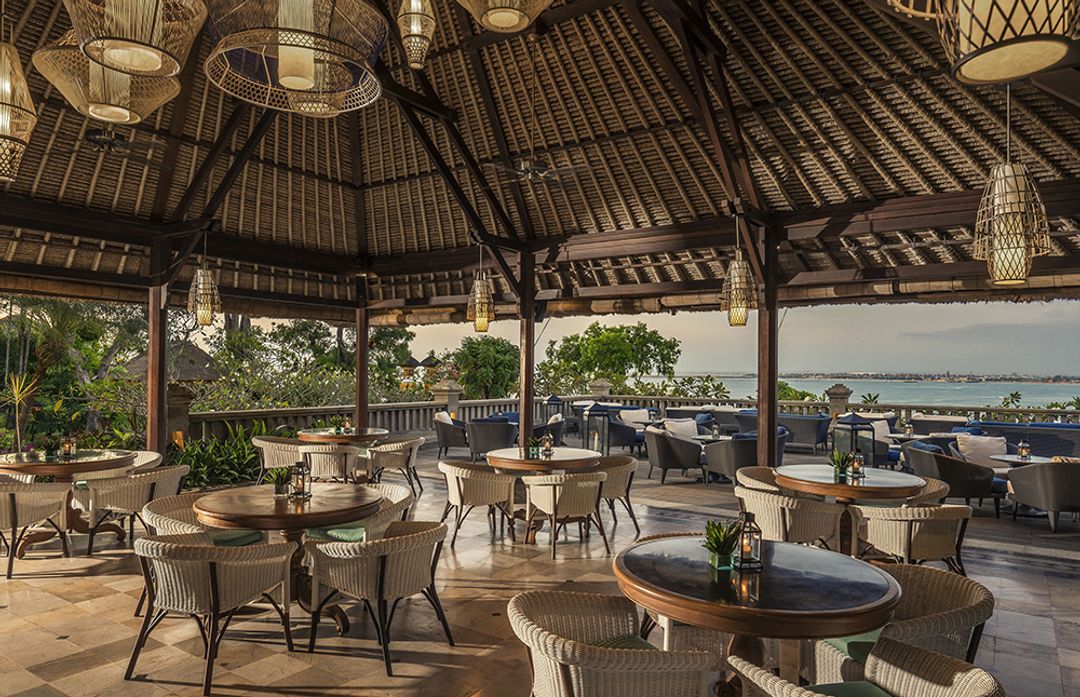
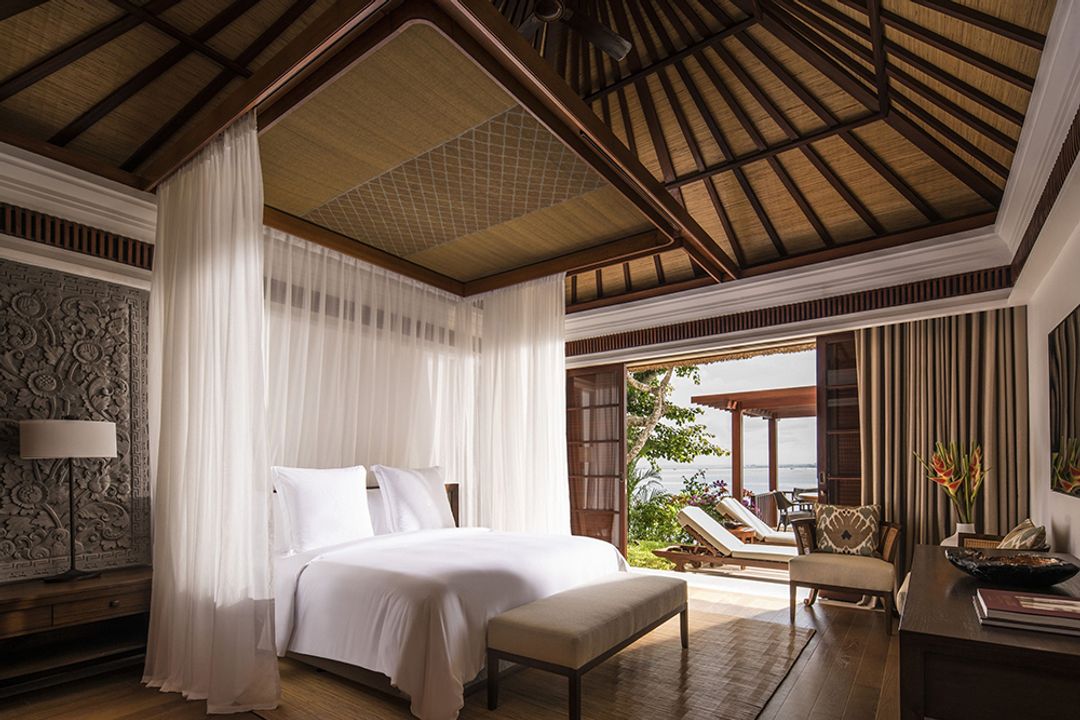
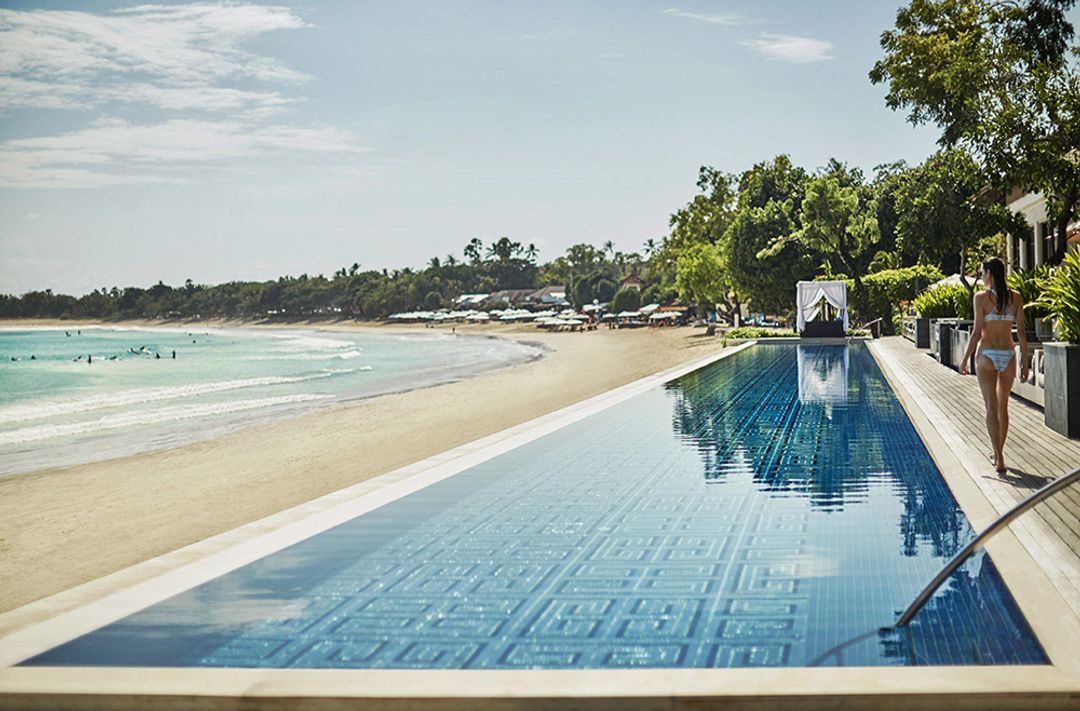
Strung across a hillside above one of Bali's most storied fishing bays, a village of 147 thatched-roof villas descends toward the Indian Ocean in a composition that owes more to Balinese sacred architecture than to conventional resort planning. The Four Seasons Bali at Jimbaran Bay, which opened in 1993 to designs by Balinese architect Hendra Hadiprana, treats the traditional meru tower and alang-alang thatched pavilion not as decorative gestures but as the structural grammar of the entire property. From the aerial, the scale of the ambition is immediately legible — each villa a discrete compound disappearing into the tropical canopy, the whole arranged so that the beachfront infinity pool and its open-sided restaurant pavilion anchor a shoreline otherwise given over entirely to white sand and breaking surf. Inside the villas, the vocabulary is consistent and precise: steeply pitched joglo-style ceilings lined with woven bamboo matting, carved grey paras stone panels set into whitewashed walls, wide-plank teak floors, and four-poster beds draped in white voile that catches the coastal breeze through sliding timber doors. The open-air dining pavilion shown in the images deploys woven rattan pendant lights and split-bamboo ceiling ribs in a way that feels entirely continuous with the surrounding architecture rather than layered on top of it. Hadiprana's achievement was to demonstrate that international luxury hospitality and Balinese spatial tradition need not compromise each other — a proposition that every subsequent resort on this island has been measured against.

Book with PB and get cash back
Capella Ubud - Image 1
Capella Ubud - Image 2
Capella Ubud - Image 3
Capella Ubud - Image 4
Capella Ubud - Image 5

Capella Ubud

Bali • Ubud • OVER THE TOP

avg. $699 / night

Includes $37 / night in cash back

Cash back is redeemable via Virtual Visa, Venmo, or bank transfer starting 24-48 hours after check-out

LHW Leaders Club property

Capella Ubud Design Editorial

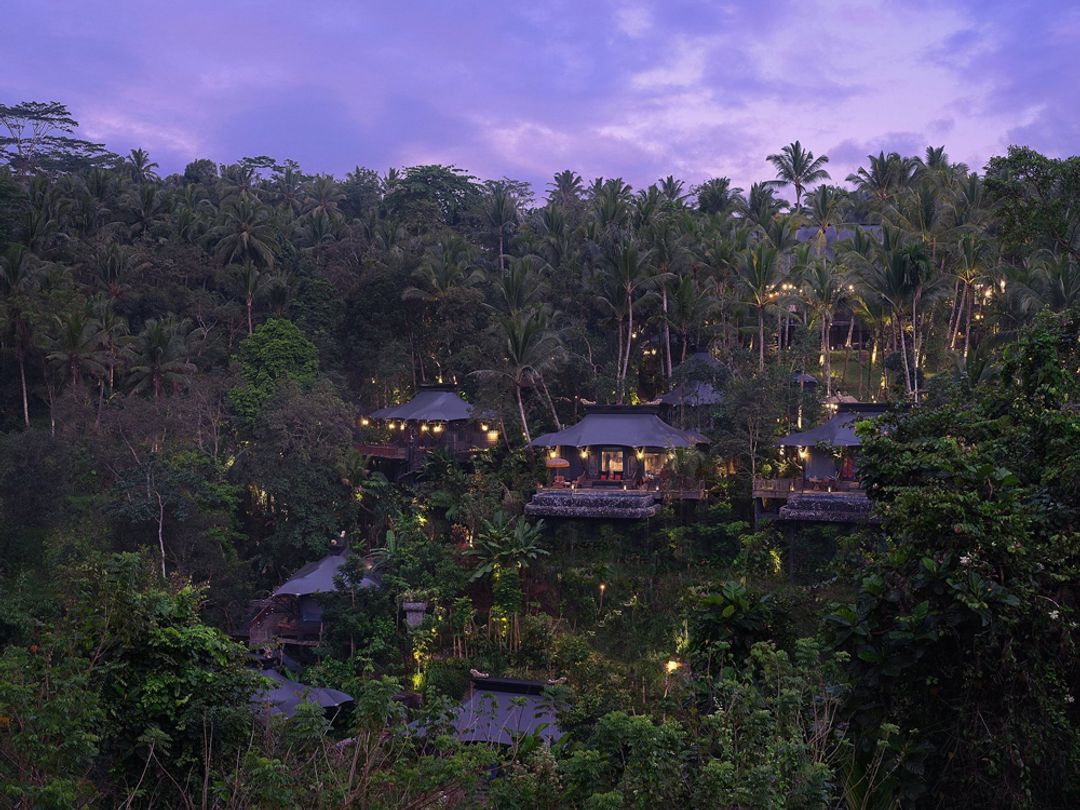
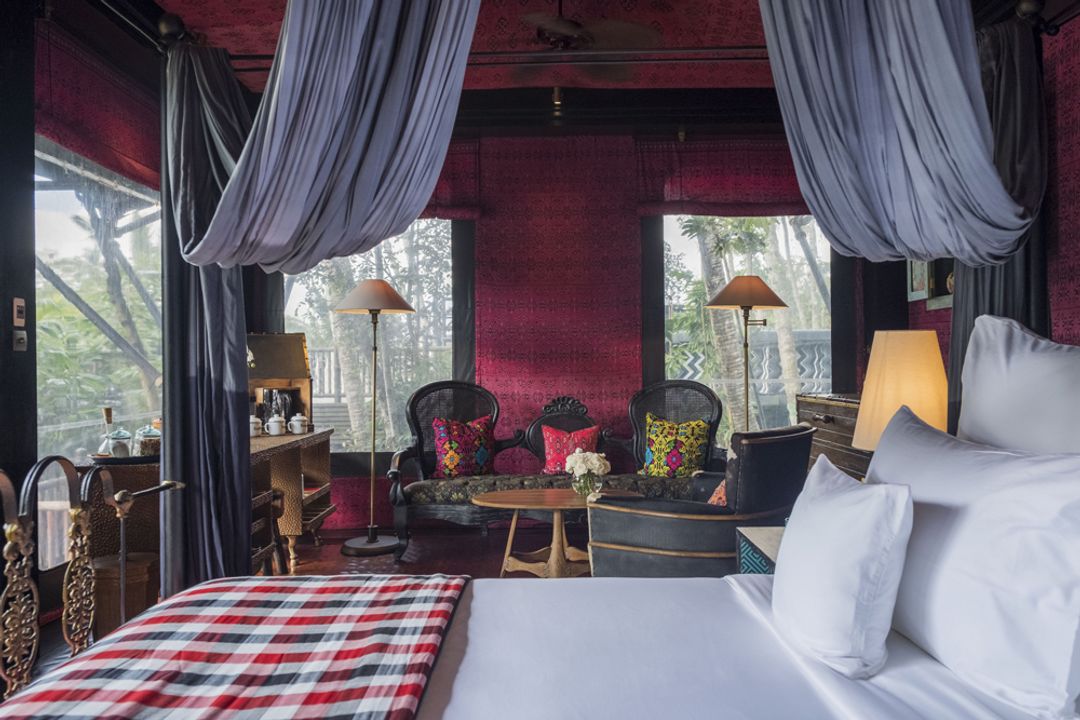
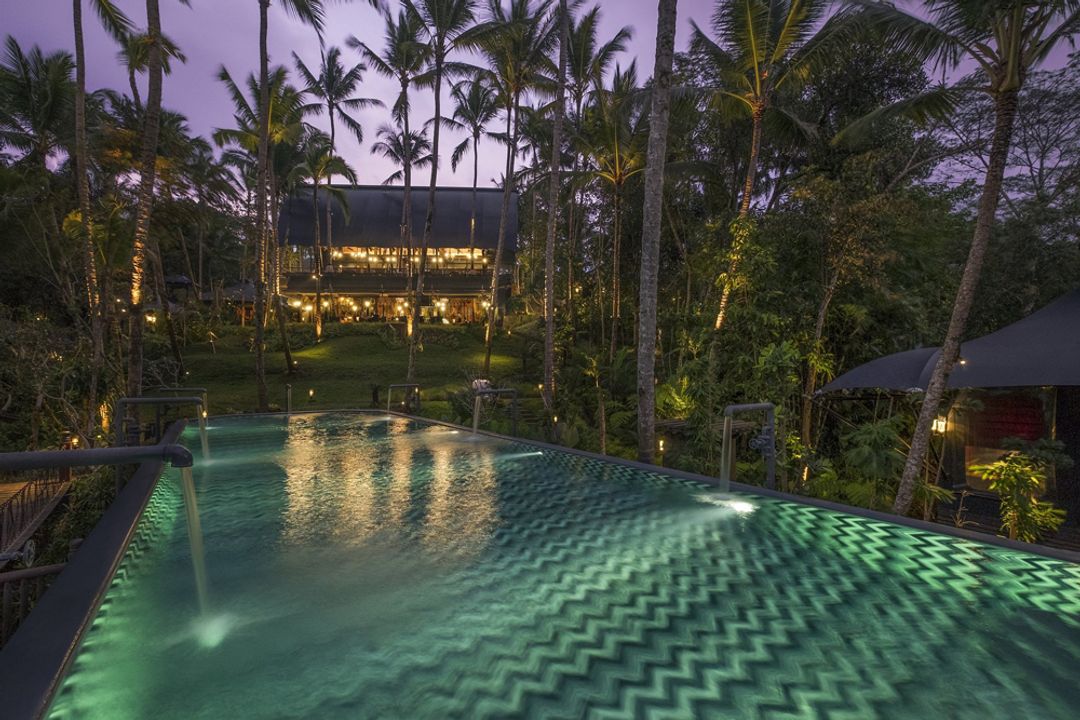
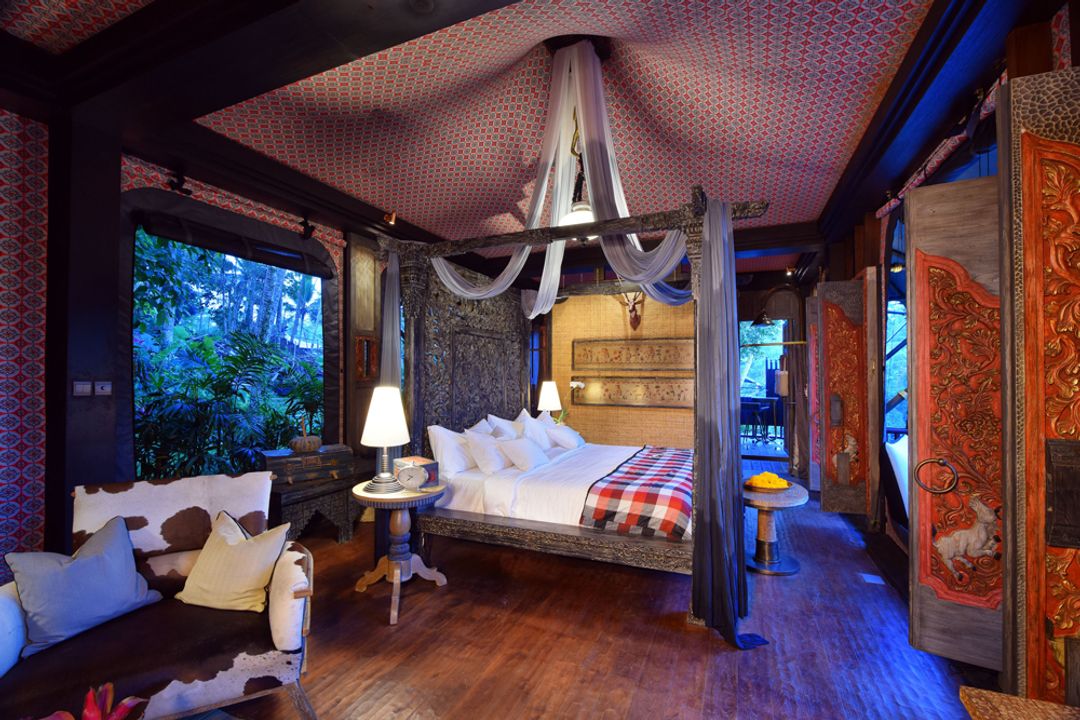
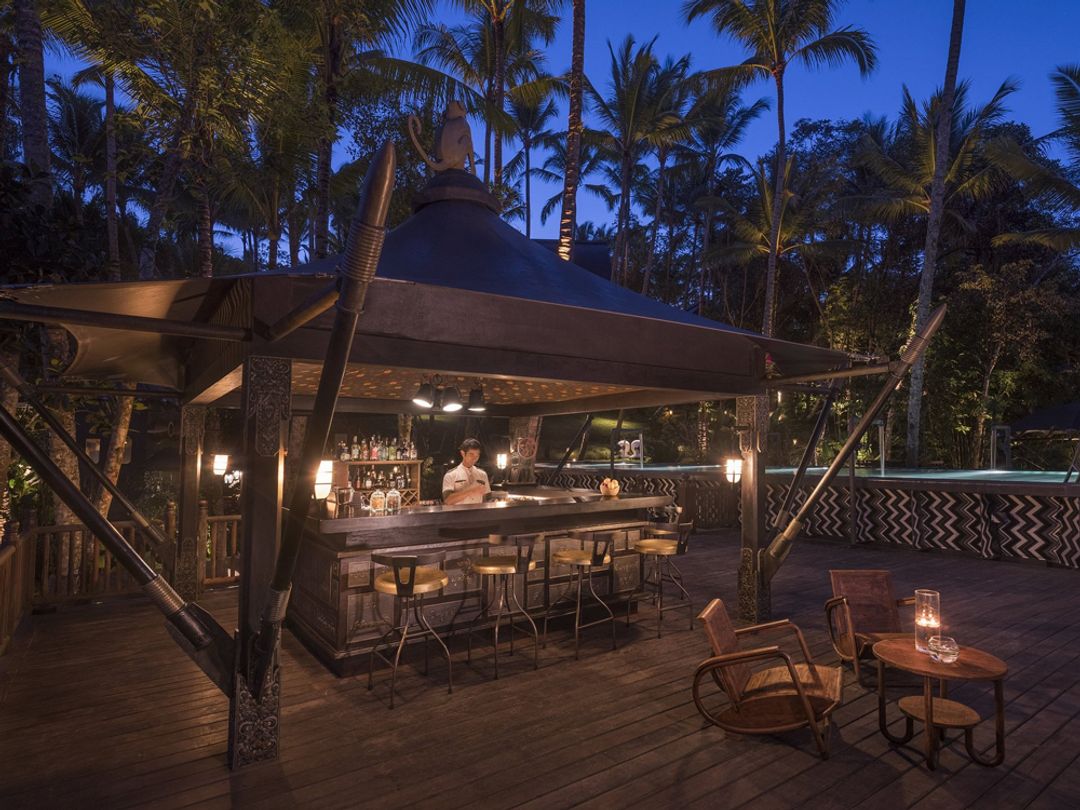
Bill Bensley's obsession with the colonial-era explorer as a design archetype found its most theatrical expression on a forested ridge above Ubud's Petanu River valley, where Capella Ubud opened in 2018 as a camp — not metaphorically but literally, a collection of 22 tented villas and one treehouse suspended among coconut palms and tropical hardwoods on a steep jungle hillside. The structures sit on raised timber platforms, their dark pointed canopies visible at dusk as warm pools of lamplight punctuating the deep green canopy, the whole ensemble closer to a nineteenth-century expedition base than anything the luxury hotel industry had attempted before in Bali. Inside, Bensley's interiors push the theatrical register as far as it will go without tipping into pastiche. Walls lined in deep crimson ikat fabric, ceilings upholstered in batik-printed textile, carved Balinese doors in gilt and lacquered red flanking four-poster beds draped in grey silk — each tent assembled as a private cabinet of curiosities, the furniture mixing French colonial rattan with antique Javanese woodwork and embroidered Uzbek suzani cushions. The pool deck's bar pavilion carries an elaborate engraved metal canopy above teak decking, its bar stools and bentwood chairs arranged against chevron-tiled pool edges that glow jade-green after dark. The effect is less hotel suite than film set, one where every prop has been sourced rather than manufactured.

Book with PB and get cash back
Alila Villas Uluwatu - Image 1
Alila Villas Uluwatu - Image 2
Alila Villas Uluwatu - Image 3
Alila Villas Uluwatu - Image 4
Alila Villas Uluwatu - Image 5

Alila Villas Uluwatu

Bali • Uluwatu • OVER THE TOP

avg. $791 / night

Includes $42 / night in cash back

Cash back is redeemable via Virtual Visa, Venmo, or bank transfer starting 24-48 hours after check-out

World of Hyatt property

Alila Villas Uluwatu Design Editorial

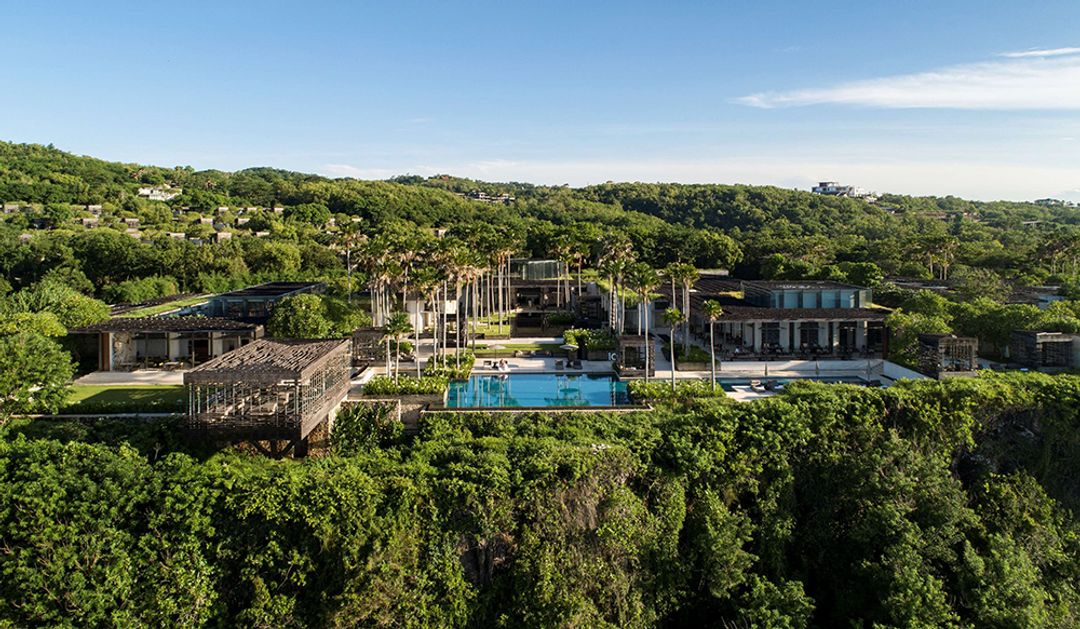
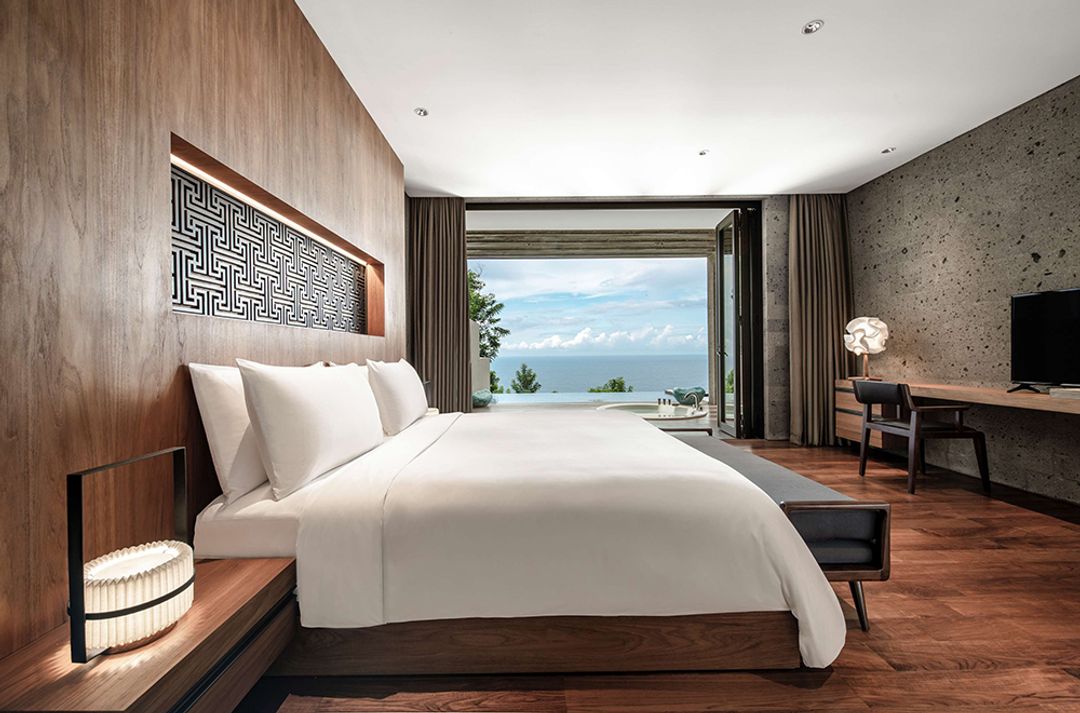
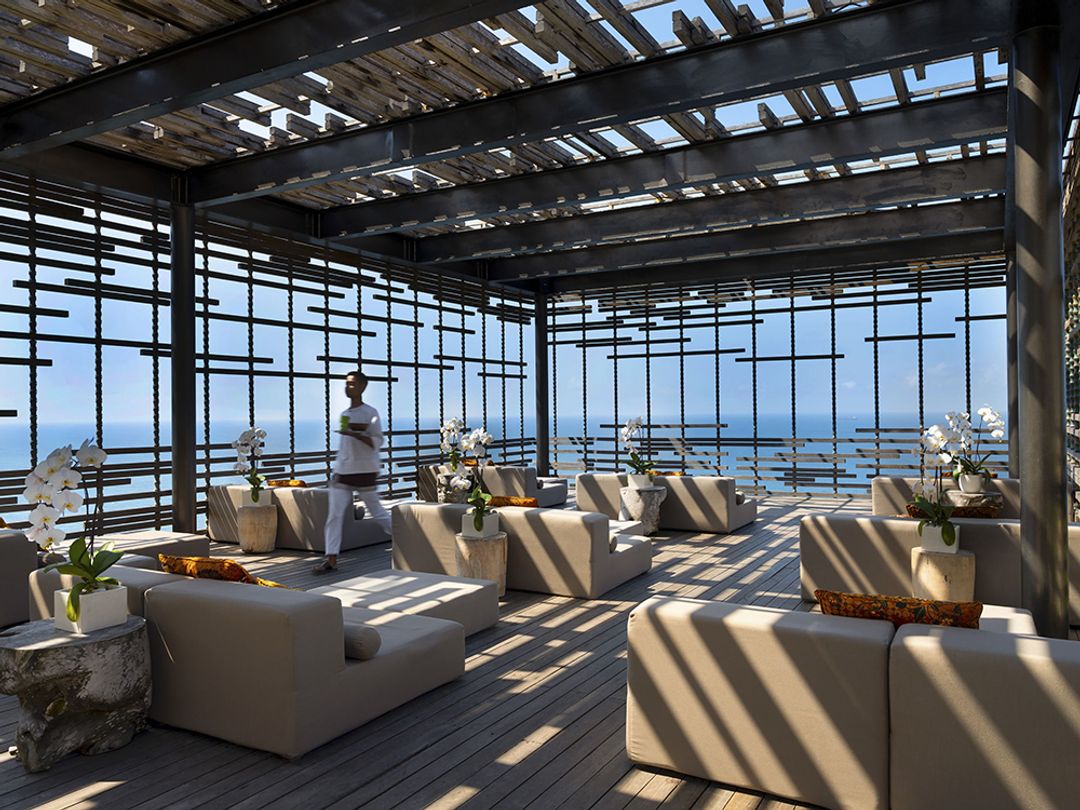
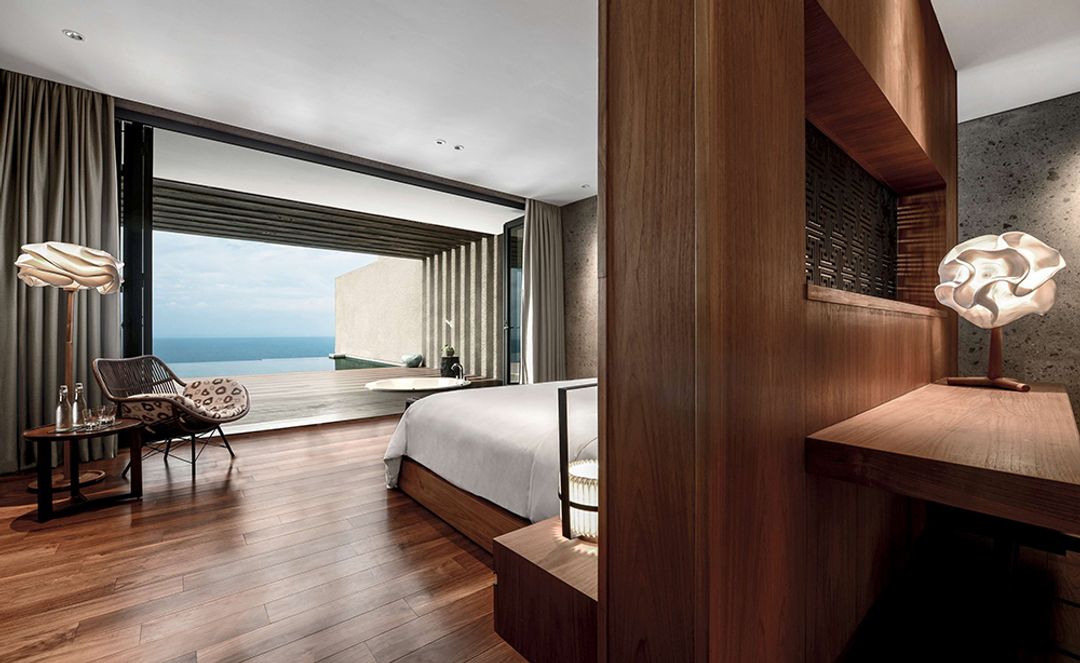
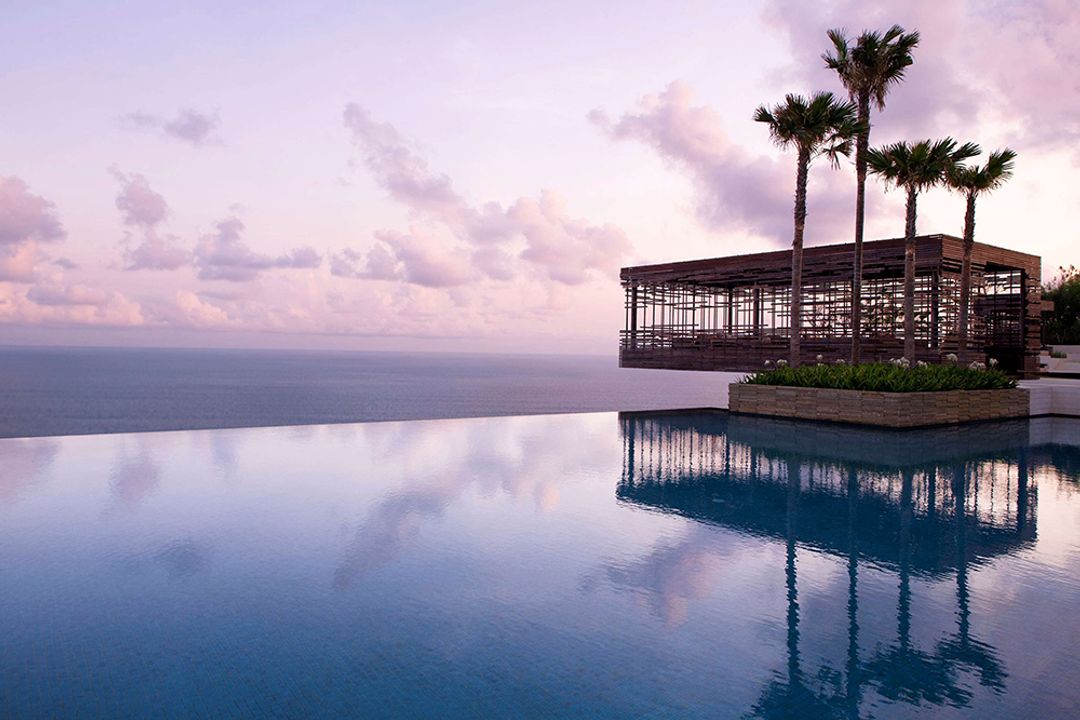
Perched at the limestone edge of the Bukit Peninsula, where Bali's southern cliffs drop sharply into the Indian Ocean, Alila Villas Uluwatu was conceived by WOHA — the Singapore-based practice whose work consistently navigates the tension between ecological ambition and formal rigour — as a zero-carbon resort embedded within, rather than imposed upon, its terrain. Opened in 2009 across 25 hectares of clifftop scrub, the property's 65 villas and 19 hotel rooms are arranged in low-slung pavilions that recede behind dense indigenous planting, their grass-covered roofs visible in the aerial view as barely-there horizontals threading through the canopy. WOHA's material choices carry the same logic: local palimanan limestone clads the walls with a porous, almost geological texture visible throughout the guestrooms, where it sits in deliberate counterpoint to warm teak flooring and walnut-panelled headboard walls inset with graphic grille panels drawn from traditional Balinese weaving motifs. Folding glass walls dissolve the boundary between bedroom and private infinity pool, the Indian Ocean positioned as a constant vertical in every sightline. The clifftop Sky Bar — a timber-lattice pavilion cantilevered above the main pool, its slatted roof casting geometric shadow across low modular seating — distils the whole project into a single gesture: open to the horizon, rooted in craft, structured by light.

Book with PB and get cash back
Amandari - Image 1
Amandari - Image 2
Amandari - Image 3
Amandari - Image 4
Amandari - Image 5

Amandari

Bali • Ubud • OVER THE TOP

avg. $939 / night

Includes $49 / night in cash back

Cash back is redeemable via Virtual Visa, Venmo, or bank transfer starting 24-48 hours after check-out

Amandari Design Editorial

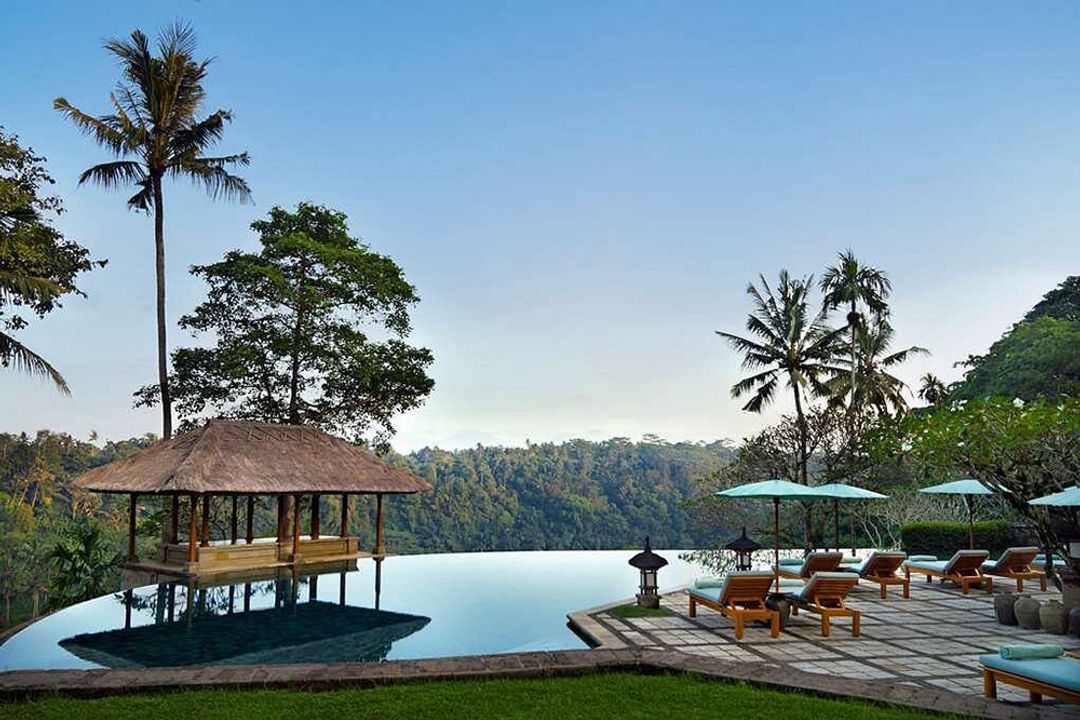
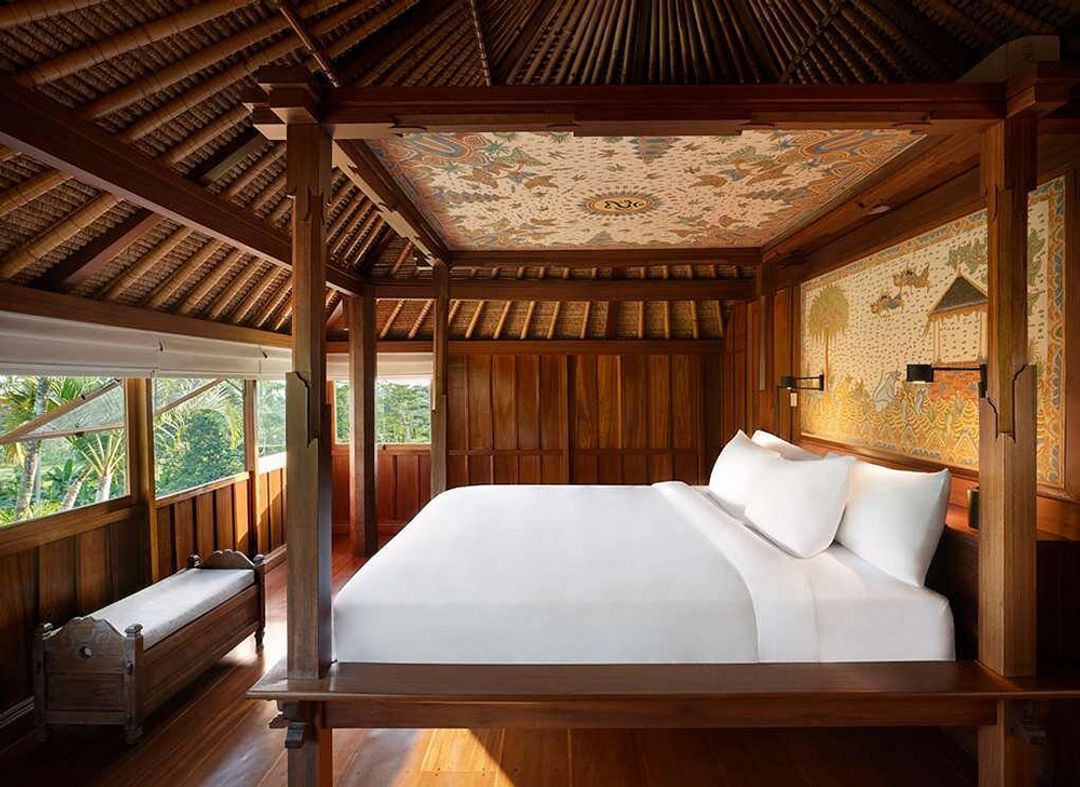
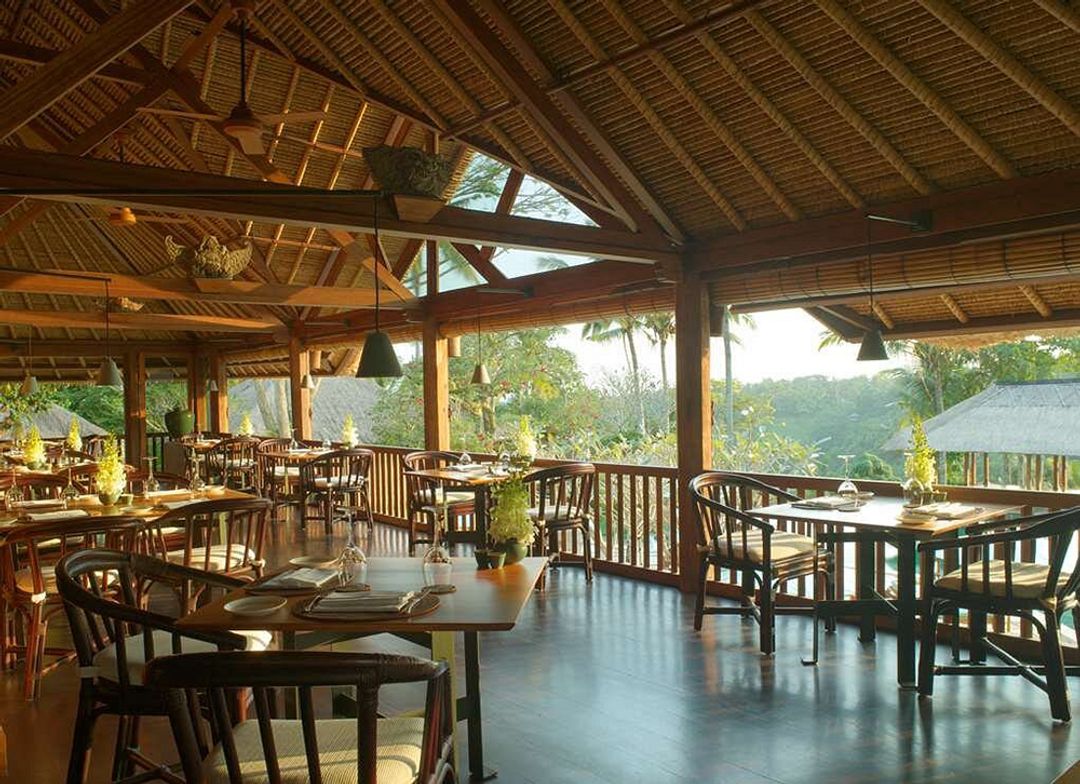
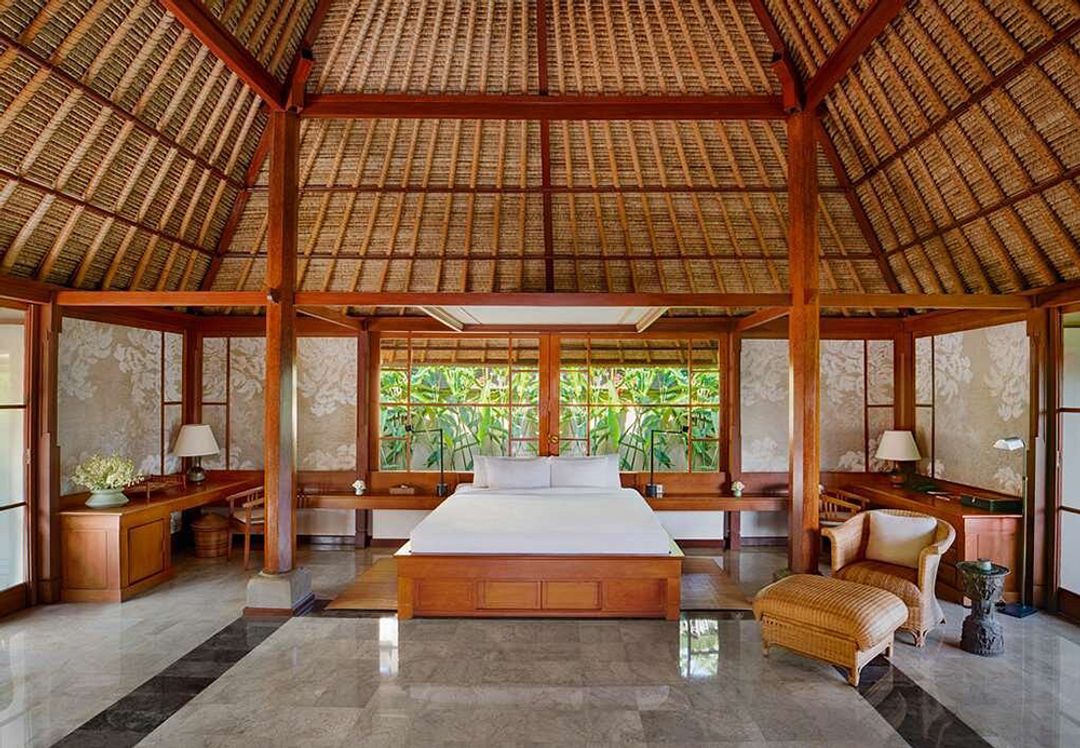
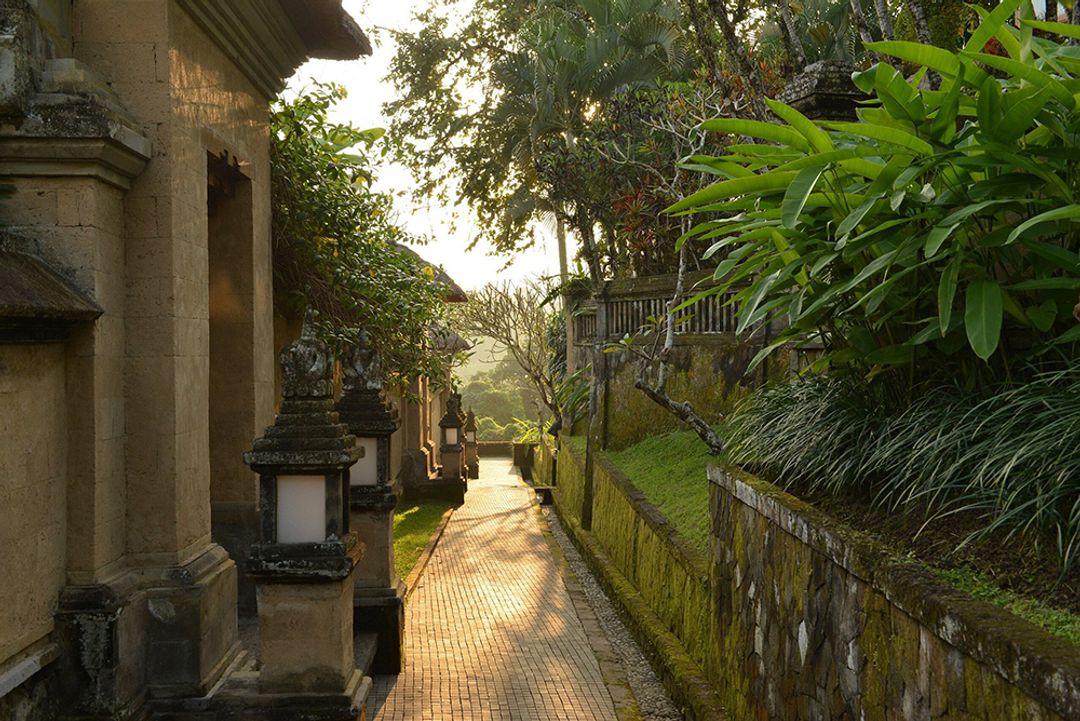
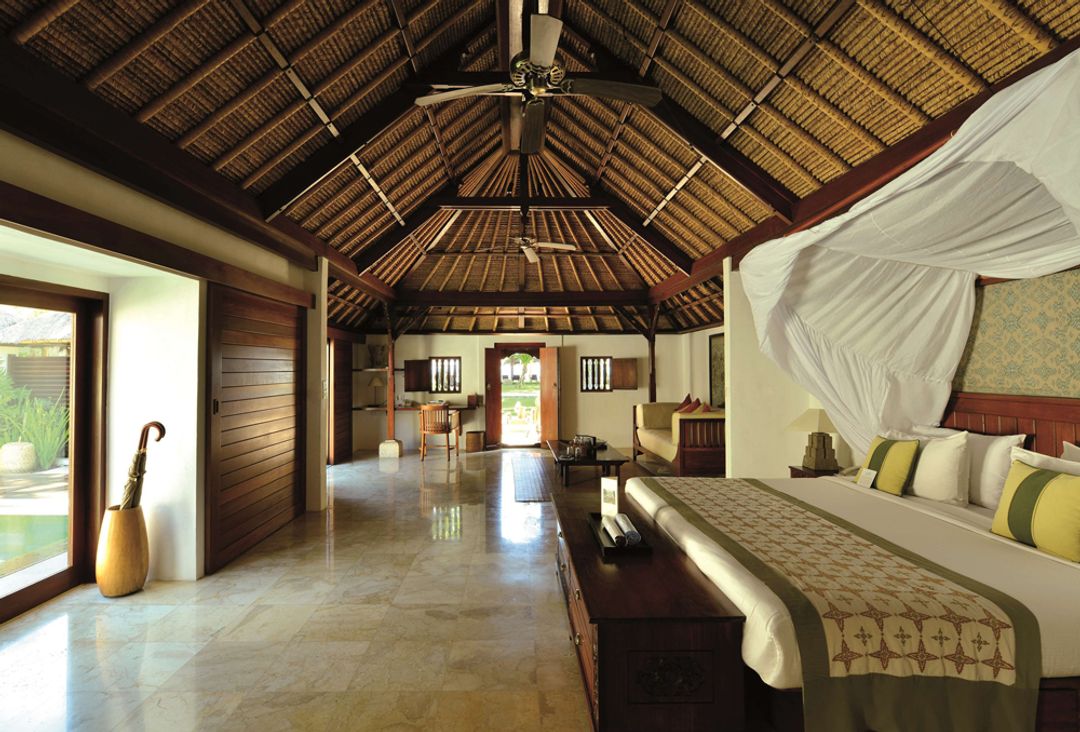
Conceived as a Balinese village rather than a hotel, Amandari was designed by Peter Muller and opened in 1989 on a ridge above the Ayung River gorge outside Ubud — a site so steep and jungle-dense that the architecture had to follow the land's logic rather than override it. Muller arranged the 30 suites as a series of individual thatched pavilions, each enclosed within its own stone-walled compound and connected by the kind of moss-edged brick pathways, carved paras stone lanterns, and planting that recall a working Balinese desa rather than a resort layout. The design drew directly from the principles of traditional Balinese spatial organisation, where domestic life is divided among separate structures for sleeping, bathing, and gathering, and where the sacred geometry of the compound determines the relationship between buildings. Inside, the rooms divide between two distinct registers visible in the images: the higher-category suites built on a circular plan, with soaring alang-alang thatch ceilings, polished grey marble floors, rattan armchairs, and views through bamboo-screened windows into private gardens; and the smaller pavilion rooms, walled entirely in warm teak, their hand-painted ceilings carrying traditional Balinese narrative murals in ochre and blue-green pigment. The open-sided restaurant, framed in timber and alang-alang, extends over the valley on one edge while the infinity pool — its thatched bale floating over dark water — dissolves into the tree canopy of the Ayung gorge beyond.

Book with PB and get cash back
Mandapa, A Ritz-Carlton Reserve - Image 1
Mandapa, A Ritz-Carlton Reserve - Image 2
Mandapa, A Ritz-Carlton Reserve - Image 3
Mandapa, A Ritz-Carlton Reserve - Image 4
Mandapa, A Ritz-Carlton Reserve - Image 5

Mandapa, A Ritz-Carlton Reserve

Bali • Ubud • OVER THE TOP

avg. $940 / night

Includes $49 / night in cash back

Cash back is redeemable via Virtual Visa, Venmo, or bank transfer starting 24-48 hours after check-out

Marriott Bonvoy® property

Mandapa, A Ritz-Carlton Reserve Design Editorial

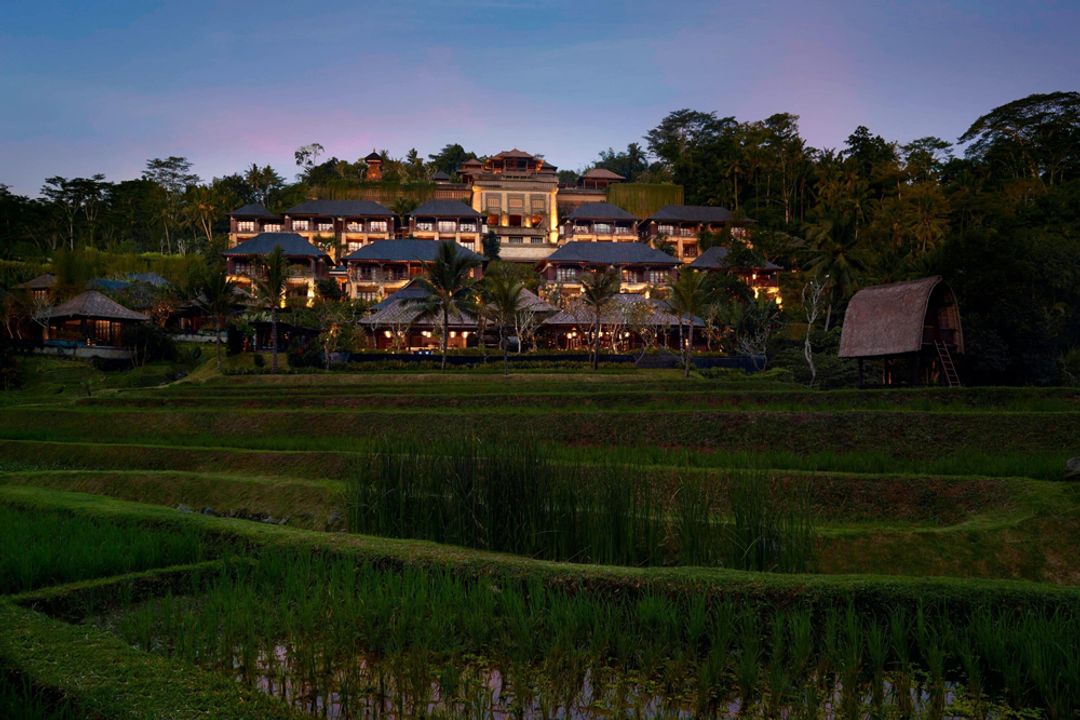
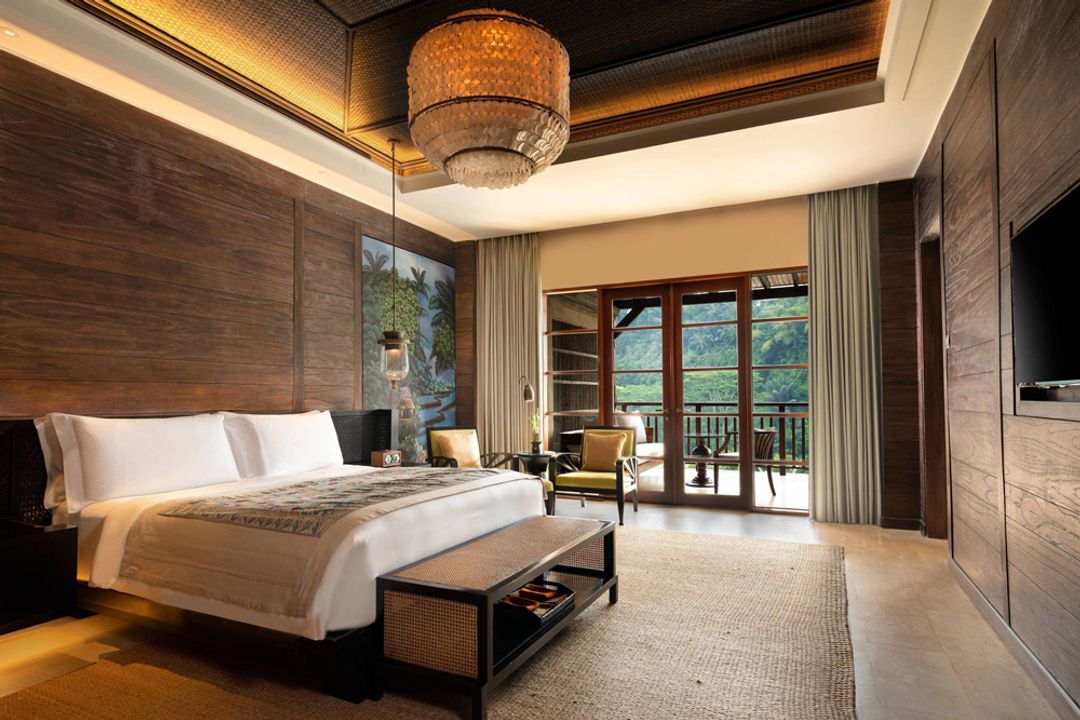
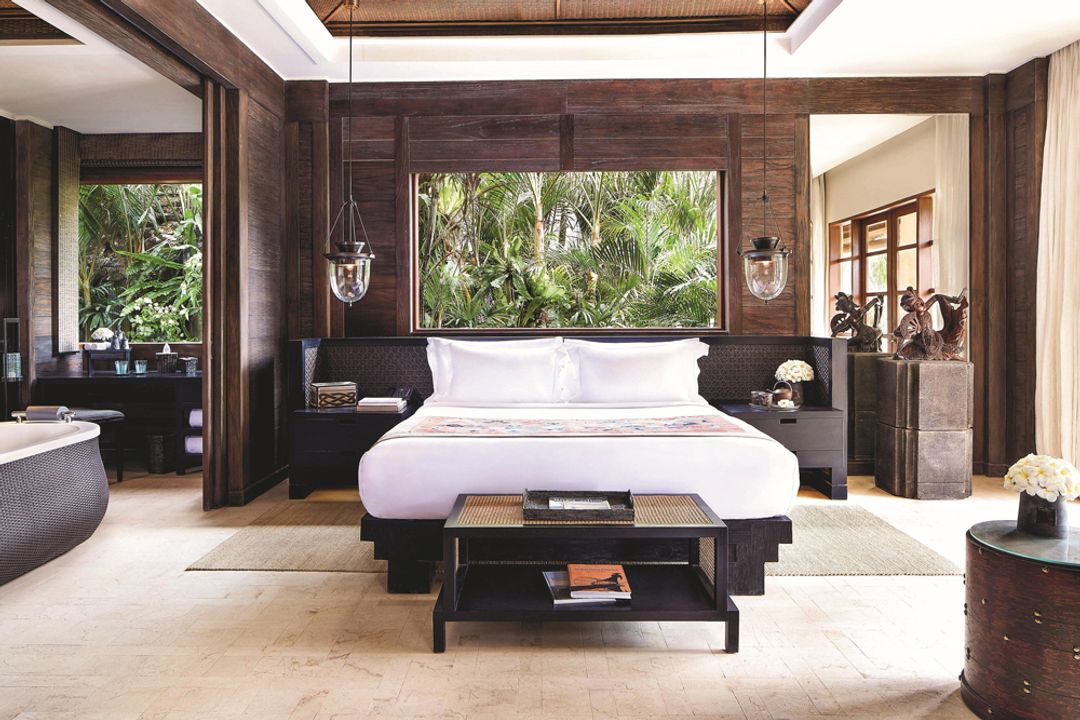
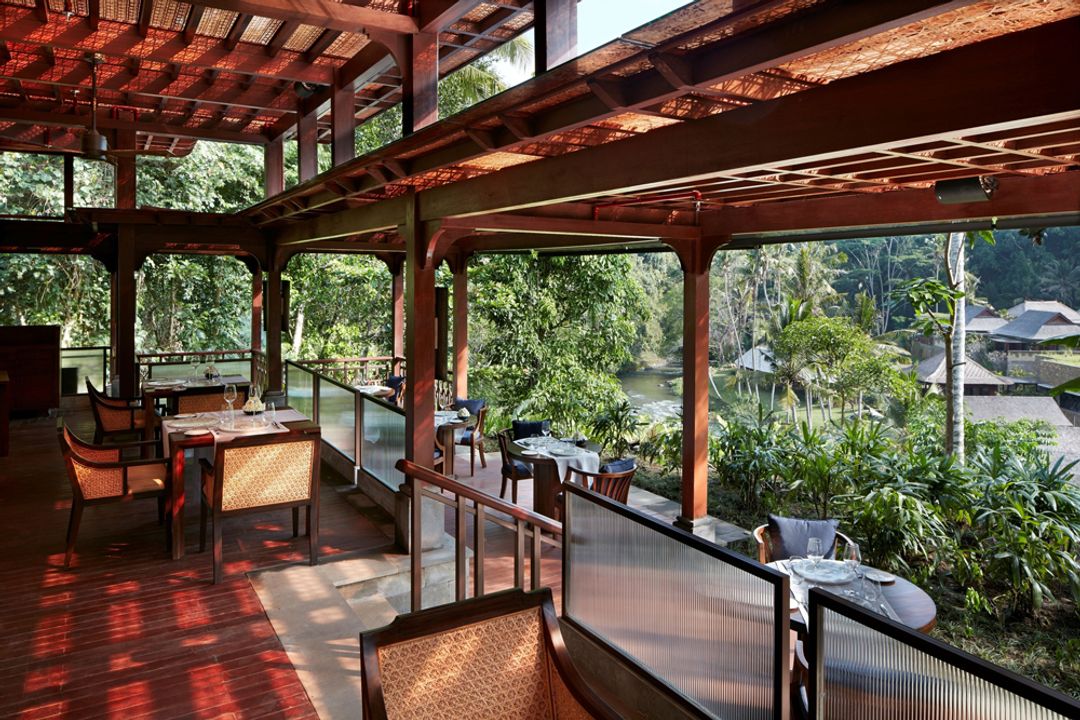
Carved into a hillside above the Ayung River valley on the outskirts of Ubud, where terraced rice paddies step down toward dense jungle and the air carries the particular quality of altitude and moisture that defines Bali's interior, Mandapa, A Ritz-Carlton Reserve opened in 2015 across a 16-hectare site designed to evoke a traditional Balinese village compound. The architecture, shaped around the concept of a sacred riverside sanctuary, draws on the vernacular vocabulary of thatched alang-alang roofs, deep timber eaves, and carved stone shrines distributed across the grounds as functional spiritual markers rather than decorative gesture. Sixty rooms and villas are arranged in low clusters that defer to the landscape, the massing deliberately fragmented to preserve sight lines across the paddies visible in the exterior dusk image. The interiors establish a material language of dark-stained teak wall panelling, honed limestone flooring, and woven rattan ceiling insets — a palette warm enough to feel residential without borrowing too heavily from the Aman-adjacent idiom that dominates this altitude. Pendant lanterns in blown glass hang above beds dressed with ikat runners, hand-carved Balinese sculpture grounds the suites in local craft tradition, and freestanding soaking tubs in dark composite stone address the open-plan bath areas with quiet confidence. The river-facing restaurant, structured beneath a lacquered timber pergola with woven bamboo infill panels and rattan-backed chairs, dissolves any boundary between dining room and forest canopy — the Ayung below, the jungle directly at eye level.

Book with PB and get cash back
Soori Bali - Image 1
Soori Bali - Image 2
Soori Bali - Image 3
Soori Bali - Image 4
Soori Bali - Image 5

Soori Bali

Bali • Tabanan Regency • OVER THE TOP

avg. $1,045 / night

Includes $55 / night in cash back

Cash back is redeemable via Virtual Visa, Venmo, or bank transfer starting 24-48 hours after check-out

LHW Leaders Club property

Soori Bali Design Editorial

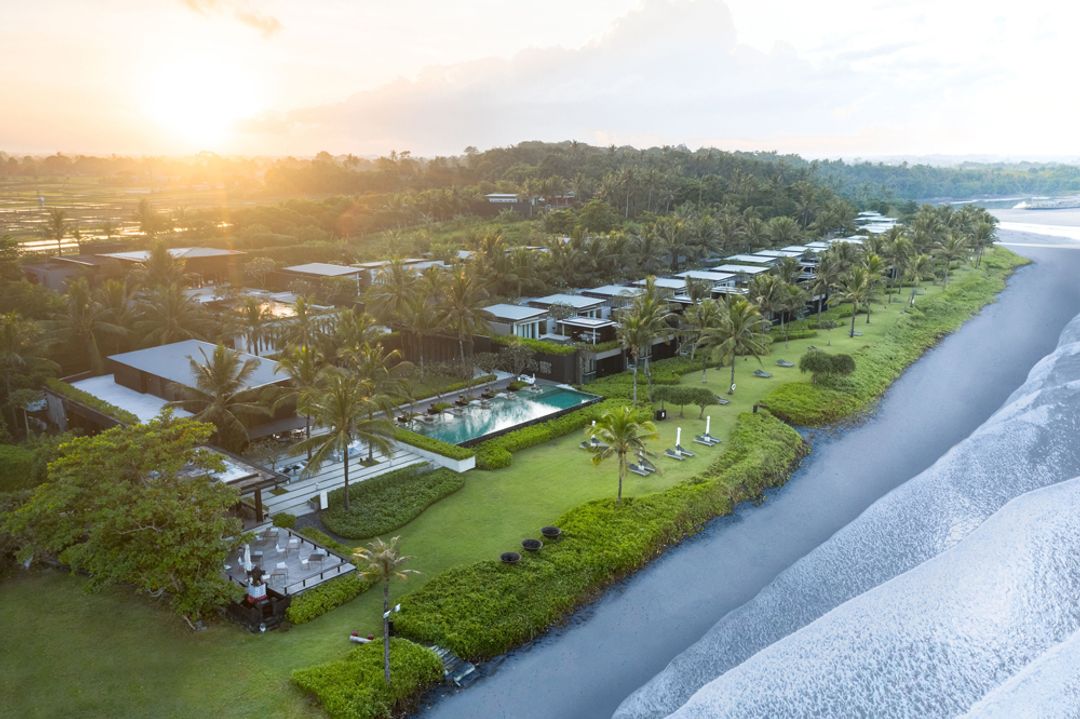
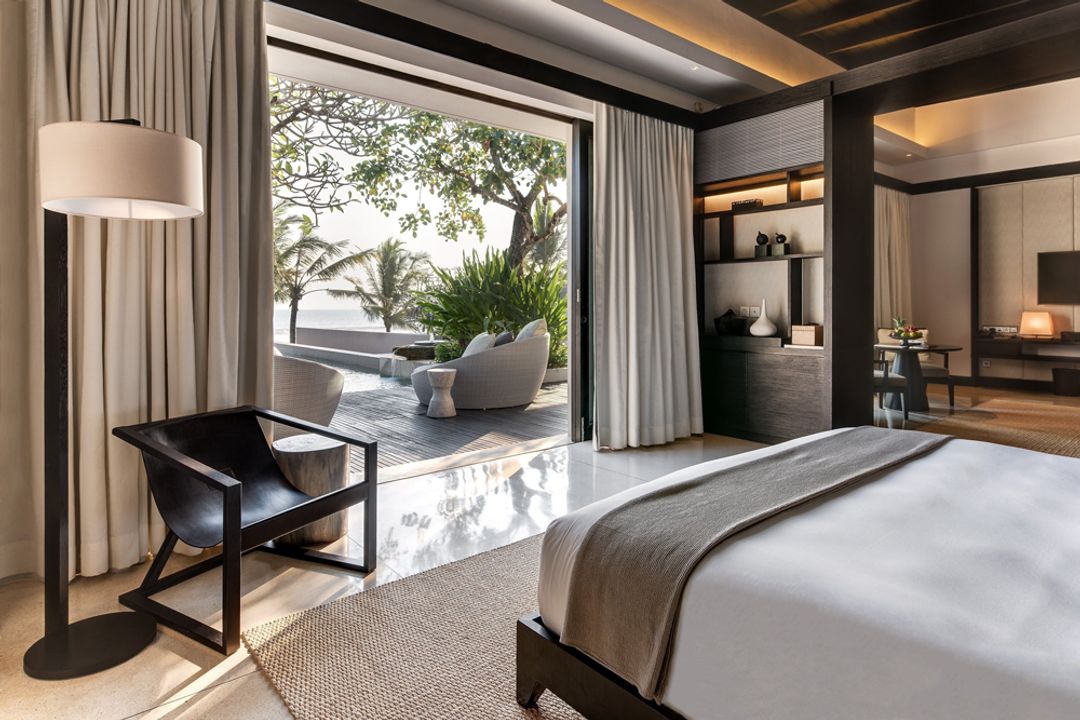
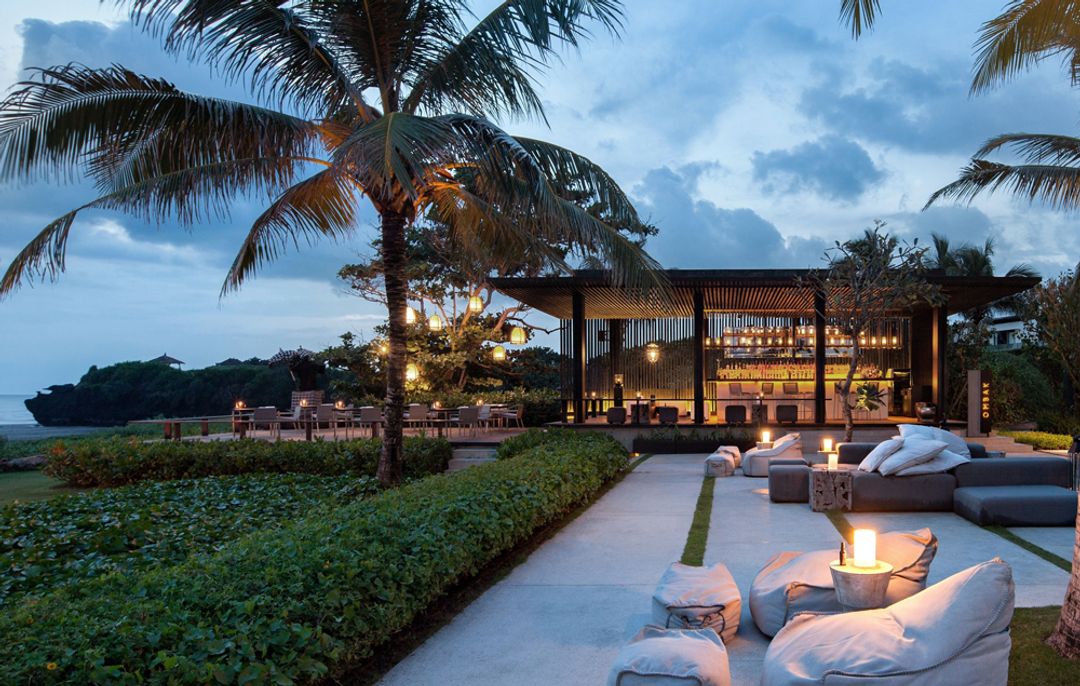
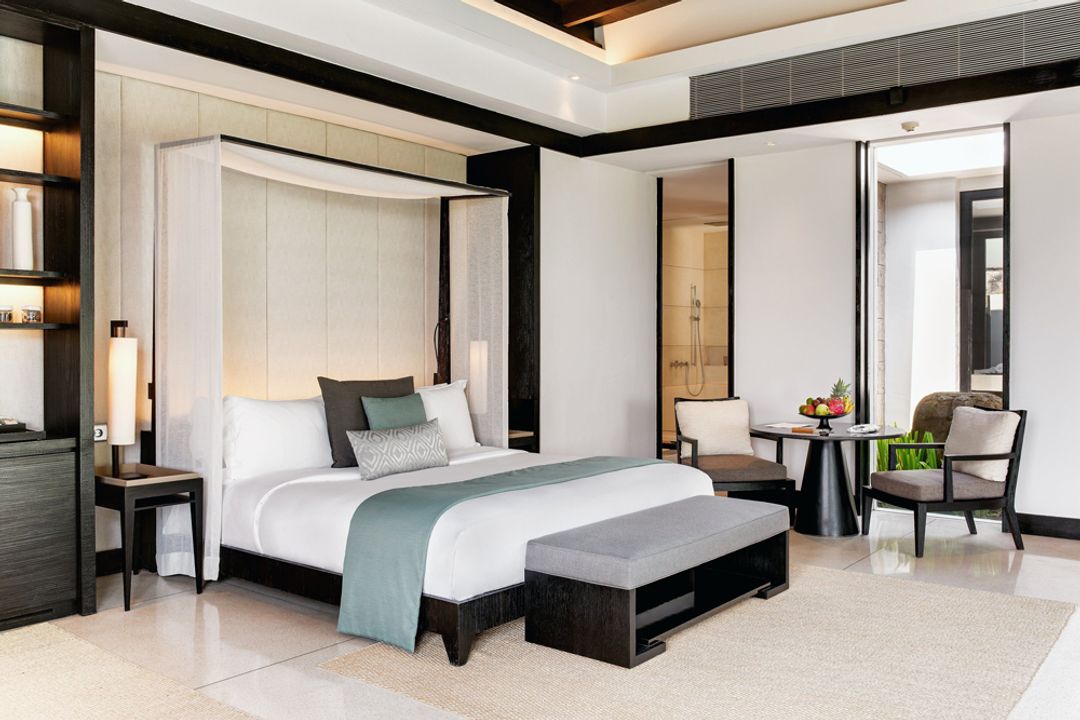
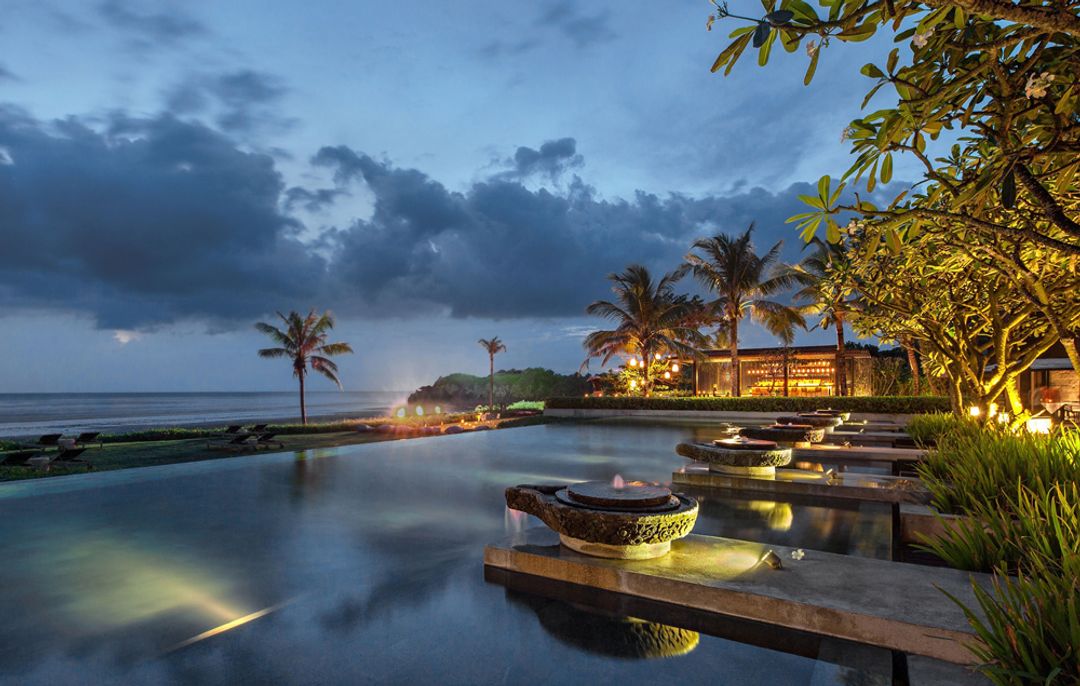
Pressed against a stretch of black-sand beach in Tabanan Regency, where Bali's volcanic coastline runs wilder and less visited than the tourist corridors to the south, Soori Bali was conceived by New York-based architect Soo K. Chan of SCDA as a study in disciplined restraint against a landscape that could easily overwhelm it. Chan arranged the property's 48 villas — each with its own private pool — in a low-slung linear formation that tracks the shoreline, their dark-framed pavilion roofs and pale limestone floors maintaining a horizontal discipline that keeps the Indian Ocean perpetually in frame rather than treating it as a backdrop. The interiors carry the same considered economy: ebonised timber structural columns, canopy bed frames in blackened wood set against softly upholstered linen headboards, and floor-to-ceiling sliding glass panels that dissolve the boundary between bedroom and terrace. Woven sisal rugs, cylindrical stone side tables, and low-profile lounge chairs upholstered in warm grey anchor the rooms without competing with the tropical light flooding through them. Outside, carved volcanic stone bowls float at pool level — a material note that anchors the property to Balinese craft tradition without resorting to pastiche. The beach bar, visible in the images with its fine timber-louvred canopy open to the prevailing breeze, extends the same structural language into the landscape: precision joinery, warm pendant lighting, and an unobstructed view of the reef-edged horizon.

Book with PB and get cash back
Amankila - Image 1
Amankila - Image 2
Amankila - Image 3
Amankila - Image 4
Amankila - Image 5

Amankila

Bali • Indrakila • OVER THE TOP

avg. $1,143 / night

Includes $60 / night in cash back

Cash back is redeemable via Virtual Visa, Venmo, or bank transfer starting 24-48 hours after check-out

Amankila Design Editorial

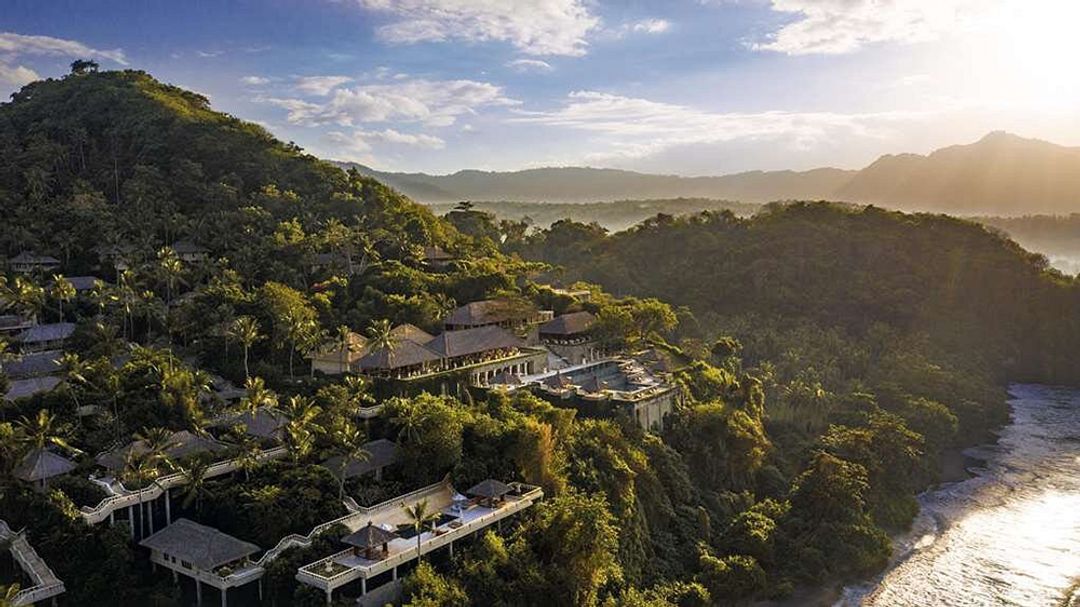
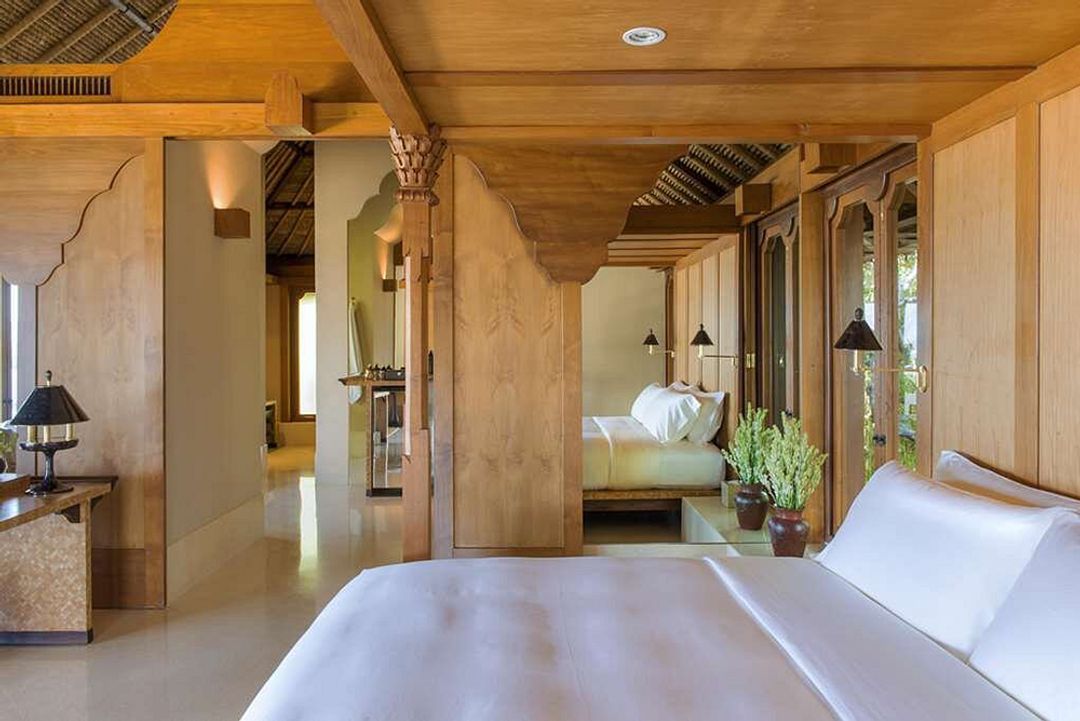
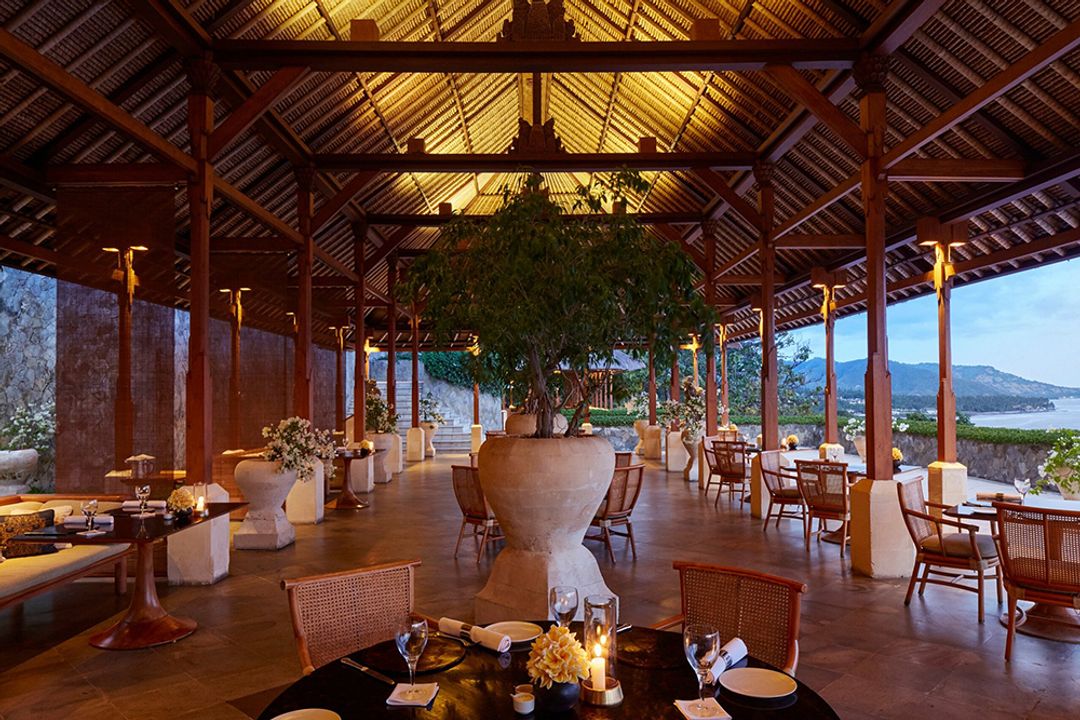
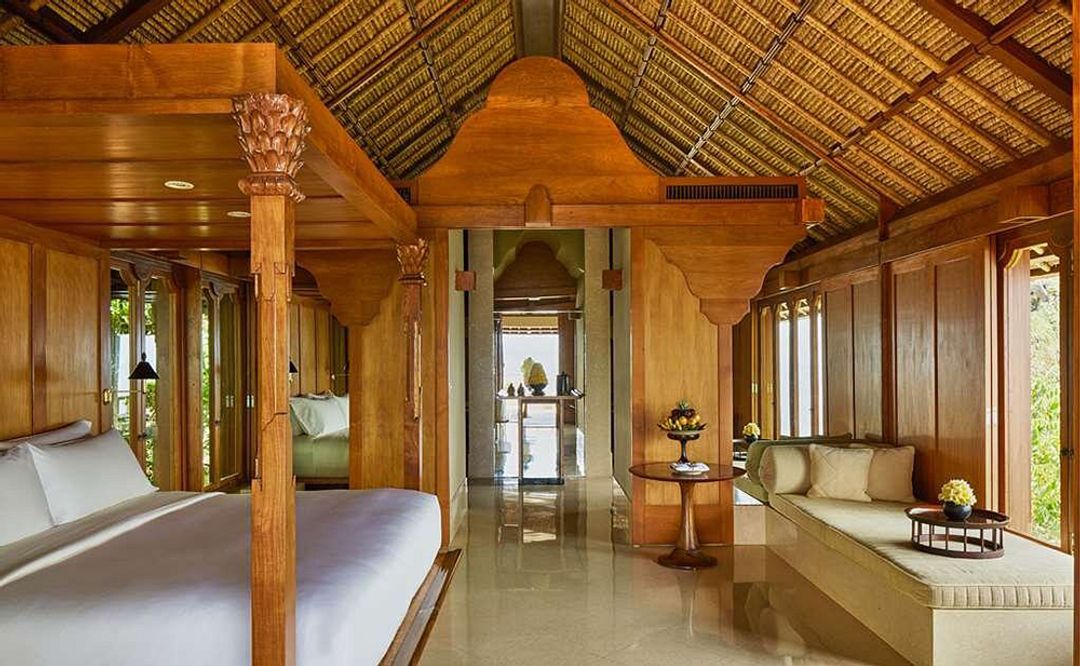
Carved into the vertiginous jungle cliffs of Bali's eastern Karangasem regency, where the island faces Lombok across the Lombok Strait, the fifty-four suite Amankila opened in 1992 as one of Ed Tuttle's most assured statements of site-responsive tropical architecture. Tuttle, the Paris-based American designer responsible for much of the early Aman vocabulary, answered the near-vertical terrain by cascading a series of thatched-roof pavilions down the hillside in tiers, each stepping lower toward a triple-level infinity pool that dissolves, on clear mornings, into an unbroken horizon of turquoise water. The massing borrows the alang-alang thatch and carved timber column capitals of traditional Balinese architecture without attempting literal reproduction — instead distilling vernacular form into something more elemental and geometrically precise. Inside the suites, the language holds. Hand-carved teak columns with lotus-capital detailing support steeply pitched alang-alang ceilings, while pale polished stone floors and cream-linen built-in daybeds absorb afternoon light filtering through louvered timber panels. The dining pavilion, open on all sides to the hillside and sea, anchors a mature tree within a massive carved stone urn at its center — flanked by cane-and-teak chairs and dark lacquered table surfaces, lit at dusk by brass column torches against the woven bamboo ceiling above. The restaurant terrace frames the bay of Amuk below in a view that the architecture appears to have been arranged, quite deliberately, to make inevitable.

Book with PB and get cash back
Raffles Bali - Image 1
Raffles Bali - Image 2
Raffles Bali - Image 3
Raffles Bali - Image 4
Raffles Bali - Image 5

Raffles Bali

Bali • Jimbaran Bay • OVER THE TOP

avg. $1,237 / night

Includes $65 / night in cash back

Cash back is redeemable via Virtual Visa, Venmo, or bank transfer starting 24-48 hours after check-out

ALL - Accor property

Raffles Bali Design Editorial

Carved into the forested cliffs above Jimbaran Bay, where Bali's southwestern peninsula drops sharply toward the Indian Ocean, Raffles Bali arranges its 32 villas across a series of terraced limestone retaining walls that follow the natural topography rather than flatten it. The architecture deploys the Balinese joglo vocabulary — steeply pitched alang-alang and slate-tiled roofs, deep overhanging eaves, open-sided pavilion structures — but tempers it with a crisp contemporary restraint that keeps the compound from tipping into pastiche. Individual villa clusters step down the hillside with private plunge pools cantilevered toward the water, the rough-cut coral stone walls binding the built environment to the volcanic geology beneath. Inside, the interiors work a considered tension between tropical materiality and refined comfort. Dark-stained hardwood floors ground each villa, the ceilings rising to exposed teak roof structures lined with woven rattan panels that absorb the afternoon heat as much as the light. Rattan armchairs with linen cushions, lacquered drum tables, and botanical-motif wallcoverings in terracotta and bronze bring warmth without weight. The bar pavilion, open to a canopy view across the jungle, pairs a pale limestone counter and backlit timber shelving with the same dark wood and woven-ceiling language found throughout the property — a consistency that gives Raffles Bali the atmosphere of a private hillside estate rather than a branded resort. The infinity pool at the base of the terraces stretches flush with the bay's horizon, tidal and unhurried.

Book with PB and get cash back
The Bulgari Resort, Bali - Image 1
The Bulgari Resort, Bali - Image 2
The Bulgari Resort, Bali - Image 3
The Bulgari Resort, Bali - Image 4
The Bulgari Resort, Bali - Image 5

The Bulgari Resort, Bali

Bali • Pecatu • OVER THE TOP

avg. $1,282 / night

Includes $67 / night in cash back

Cash back is redeemable via Virtual Visa, Venmo, or bank transfer starting 24-48 hours after check-out

The Bulgari Resort, Bali Design Editorial

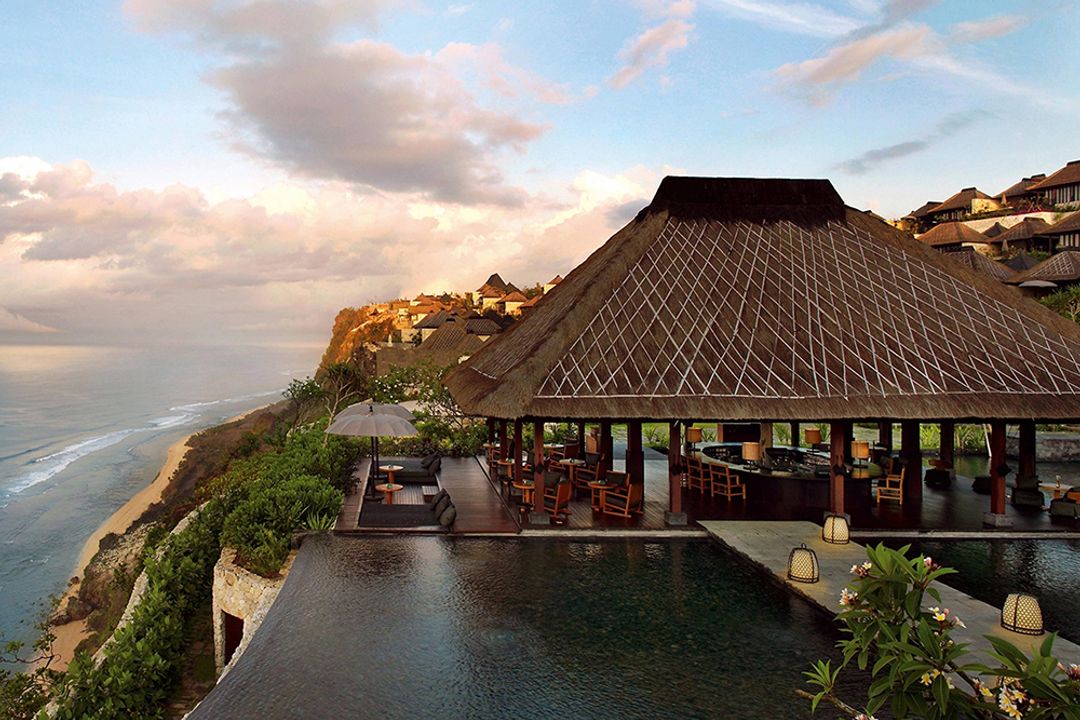
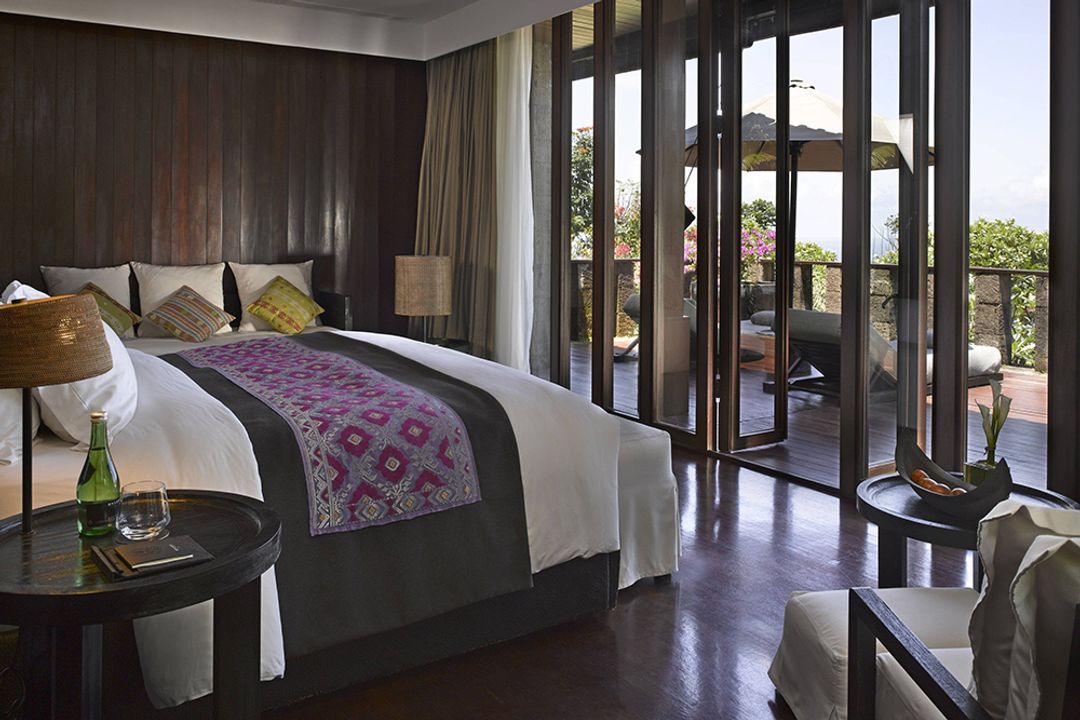
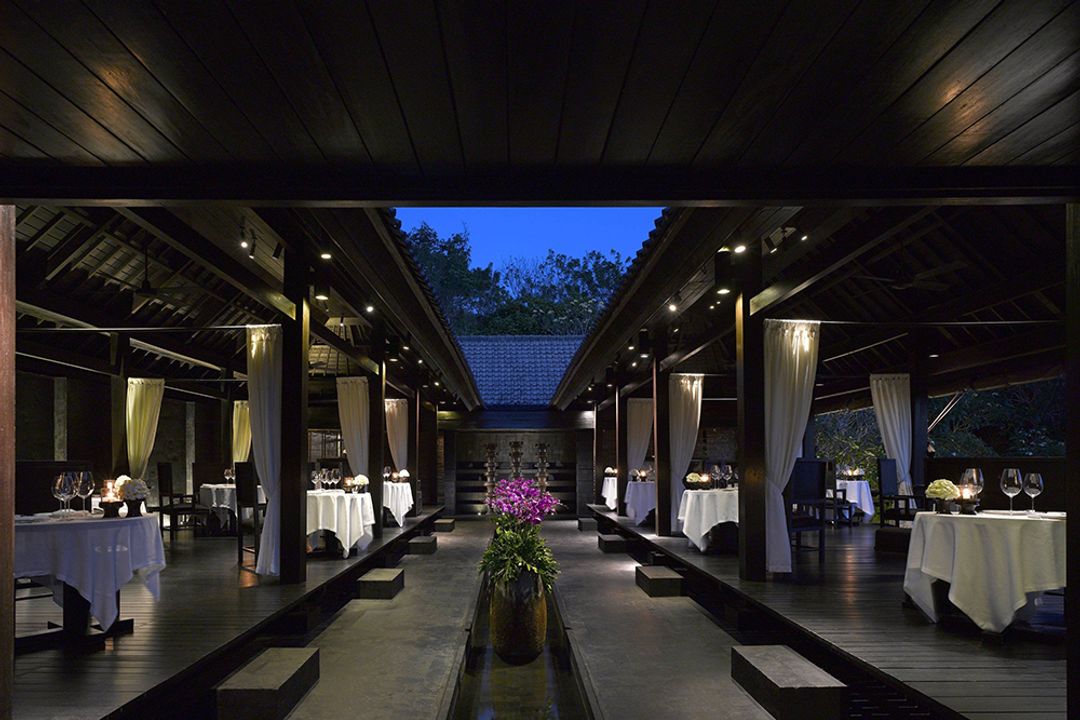
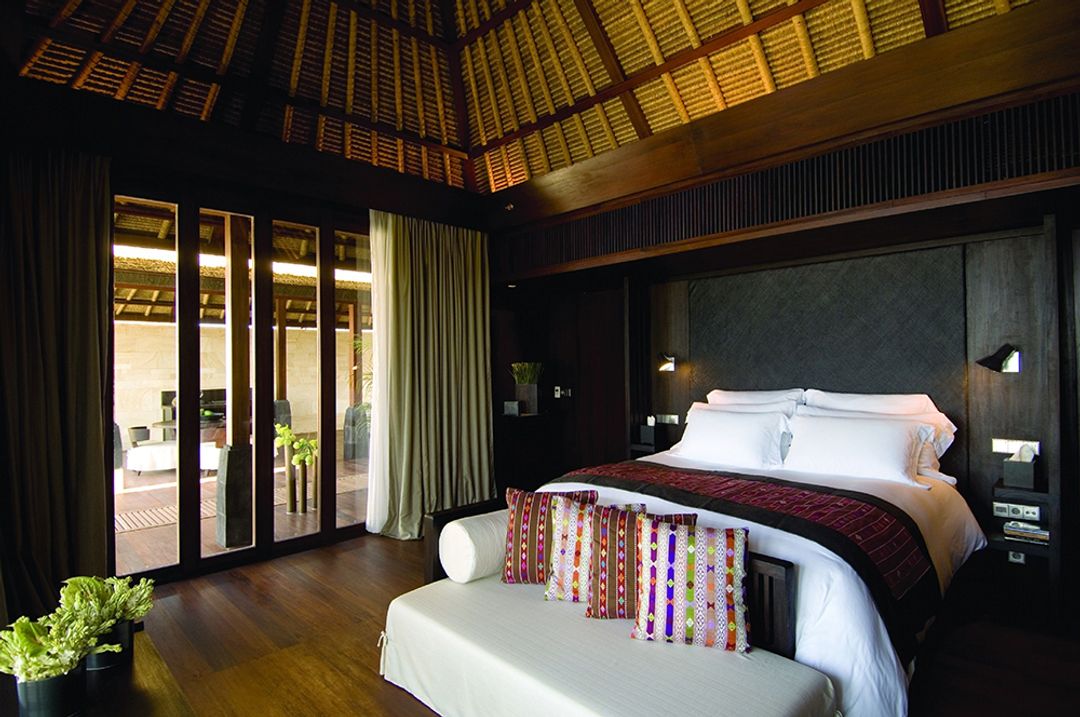
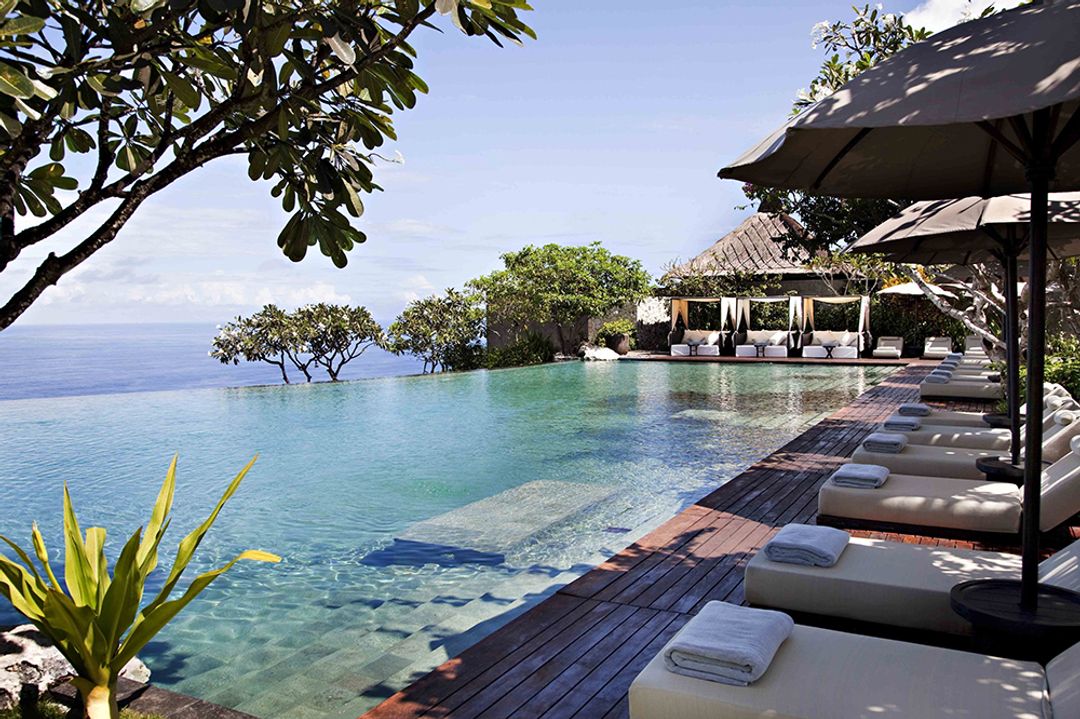
Carved into the limestone cliffs of Uluwatu on Bali's Bukit Peninsula, some 150 metres above the Indian Ocean, the Bulgari Resort Bali represents one of the more geographically audacious briefs the Italian house has ever pursued. Completed in 2006 and designed by Antonio Citterio Patricia Viel — the Milan studio responsible for all Bulgari hotel properties — the resort distributes 59 villas and suites across a dramatically terraced clifftop site, each pavilion oriented to hold the ocean horizon. The thatched alang-alang roofs, dark ironwood timber columns, and volcanic paras stone walls draw directly from Balinese vernacular architecture, but the proportions have been tightened and the palette pushed toward the austere end of tropical luxury. Inside the villas, deep-stained hardwood floors run beneath soaring woven-bamboo ceilings, the beds dressed with ikat textiles in magenta and indigo that carry the room's only concentrated colour against walls panelled in near-black timber. The cliff-edge infinity pool extends as a sheet of turquoise toward frangipani trees and open sky, its teak deck lined with cream-cushioned sunbeds that keep the eye moving outward rather than inward. The Ju-Ma-Na restaurant at dusk — two dark timber pavilions flanking a central water channel, white-clothed tables stepping down toward a stone-carved backdrop — has the ceremonial quality of a temple compound repurposed with remarkable restraint.

Book with PB and get cash back
COMO Uma Canggu - Image 1
COMO Uma Canggu - Image 2
COMO Uma Canggu - Image 3
COMO Uma Canggu - Image 4
COMO Uma Canggu - Image 5

COMO Uma Canggu

Bali • Canggu • OPTIMIZE

avg. $235 / night

Includes $12 / night in cash back

Cash back is redeemable via Virtual Visa, Venmo, or bank transfer starting 24-48 hours after check-out

COMO Uma Canggu Design Editorial

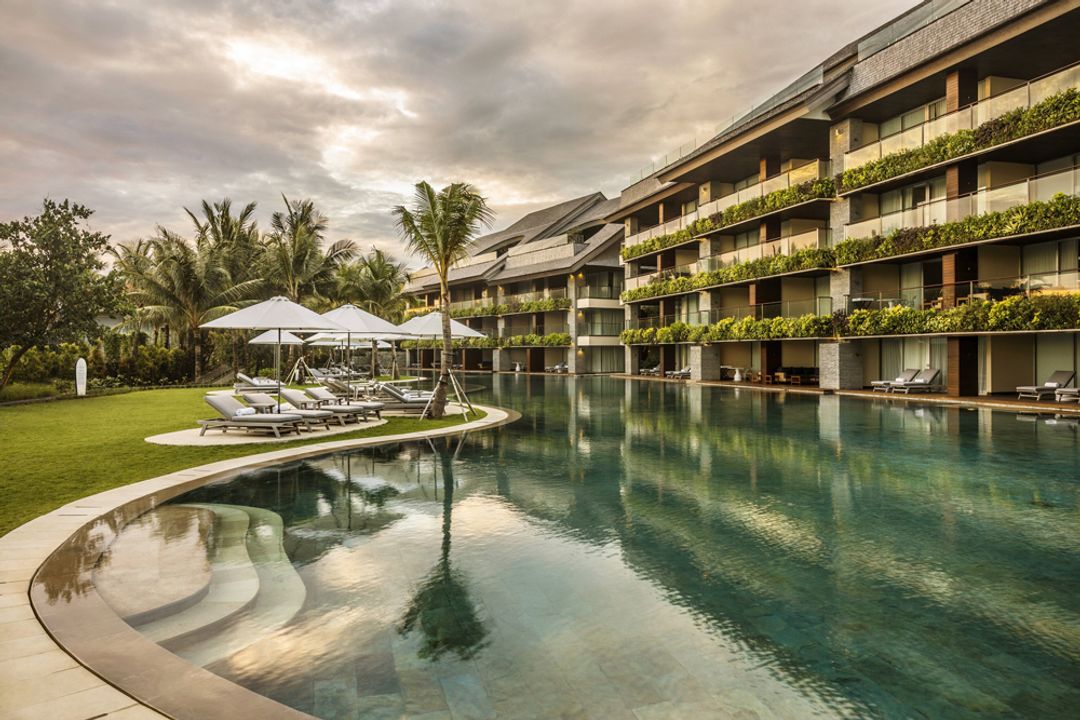
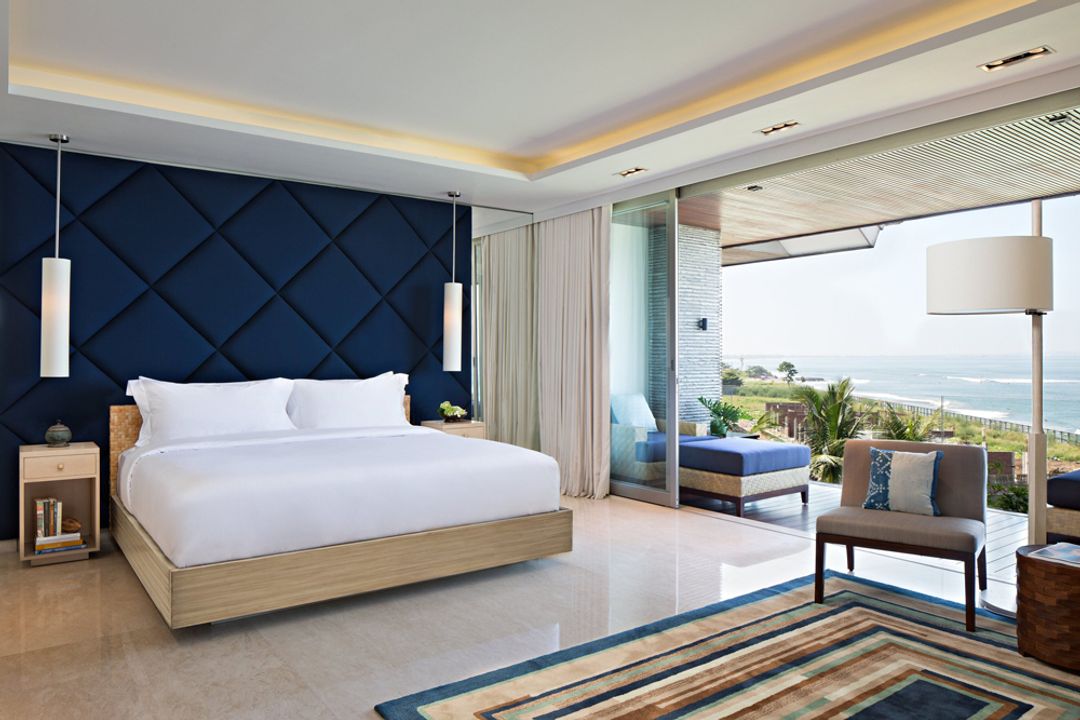
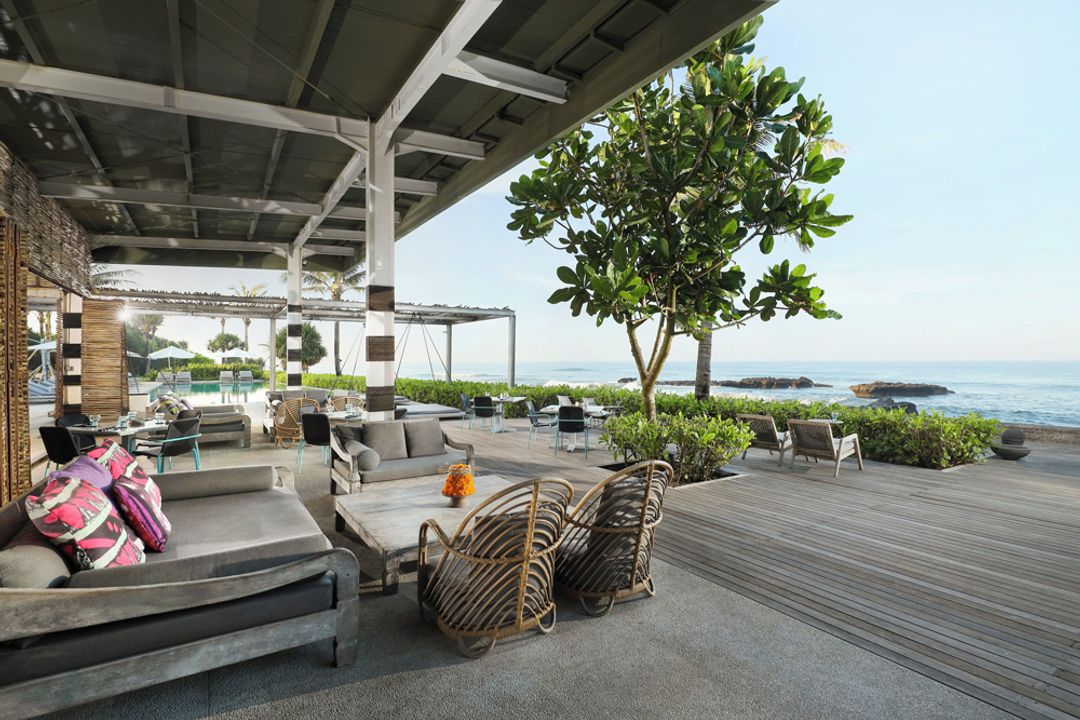
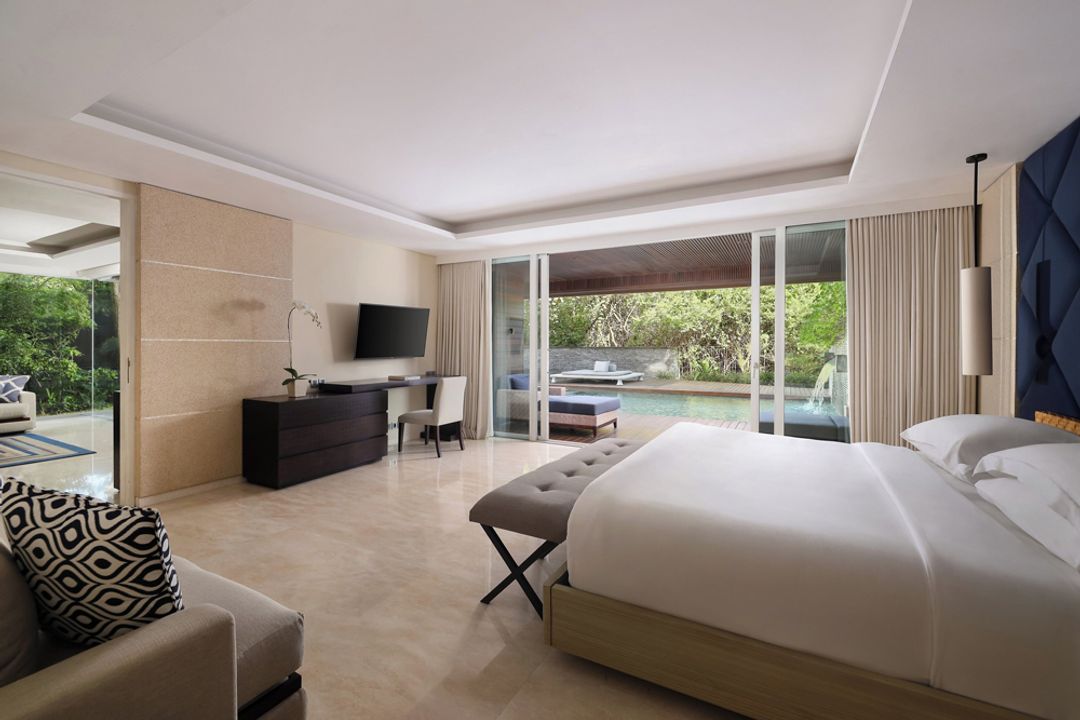
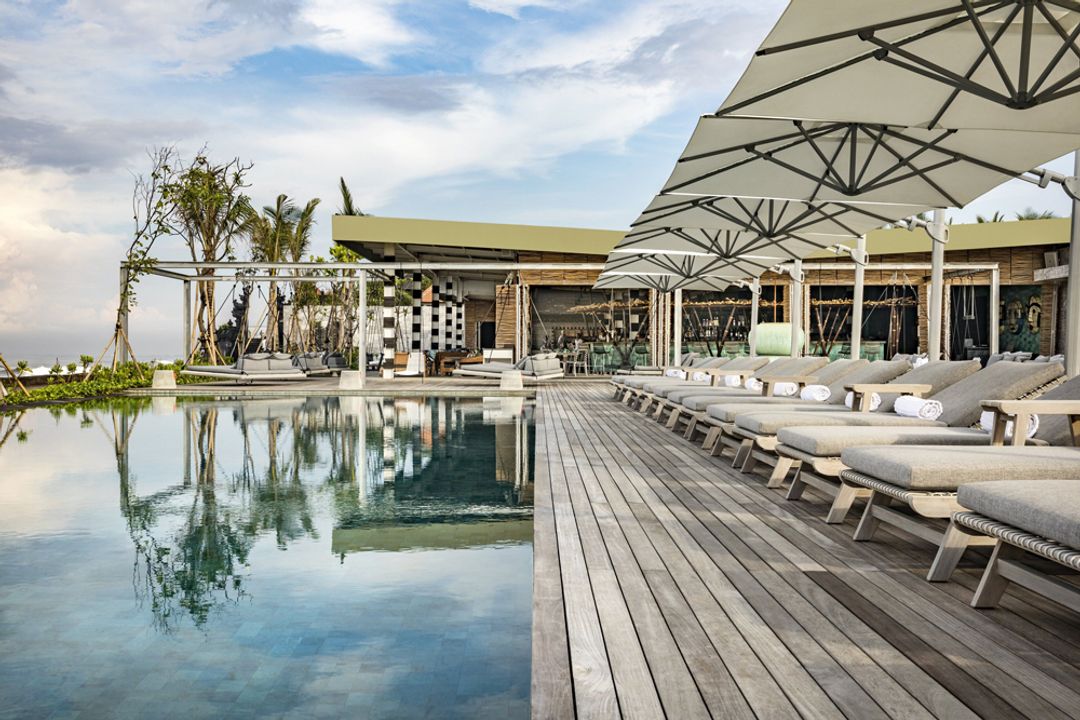
Canggu's surf-village identity — part rice-field bohemia, part creative expat enclave — made it an unlikely address for a COMO property when COMO Uma Canggu opened in 2016, and the design brief had to hold both registers without losing either. Architect Grounds Kent and interior designer Koichiro Ikebuchi navigated that tension by stacking a low-rise concrete and dark-timber block along the Indian Ocean shoreline, its tiered balconies planted with dense trailing greenery that softens what might otherwise read as resort formalism. The pool — a long, kidney-curved body of water pressed directly against the ground-floor rooms — dissolves the boundary between accommodation wing and garden in a way that owes more to the compound villas of Seminyak's earlier generation than to conventional hotel planning. Inside the 119 rooms and villas, the palette runs to cream travertine floors, pale oak bed platforms, and deep navy diamond-quilted headboards that pull the colour of the sea indoors. Sliding glass walls open entire room faces onto private terraces or plunge pools framed by timber slatted screens. The beach club, visible in the images as an open-sided pavilion of white-painted steel and woven bamboo panels with characteristic Balinese black-and-white poleng check columns, leans harder into the Canggu vernacular — rattan lounge chairs, grey linen day beds, vivid ikat cushions — giving the property two distinct moods that coexist without contradiction.

Book with PB and get cash back
Hidden Hills Villas - Image 1
Hidden Hills Villas - Image 2
Hidden Hills Villas - Image 3
Hidden Hills Villas - Image 4
Hidden Hills Villas - Image 5

Hidden Hills Villas

Bali • Uluwatu • SPLURGE

avg. $302 / night

Includes $16 / night in cash back

Cash back is redeemable via Virtual Visa, Venmo, or bank transfer starting 24-48 hours after check-out

Hilton Honors™ property

Hidden Hills Villas Design Editorial

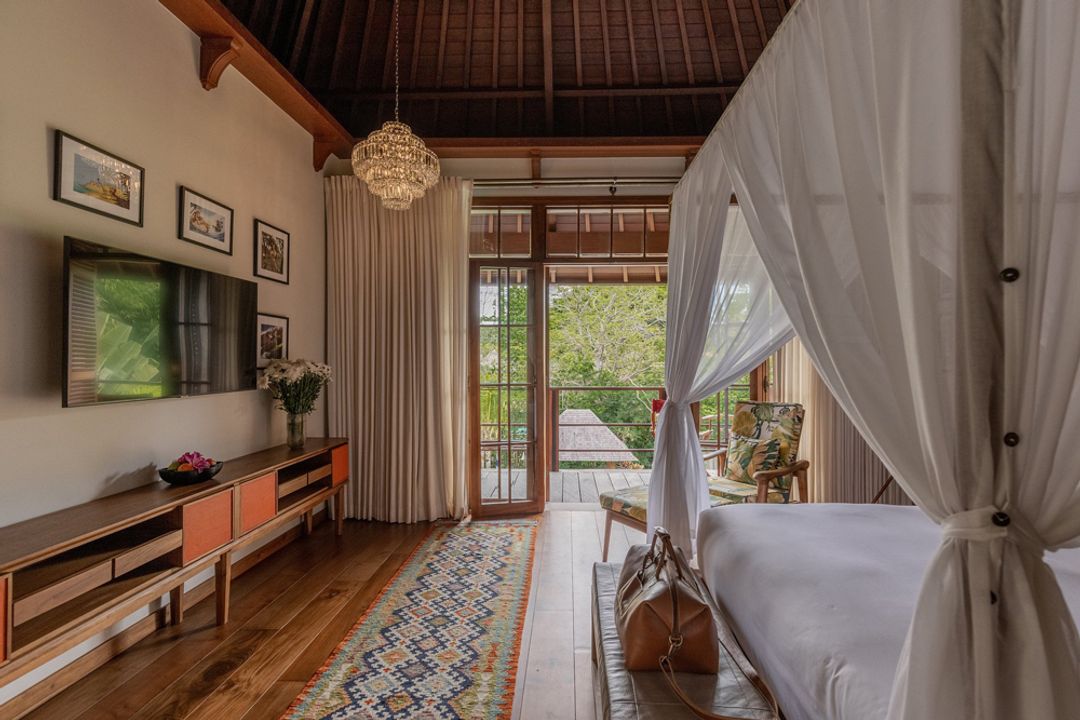
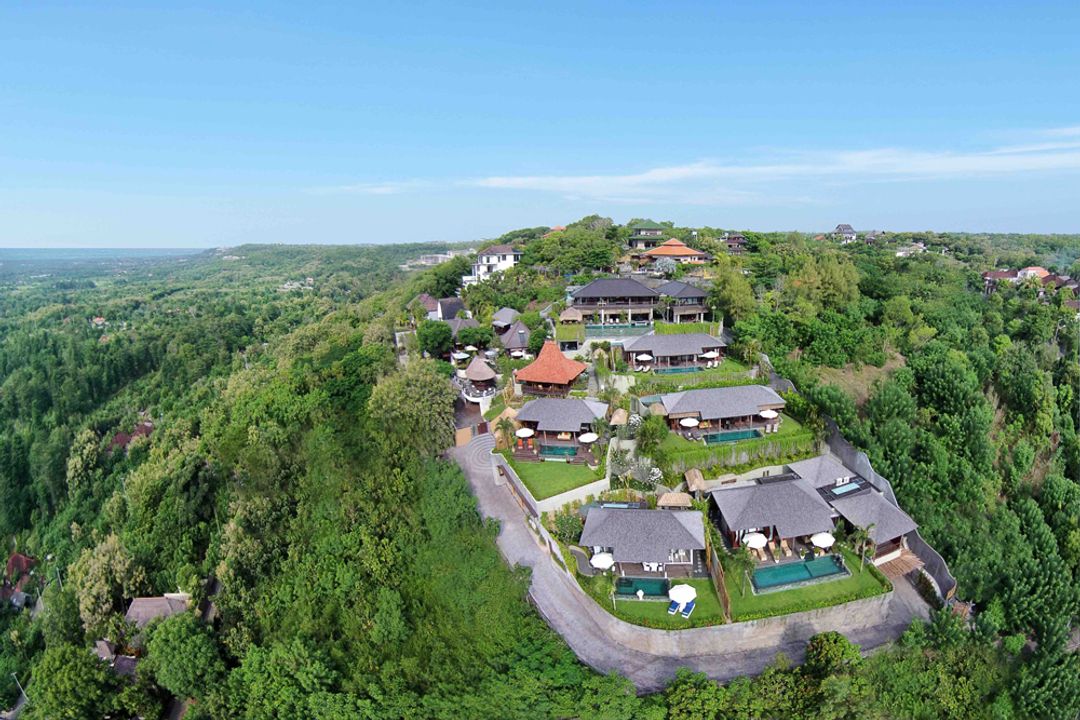
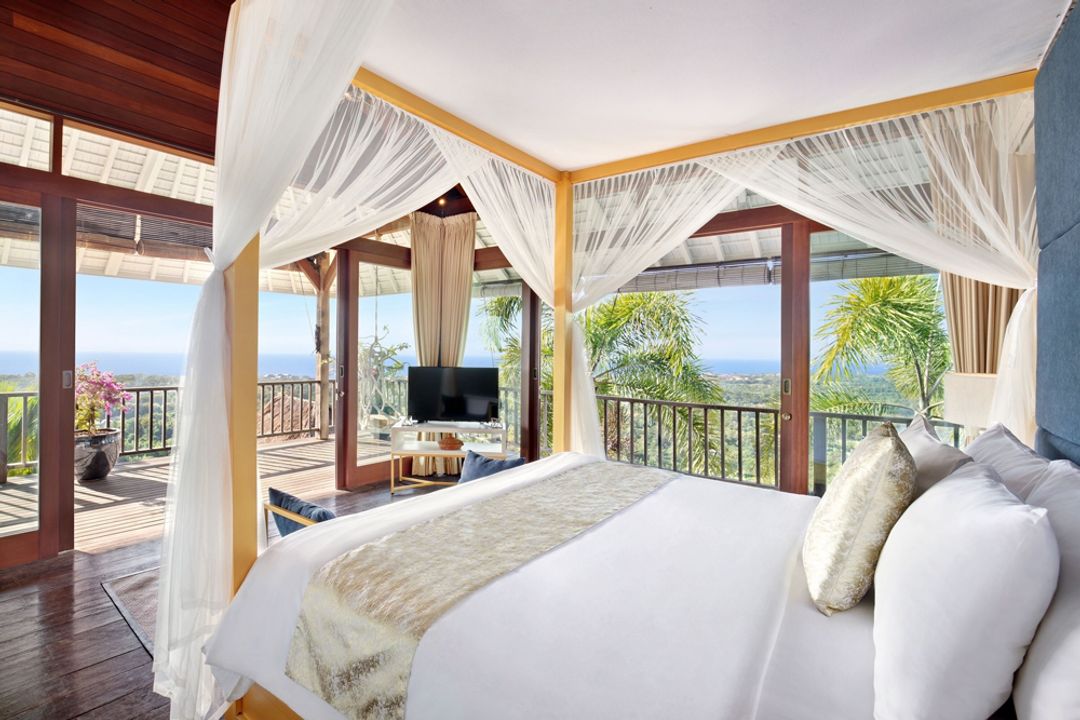
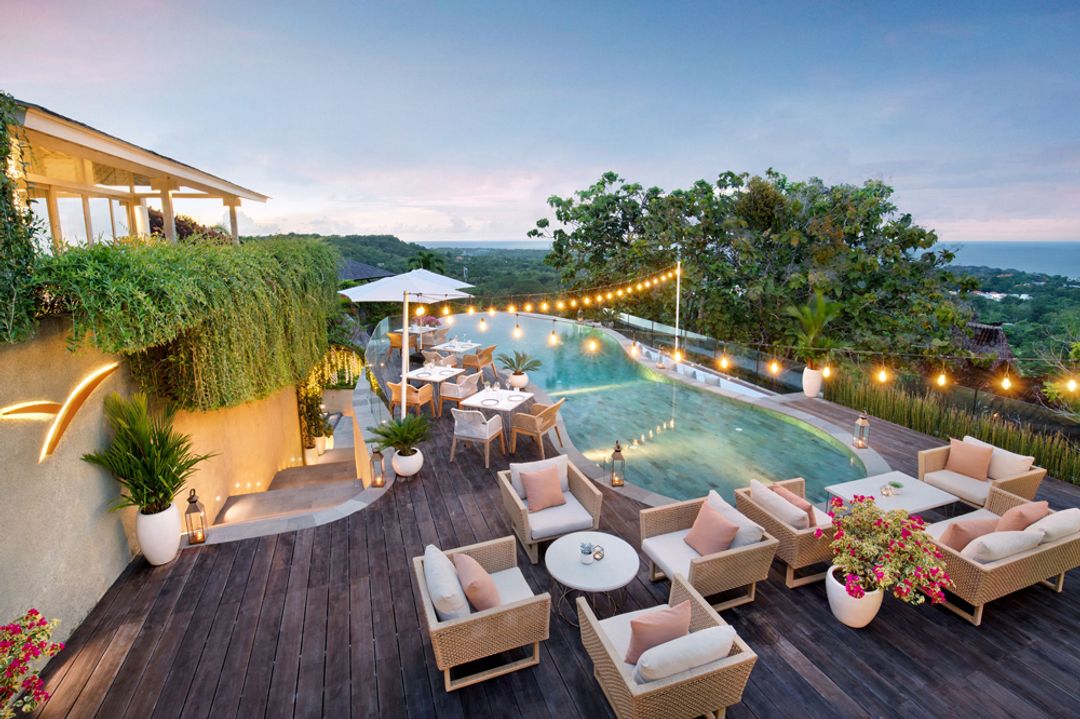
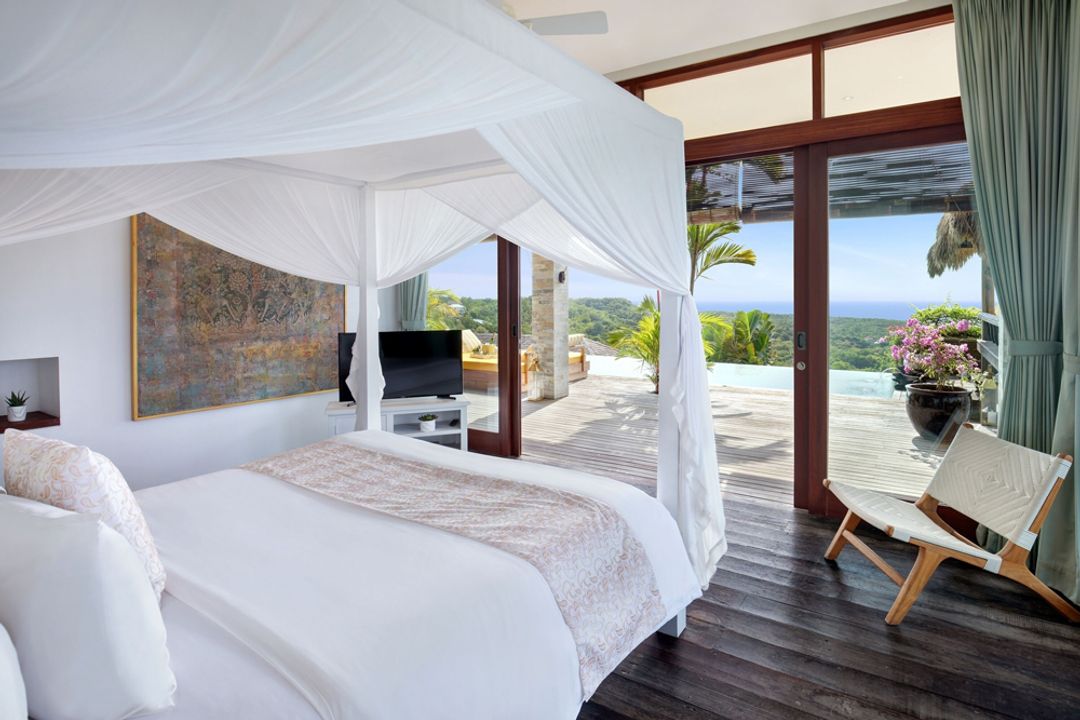
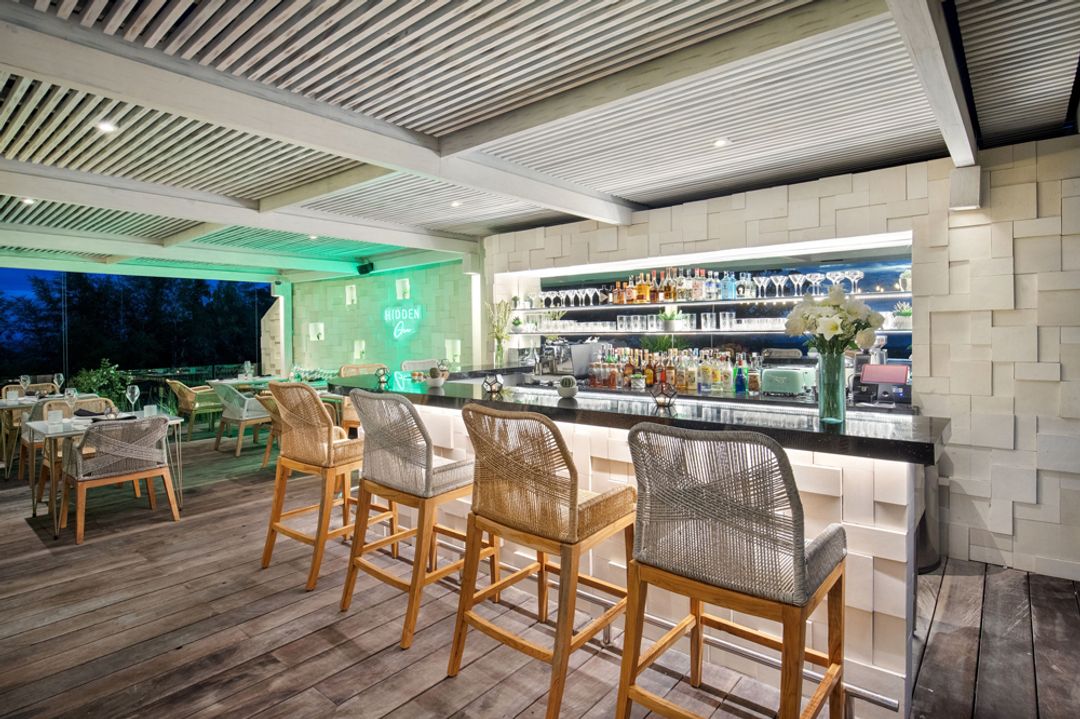
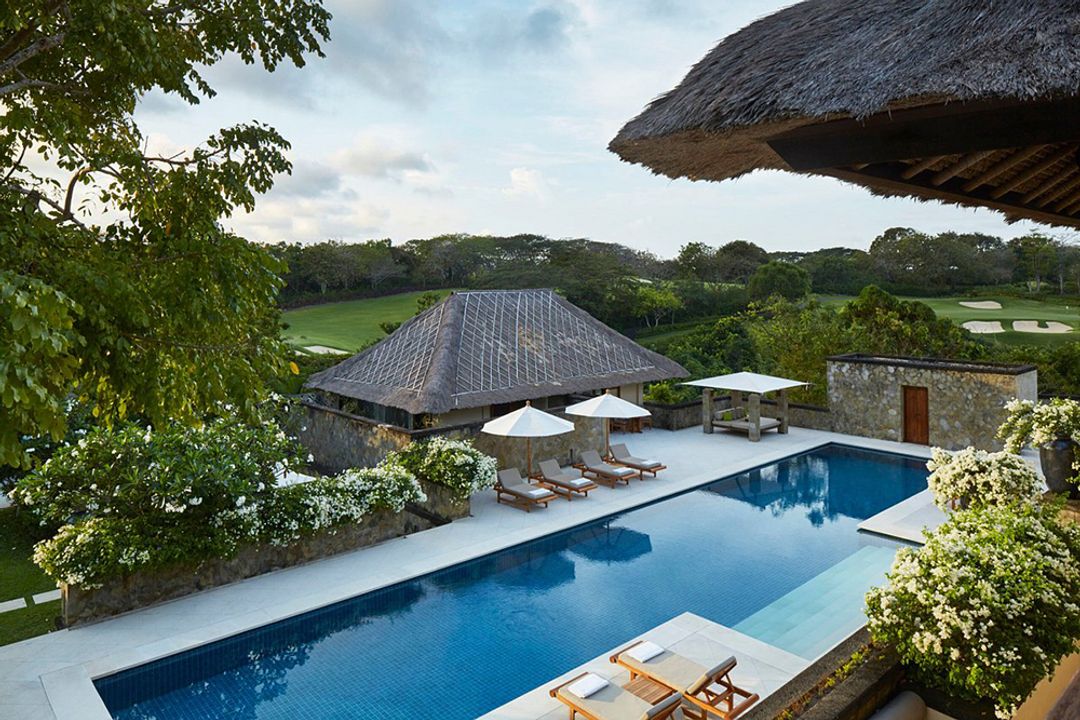
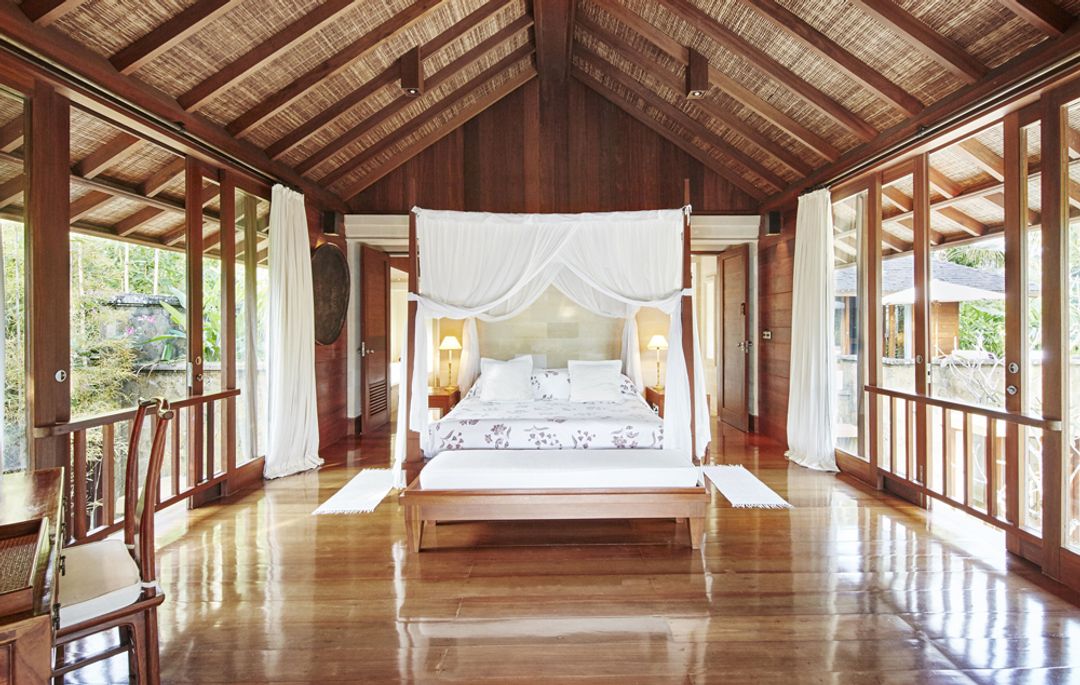
Scattered across a limestone ridge on Bali's Bukit Peninsula, where the land rises sharply before the cliffs drop toward the Indian Ocean, Hidden Hills Villas arranges its pavilions in the manner of a Balinese hillside village — each structure claiming its own terrace, its own pool, its own sightline through the jungle canopy to the sea beyond. The aerial view confirms what the concept promises: traditional alang-alang and dark timber rooflines dispersed among dense tropical planting, the compound feeling discovered rather than constructed. Inside the villas, the approach balances vernacular warmth against a cleaner contemporary sensibility. Dark ironwood floors run beneath canopied four-poster beds dressed in white linen, their gossamer curtains caught in the cross-breeze that moves through fully retractable timber-framed doors. One bedroom carries an ochre-washed ceiling and bold Balinese painting above the headboard, grounding the space in island craft without tipping into pastiche; another strips the palette back entirely to white, with a teak butterfly chair as the sole accent. The communal areas shift register toward something more polished — the Hidden Gem bar and restaurant features tactile white-stacked limestone cladding, woven-rattan bar stools on teak frames, and a louvred ceiling that mediates between interior and open air. At dusk, the infinity pool terrace, strung with warm filament lights and furnished in blush-cushioned wicker, draws the two halves of the property together in a register that is entirely, self-assuredly Uluwatu.

Book with PB and get cash back
Jimbaran Puri, A Belmond Hotel - Image 1
Jimbaran Puri, A Belmond Hotel - Image 2
Jimbaran Puri, A Belmond Hotel - Image 3
Jimbaran Puri, A Belmond Hotel - Image 4
Jimbaran Puri, A Belmond Hotel - Image 5

Jimbaran Puri, A Belmond Hotel

Bali • Jimbaran Bay • SPLURGE

avg. $323 / night

Includes $17 / night in cash back

Cash back is redeemable via Virtual Visa, Venmo, or bank transfer starting 24-48 hours after check-out

Jimbaran Puri, A Belmond Hotel Design Editorial

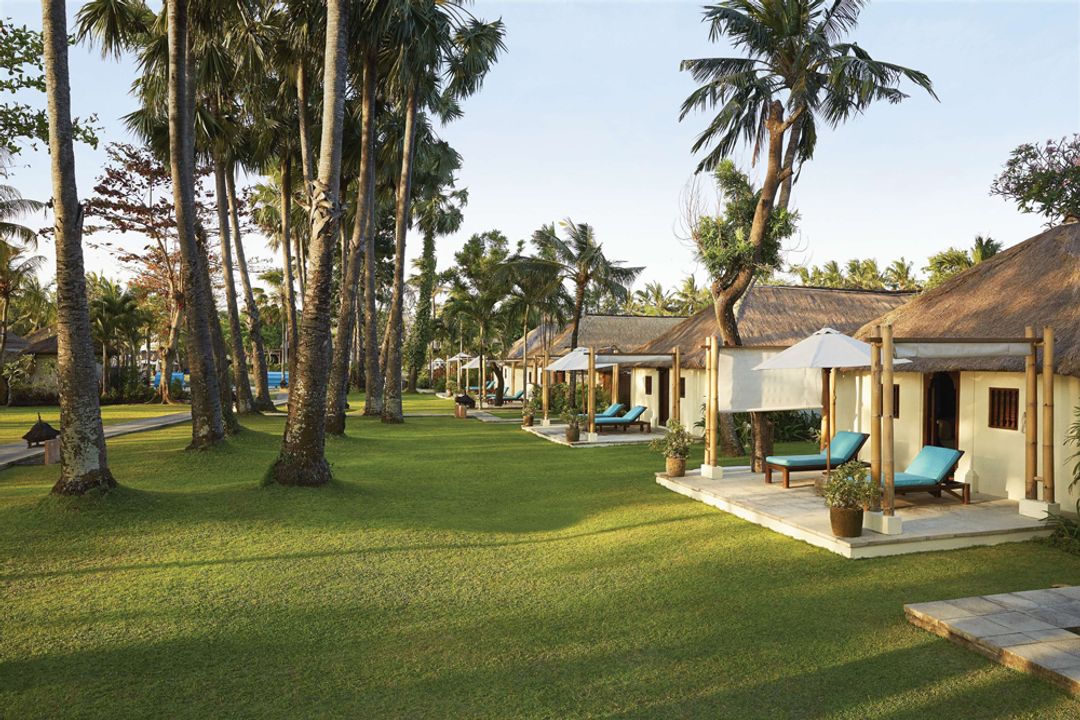
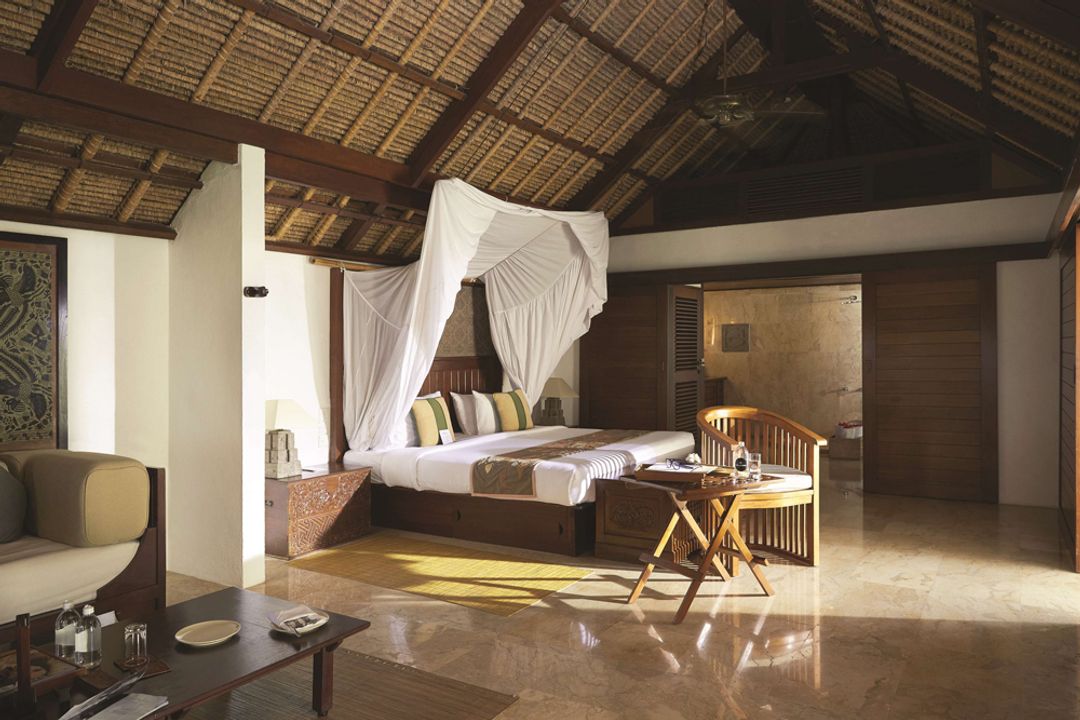
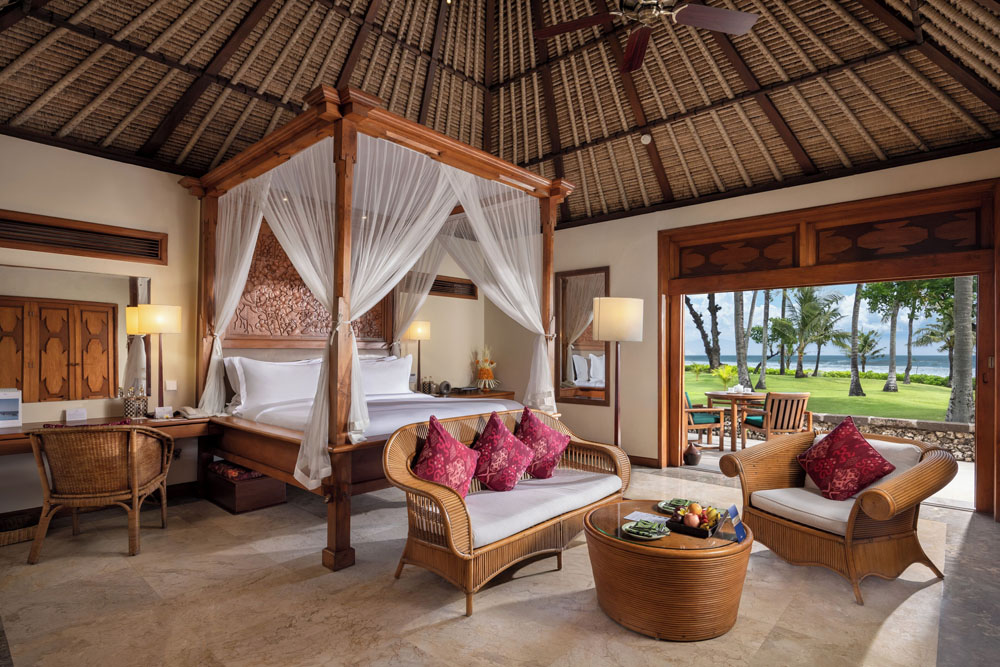
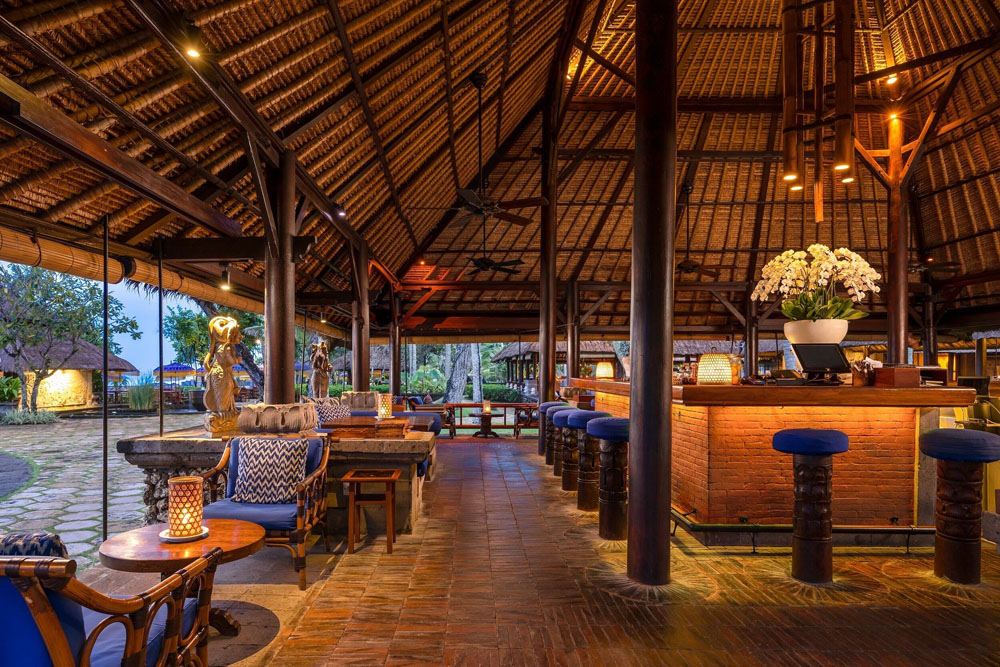
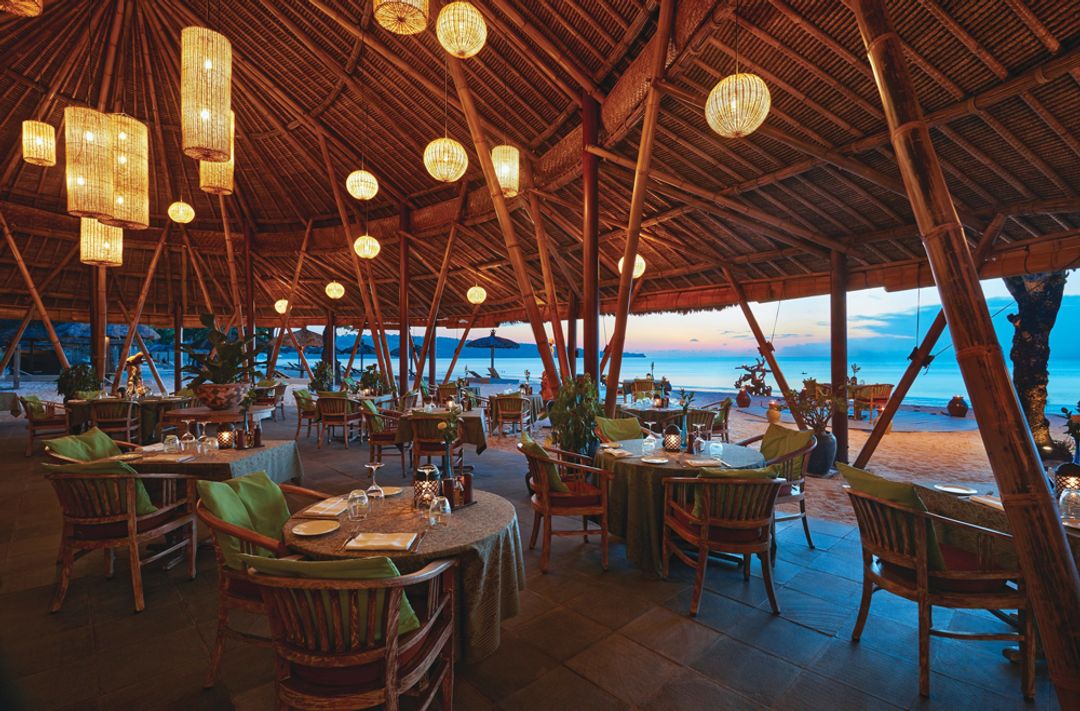
Strung along Jimbaran Bay's western shore, where a sweep of white sand meets the calm waters of the Indian Ocean, a collection of thatched bungalows set within ten acres of tropical garden established one of Bali's earliest templates for resort design. Jimbaran Puri, now part of the Belmond portfolio, was conceived by California-based designer Peter Muller in the early 1990s as a conscious rejection of the monolithic hotel block — low-slung alang-alang thatched pavilions dispersed across manicured lawns planted with coconut palms and frangipani, each structure oriented to preserve sightlines across the grounds toward the sea. The 41 one- and two-storey bungalows draw on the vernacular architecture of traditional Balinese compounds, their whitewashed masonry walls and steeply pitched roofs recalling the domestic scale of a Balinese village rather than international resort convention. Inside, the rooms carry polished travertine floors, carved dark-timber bed platforms, and four-poster canopied beds draped in white cotton, the exposed alang-alang ceilings rising dramatically above to reveal their full structural geometry. Ikat-patterned textiles and carved headboard panels in the Balinese tradition give the interiors a specific cultural grounding that avoids generic tropical decoration. The beachfront restaurant, a soaring open-sided structure of lashed bamboo columns and rattan pendant lamps, frames the bay at dusk through its entirely open perimeter — a room that is essentially a sheltered extension of the beach itself, with teak and rattan armchairs arranged around candlelit tables on a stone-flagged floor.

Book with PB and get cash back
W Bali - Seminyak - Image 1
W Bali - Seminyak - Image 2
W Bali - Seminyak - Image 3
W Bali - Seminyak - Image 4
W Bali - Seminyak - Image 5

W Bali - Seminyak

Bali • Seminyak Beach • SPLURGE

avg. $341 / night

Includes $18 / night in cash back

Cash back is redeemable via Virtual Visa, Venmo, or bank transfer starting 24-48 hours after check-out

Marriott Bonvoy® property

W Bali - Seminyak Design Editorial

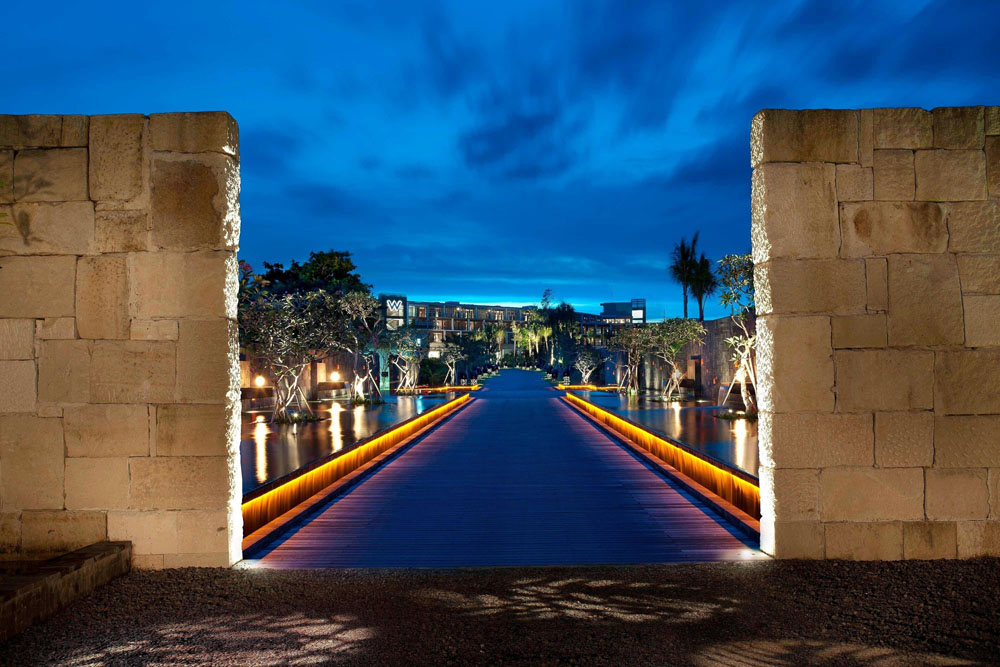
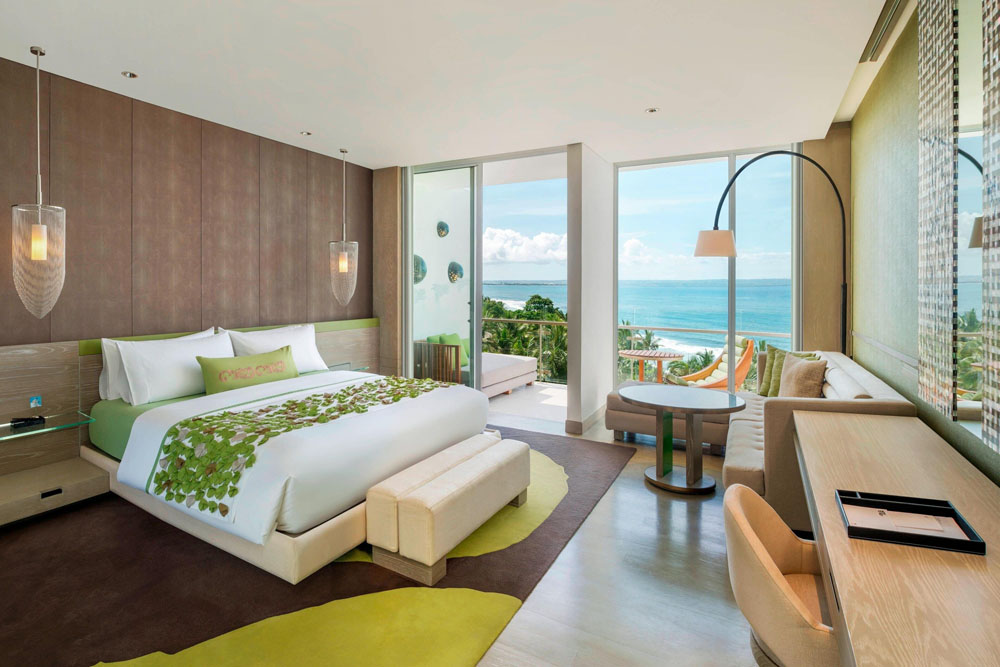
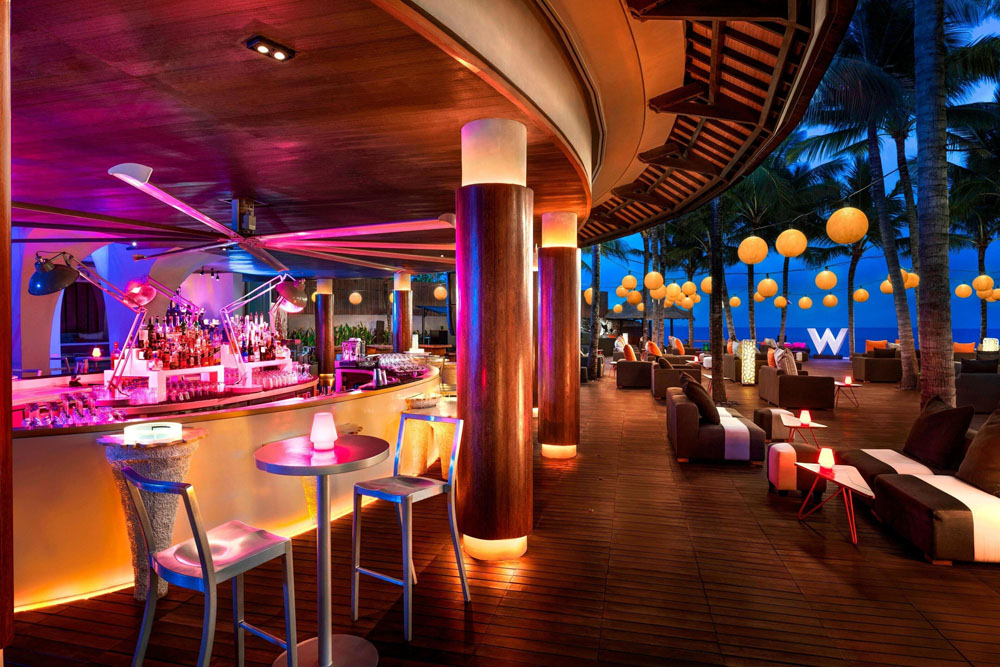
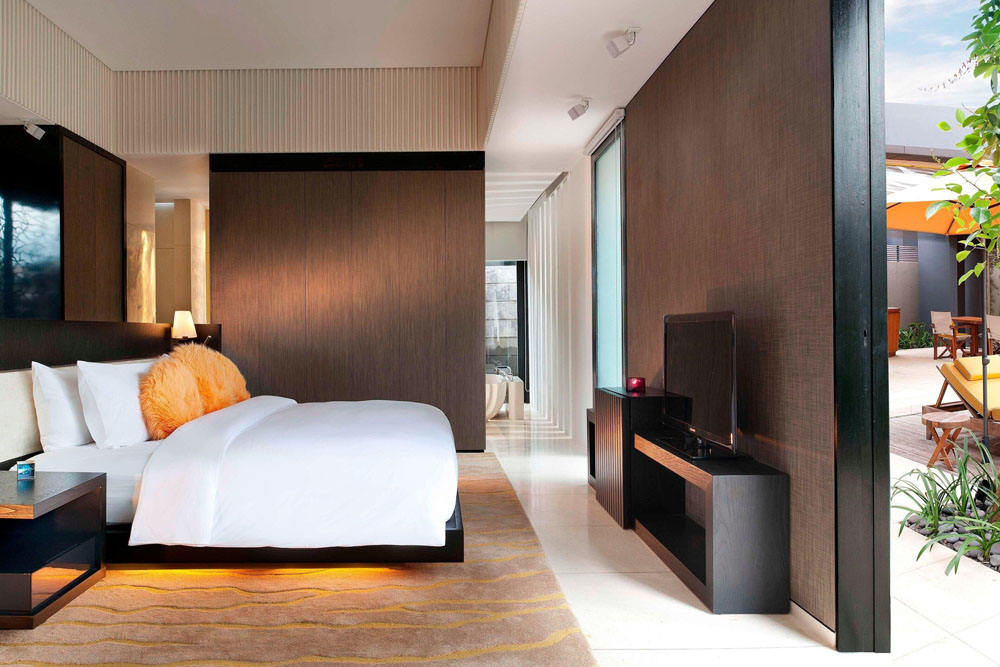
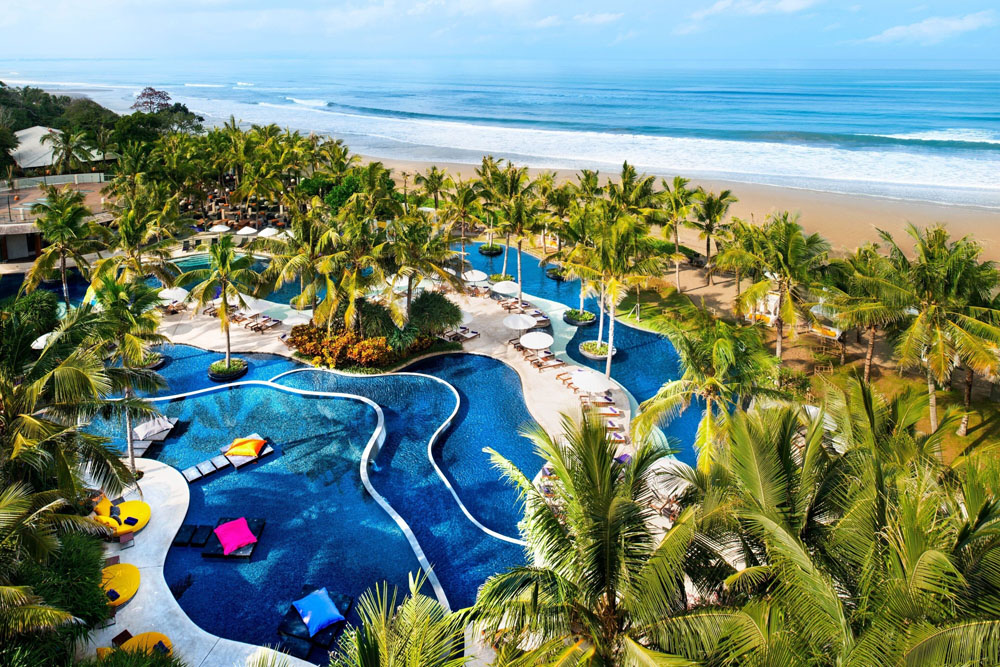
Carved from Seminyak's beachfront through a dramatic gateway of rough-hewn volcanic sandstone blocks — the kind of paras stone that has defined Balinese sacred architecture for centuries — W Bali Seminyak sets its contemporary ambitions against an ancient material language from the first moment of arrival. The illuminated timber boardwalk that cuts between shallow reflection pools toward the resort's main building establishes the design's central tension: a globally branded sensibility rendered through locally resonant forms. Opened in 2011 and spread across a low-rise complex directly fronting the Indian Ocean, the property houses 237 rooms, suites, and villas across terraced structures that keep their profile deliberately horizontal against the palm canopy. The interiors move between two distinct registers. Ocean-facing rooms deploy floor-to-ceiling glazing, warm timber wall panelling, and chartreuse-accented bedding that pulls the tropical garden into the colour palette, while the villa accommodation shifts darker — ebonised timber joinery, wave-patterned wool rugs in amber and sand, platform beds with underlit bases casting a warm amber wash. The WET pool deck, its freeform blue-tiled water bodies threading between coconut palms to the beach, carries the brand's signature chromatic energy in its scatter of magenta and yellow float cushions. At night, the WOOBAR beach club draws the full resort down to the shore, its circular timber-ceilinged bar flanked by glowing globe lanterns strung through the palms — playful, loud, and entirely intentional.

Book with PB and get cash back
The Legian Seminyak, Bali - Image 1
The Legian Seminyak, Bali - Image 2
The Legian Seminyak, Bali - Image 3
The Legian Seminyak, Bali - Image 4
The Legian Seminyak, Bali - Image 5

The Legian Seminyak, Bali

Bali • Seminyak Beach • SPLURGE

avg. $468 / night

Includes $25 / night in cash back

Cash back is redeemable via Virtual Visa, Venmo, or bank transfer starting 24-48 hours after check-out

LHW Leaders Club property

The Legian Seminyak, Bali Design Editorial

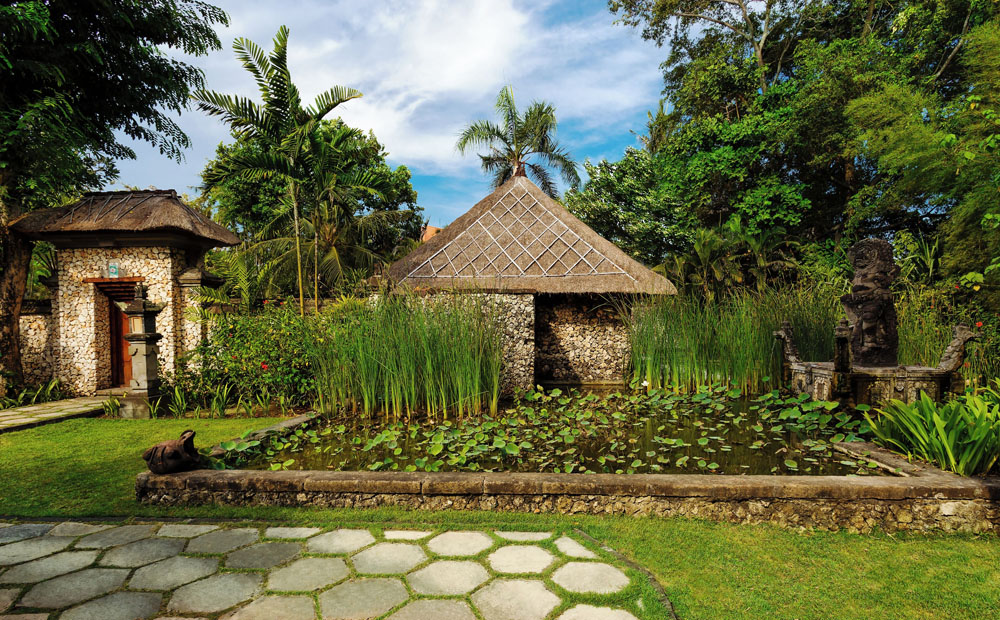
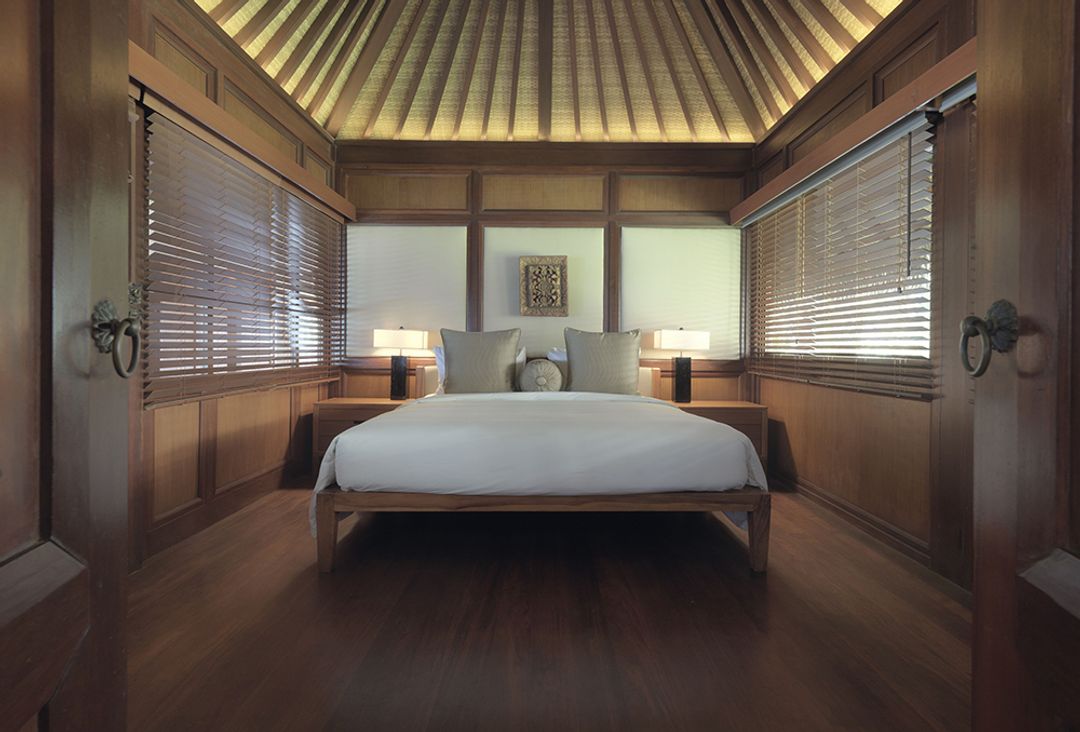
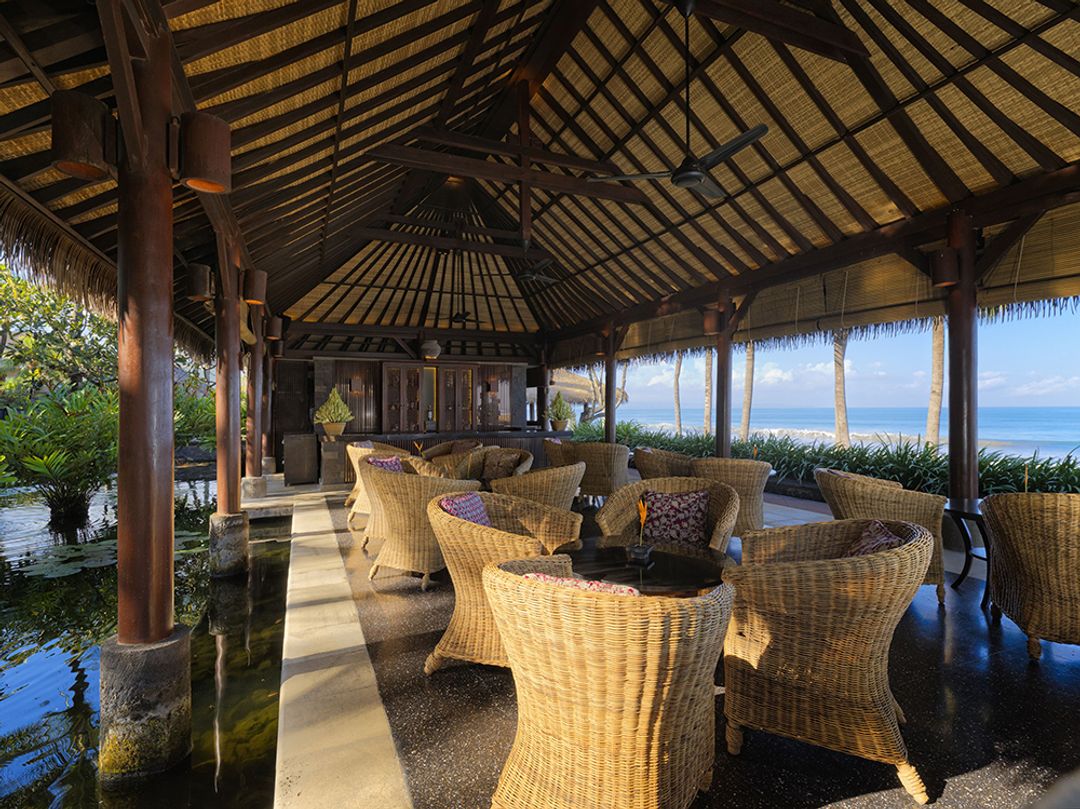
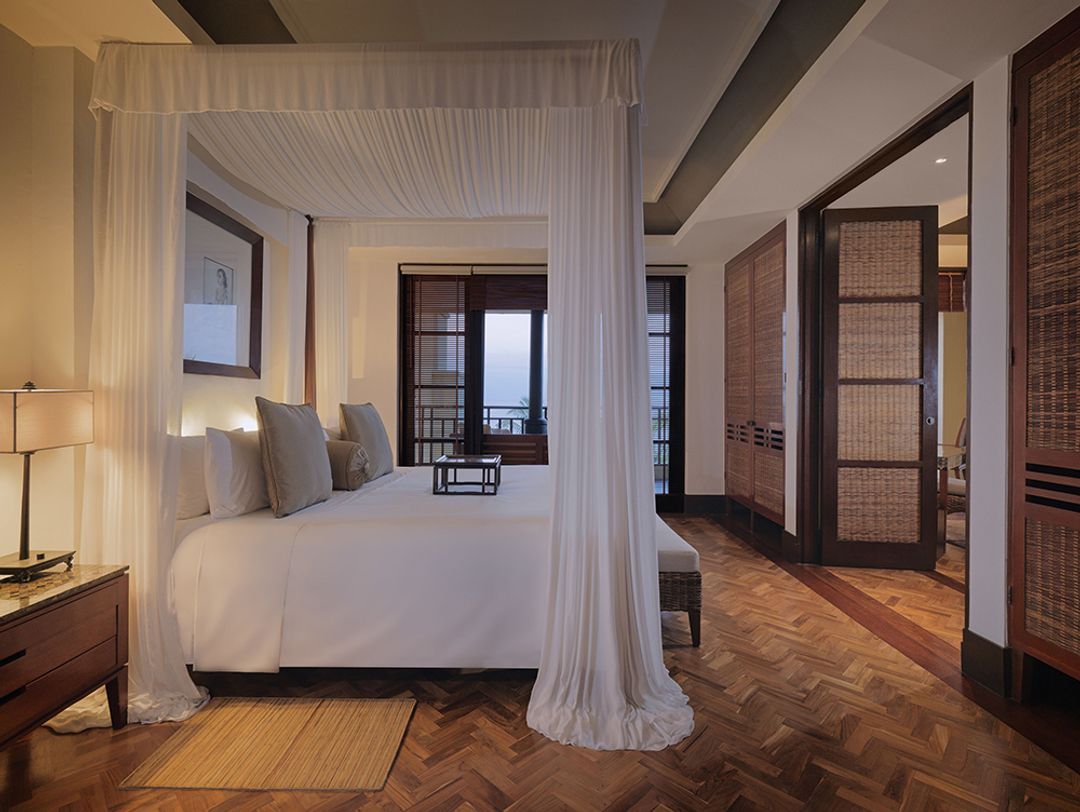
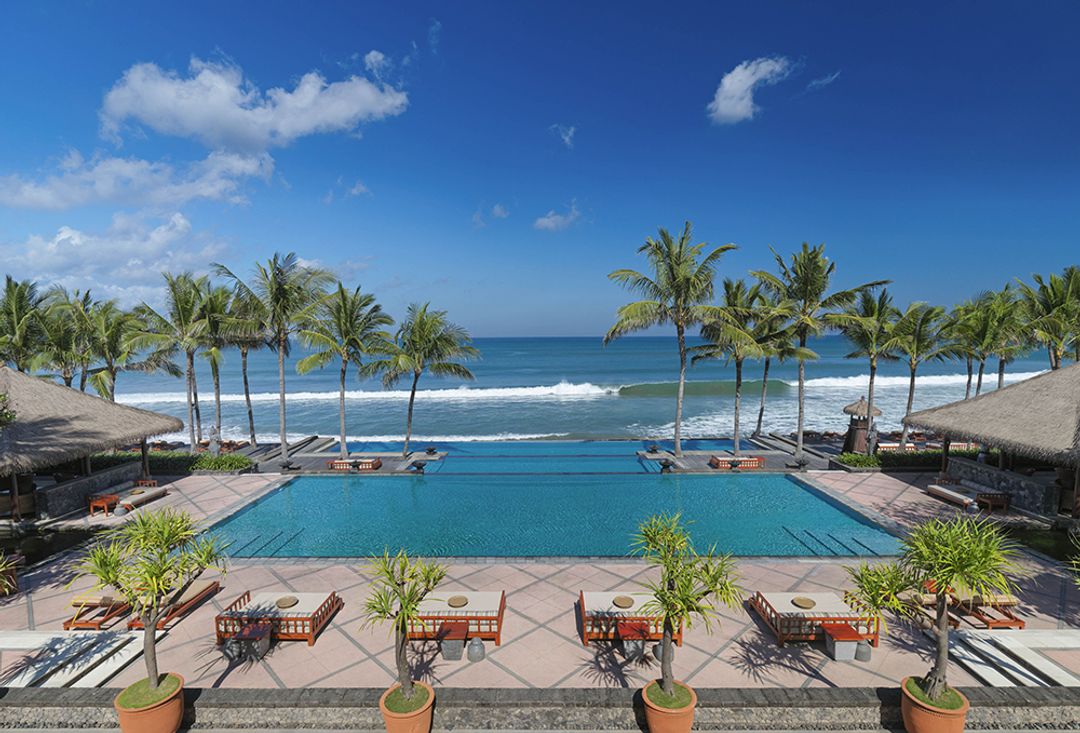
Directly above Seminyak Beach, where the Indian Ocean arrives with enough force to discourage casual swimming, a low-rise compound of thatched pavilions and alang-alang rooflines has held its position since 1997 as the definitive argument for Balinese resort architecture at its most considered. The Legian Seminyak Bali was conceived by Singapore-based architect Kerry Hill, whose approach here — as at Amanjiwo and his later work across Asia — treated traditional Balinese construction not as decorative motif but as structural logic. Steep pitched roofs in hand-cut thatch, dark tropical timber columns, and carved stone detailing are deployed with a restraint that keeps the compound feeling more like a private estate than a hotel. The property holds just 67 suites across three floors, a room count that allows the landscape — lily ponds, coconut palms, volcanic stone pathways — to dominate the experience rather than yield to it. The interiors calibrate the same tension between local craft and contemporary ease. Bedroom pavilions are lined in warm teak panelling, their octagonal ceilings backlit to emphasise the geometry of the rafter structure, while upper-floor rooms in the main building feature herringbone timber floors and white linen four-poster canopies that soften the architecture without disguising it. The beach-facing bar sits beneath a great alang-alang canopy raised on dark timber posts above a reflective water feature, rattan bucket chairs arranged to face the surf line — a configuration that has barely needed updating in nearly three decades.

Book with PB and get cash back
Four Seasons Bali at Sayan - Image 1
Four Seasons Bali at Sayan - Image 2
Four Seasons Bali at Sayan - Image 3
Four Seasons Bali at Sayan - Image 4
Four Seasons Bali at Sayan - Image 5

Four Seasons Bali at Sayan

Bali • Ubud • OVER THE TOP

avg. $821 / night

Includes $43 / night in cash back

Cash back is redeemable via Virtual Visa, Venmo, or bank transfer starting 24-48 hours after check-out

Four Seasons Bali at Sayan Design Editorial

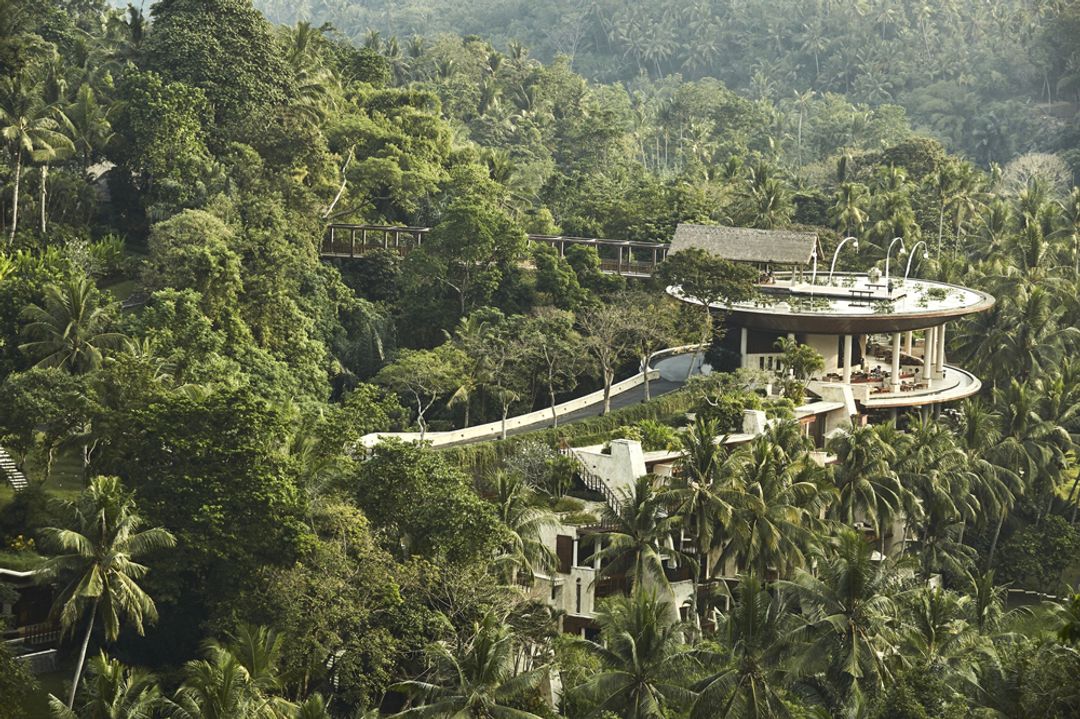
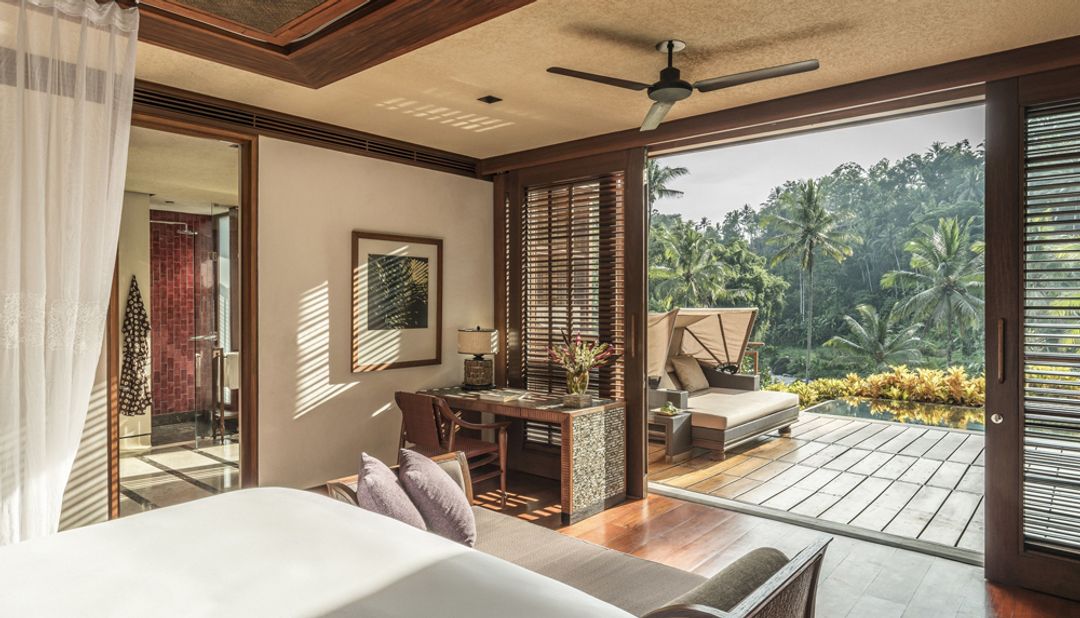
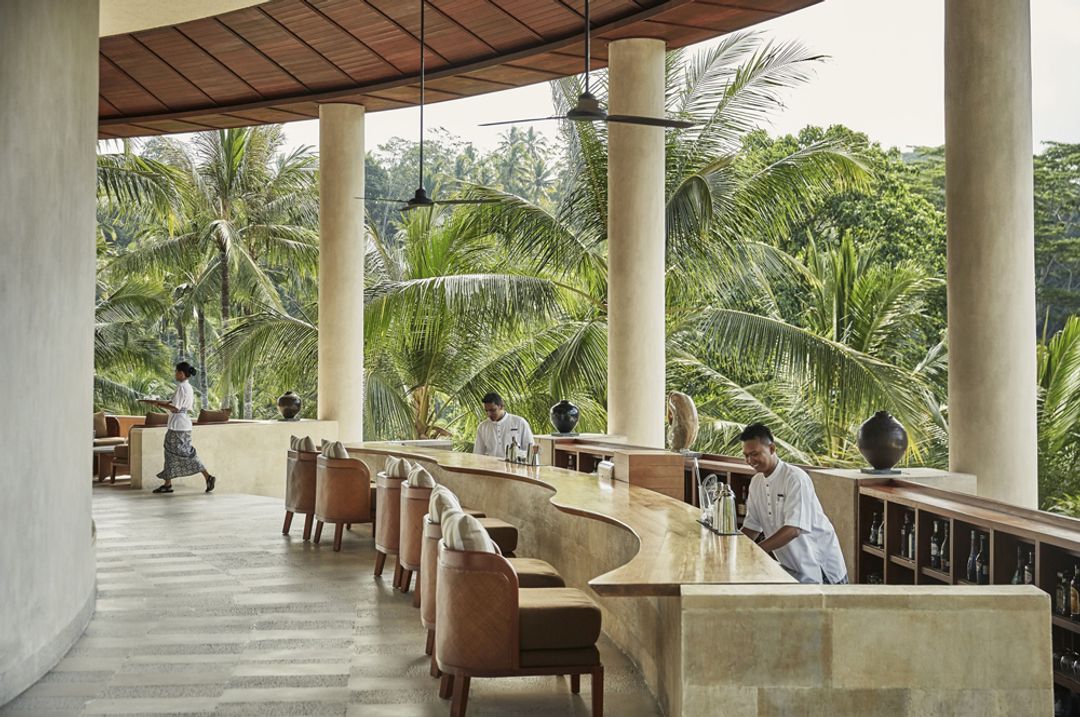
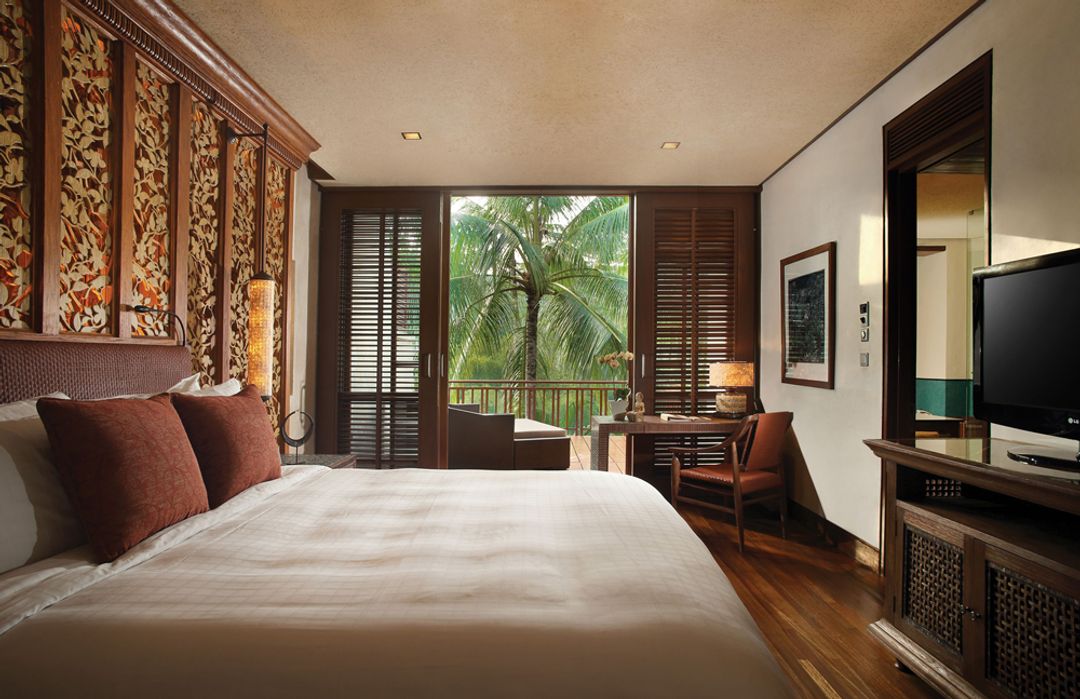
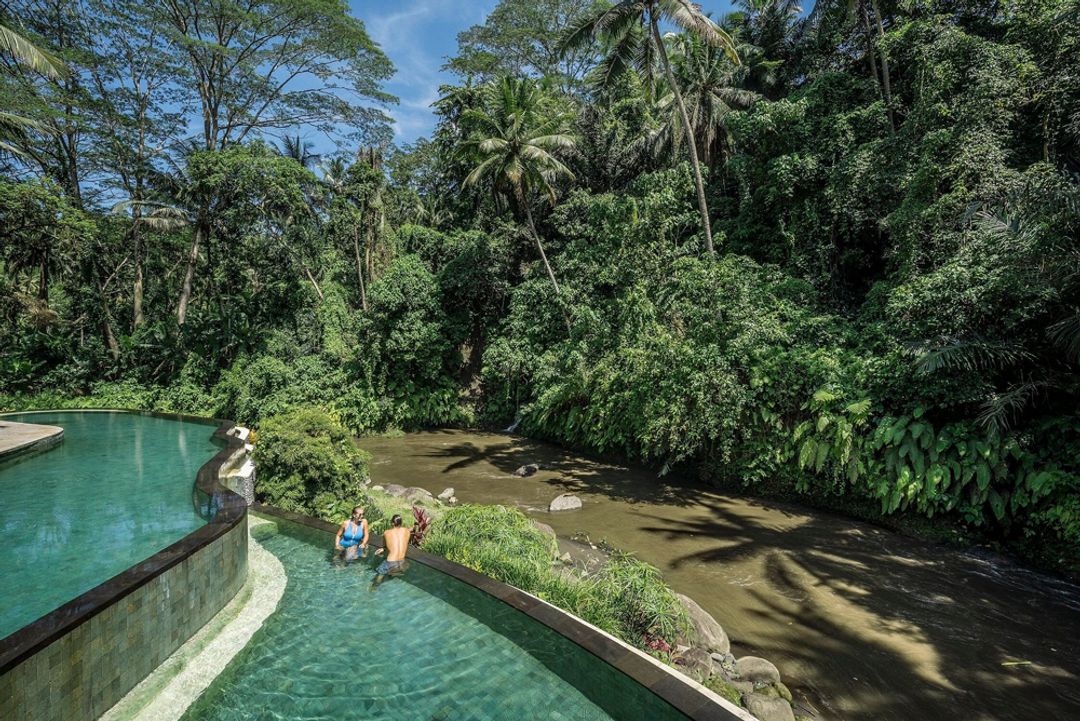
Hovering above the Ayung River gorge on a sculpted concrete platform, the Four Seasons Bali at Sayan represents one of the most spatially audacious hotel commissions of the 1990s — a building by John Heah that arrives not through a grand entrance but via a footbridge that deposits guests onto the roof of an elliptical lotus pond, from which they descend into the resort rather than climb toward it. That inversion of conventional arrival logic, conceived when the property opened in 1998, remains disorienting in the best possible way: the jungle canopy surrounds you before a single room comes into view. The 18 suites and 42 villas cascade down the steep river valley in terraced clusters, connected by pathways through stands of coconut palm and tropical hardwood. Interiors work through dark teak joinery, carved wooden headboards with intricate floral relief, and louvered shutters that dissolve the boundary between bedroom and the garden beyond — details drawn from Balinese craft traditions rather than imported as ornament. The pool deck at river level runs in a long sinuous curve directly above the Ayung, with mosaic-tiled lap pools edging close enough to the bank that the sound of moving water enters continuously. The bar's crescent-shaped limestone counter, set beneath a teak-slatted ceiling and open on all sides to the tree canopy, captures the property's central ambition: architecture that refuses to compete with the landscape it was built to serve.

Book with PB and get cash back
Aman Villas at Nusa Dua - Image 1
Aman Villas at Nusa Dua - Image 2
Aman Villas at Nusa Dua - Image 3
Aman Villas at Nusa Dua - Image 4
Aman Villas at Nusa Dua - Image 5

Aman Villas at Nusa Dua

Bali • Nusa Dua • OVER THE TOP

avg. $2,518 / night

Includes $133 / night in cash back

Cash back is redeemable via Virtual Visa, Venmo, or bank transfer starting 24-48 hours after check-out

Aman Villas at Nusa Dua Design Editorial

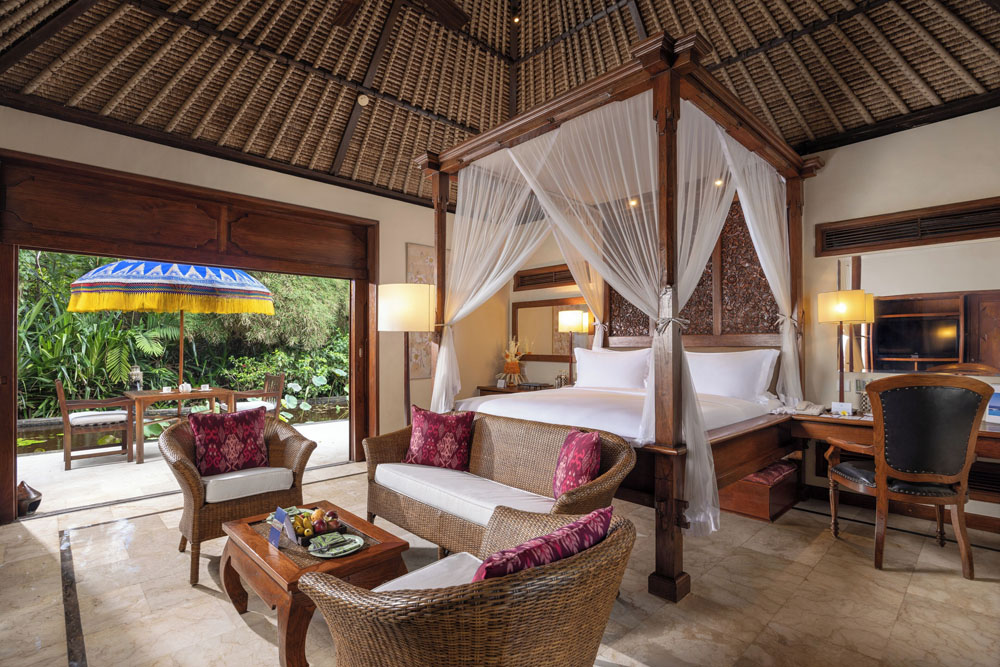
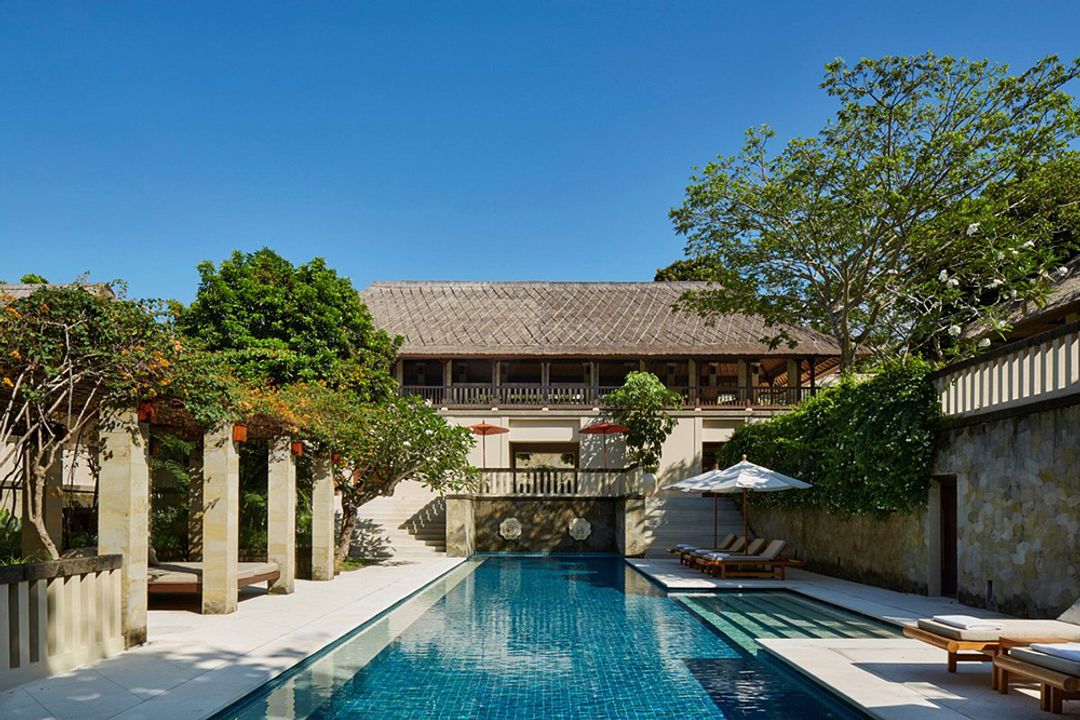
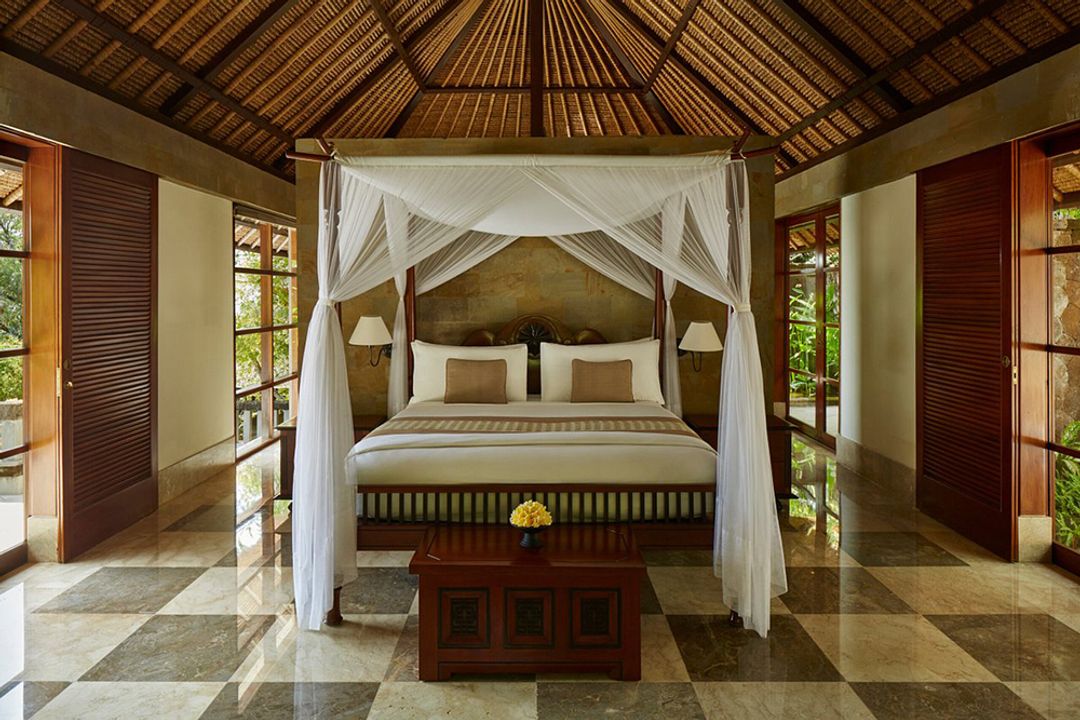
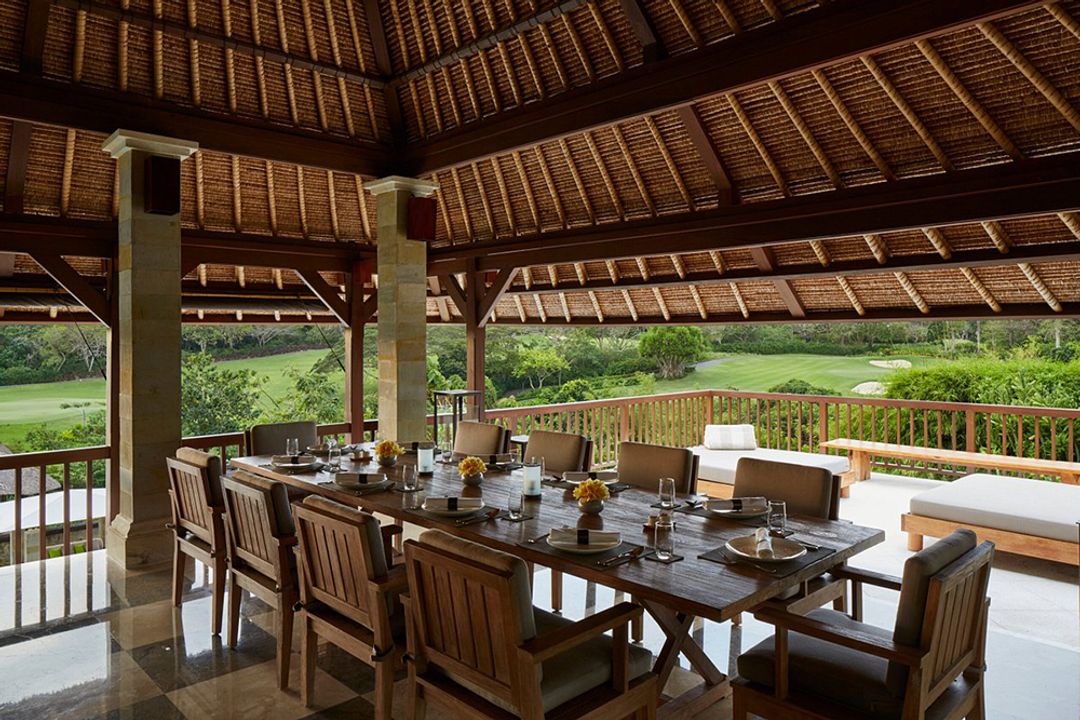
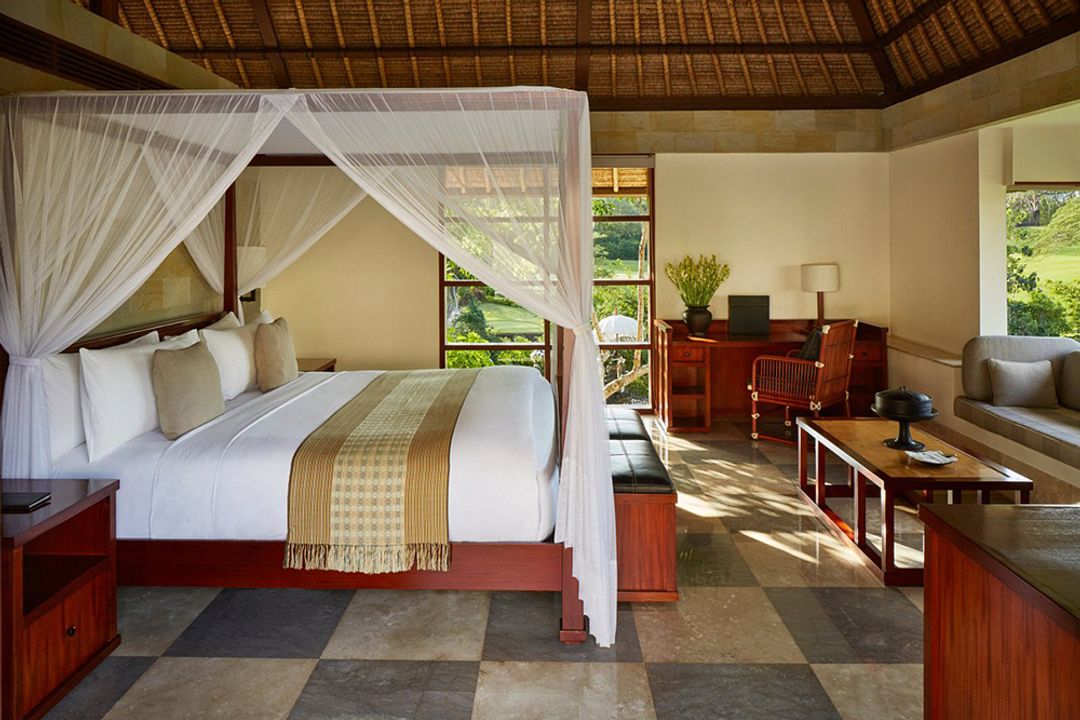
When Ed Tuttle conceived the original Amanusa on Bali's Nusa Dua peninsula in 1992, he drew the architecture directly from the aristocratic compound tradition of southern Bali — low pavilions arranged around courts, alang-alang thatch pulled low over deeply shaded verandahs, pale Balinese sandstone used for walls and colonnades rather than polished surfaces. The Aman Villas at Nusa Dua, a cluster of freestanding private residences woven into the Amanusa grounds, carries that same language forward at a more intimate scale, each villa configured as its own walled compound with a dedicated lap pool, teak sun deck, and open-sided bale dining pavilion overlooking the Nirwana golf course. Inside, the rooms layer handsome Balinese craft details against the mineral calm of checkerboard marble floors — local stone cut in alternating warm and cool tones — while four-poster beds draped in white mosquito net hang beneath alang-alang ceilings woven into radial patterns that concentrate the eye upward. Teak louvred shutters and dark-stained timber joinery frame each opening onto the gardens, the furniture mixing Balinese carved case pieces with rattan desk chairs and teak campaign-style tables. The palette throughout — raw stone, aged teak, ivory linen, ochre ikat throws — keeps the architecture in charge, the vegetation of frangipanis and bougainvillea doing as much compositional work as anything drawn or built.

Best hotels in Bali | A Curated Visual Guide to Top Stays